2. Area Under a Curve by Integration
by M. Bourne
We met areas under curves earlier in the Integration section (see 3. Area Under A Curve), but here we develop the concept further. (You may also be interested in Archimedes and the area of a parabolic segment, where we learn that Archimedes understood the ideas behind calculus, 2000 years before Newton and Leibniz did!)
It is important to sketch the situation before you start.
We wish to find the area under the curve `y = f(x)` from `x = a` to `x = b`.
We can have several situations:
Case 1: Curves which are entirely above the x-axis.
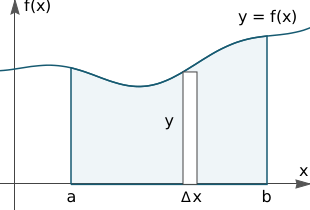
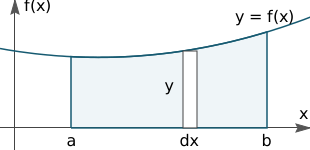
The curve y = f(x), completely above the x-axis. Shows a "typical" rectangle, Δx wide and y high.
In this case, we find the area by simply finding the integral:
`"Area"=int_a^bf(x)dx`
Where did this formula come from?
Area Under a Curve from First Principles
In the diagram above, a "typical rectangle" is shown with width `Δx` and height `y`. Its area is `yΔx`.
If we add all these typical rectangles, starting from `a` and finishing at `b`, the area is approximately:
`sum_{x=a}^\b(y)Deltax`
Now if we let `Δx → 0`, we can find the exact area by integration:
`"Area"=int_a^bf(x)dx`
This follows from the Riemann Sums, from the Introduction to Integration chapter.
Example of Case 1
Need Graph Paper?

Find the area underneath the curve `y = x^2+ 2` from `x = 1` to `x = 2`.
Answer
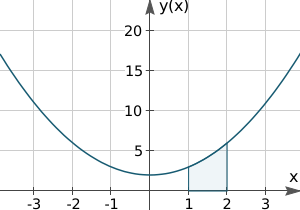
The curve y = x2 + 2, showing the portion under the curve from x = 1 to x = 2.
`text[Area] = int_a^b f(x) dx`
`=int_1^2(x^2+2)dx`
`=[(x^3)/(3)+2x]_1^2`
`=[(8/3 + 4 )-(1/3 + 2)]`
`=13/3\ text[units]^2`
Case 2: Curves which are entirely below the x-axis
We consider the case where the curve is below the `x`-axis for the range of `x` values being considered.
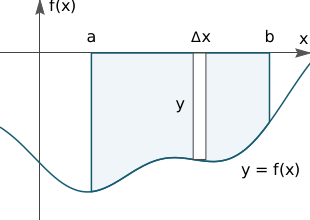
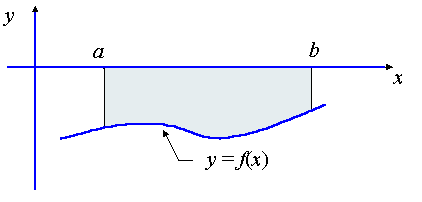
In this case, the integral gives a negative number. We need to take the absolute value of this to find our area:
`"Area"=|int_a^bf(x)dx|`
Example of Case 2
Find the area bounded by `y = x^2 − 4`, the `x`-axis and the lines `x = -1` and `x = 2`.
Answer
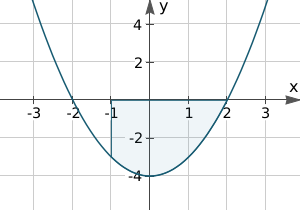
The curve y = x2 − 4, showing the portion under the curve from x = −1 to x = 2.
The required area is totally below the `x`-axis in this example, so we need to use absolute value signs.
`text[Area] = |int_a^bf(x) dx|`
`=|int_-1^2(x^2-4) dx|`
`=|[x^3/3 - 4x]_-1^2|`
`=|[(8/3-8)-(-1/3+4)]|`
`=|-9|`
`=9\ text[units]^2`
Case 3: Part of the curve is below the x-axis, part of it is above the x-axis
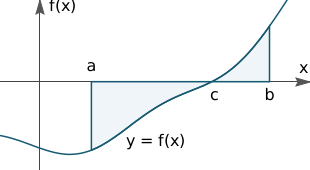
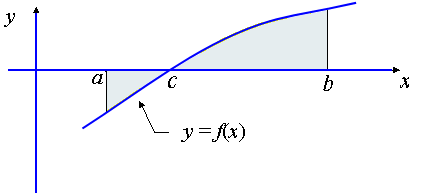
In this case, we have to sum the individual parts, taking the absolute value for the section where the curve is below the `x`-axis (from `x = a` to `x = c`).
`"Area"=|int_a^cf(x)dx|+int_c^bf(x)dx`
If we don't do it like this, the "negative" area (the part below the `x`-axis) will be subtracted from the "positive" part, and our total area will not be correct.
Example of Case 3
What is the area bounded by the curve `y = x^3`, `x = -2` and `x = 1`?
Answer
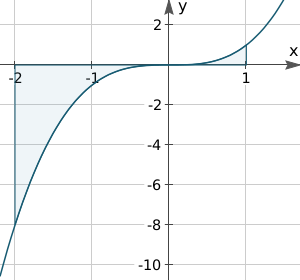
The curve y = x3, showing the portion under the curve from x = −2 to x = 1.
We can see from the graph that the portion between `x = -2` and `x = 0` is below the x-axis, so we need to take the absolute value for that portion.
`text[Area]= |int_-2^0x^3 dx|+int_0^1x^3 dx`
`=|[x^4/4]_-2^0|+[x^4/4]_0^1`
`=|(0-16/4)|+(1/4-0)`
`=4+1/4`
`=4.25\ text[units]^2`
Don't do it like this!
If you just blindly find the integral from the lower limit to the upper limit, you won't get the actual area in such cases.
`text[Integral]= int_(-2)^1x^3 dx`
`=[x^4/4]_(-2)^1`
`=(1/4-16/4)`
`=-15/4`
`=-3.25`
This is not the correct answer for the area under the curve. It is the value of the integral, but clearly an area cannot be negative.
It's always best to sketch the curve before finding areas under curves.
Summary (so far)
In each of Case 1, Case 2 and Case 3, we are summing elements left to right, like this:
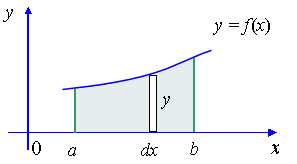
We are (effectively) finding the area by horizontally adding the areas of the rectangles, width `dx` and heights `y` (which we find by substituting values of `x` into `f(x)`).
So
`A=int_a^bf(x)dx`
(with absolute value signs where necessary, if the curve goes under the `x`-axis).
Case 4: Certain curves are much easier to sum vertically
In some cases, it is easier to find the area if we take vertical sums. Sometimes the only possible way is to sum vertically.
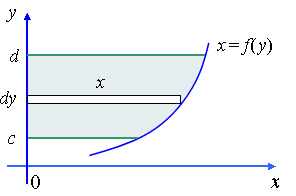
In this case, we find the area is the sum of the rectangles, heights `x = f(y)` and width `dy`.
If we are given `y = f(x)`, then we need to re-express this as `x = f(y)` and we need to sum from bottom to top.
So, in case 4 we have:
`A=int_c^df(y)dy`
Example of Case 4
Find the area of the region bounded by the curve `y=sqrt(x-1)`, the `y`-axis and the lines `y = 1` and `y = 5`.
Answer
Sketch first:
The curve x = y2 + 1, showing the portion "under" the curve from y = 1 to y = 5.
In this case, we express x as a function of y:
`y=sqrt{x-1}`
`y^2=x-1`
`x=y^2+1`
So the area is given by:
`A=int_1^5(y^2+1) dy=[y^3/3+y]_1^5`
`=45 1/3\ text[sq units]`
Note: For this particular example, we could have also summed it horizontally (integrating `y` and using `dx`), but we would need to break it up into sections first.