1. Applications of the Indefinite Integral
by M. Bourne
Displacement from Velocity, and Velocity from Acceleration

A very useful application of calculus is displacement, velocity and acceleration.
Recall (from Derivative as an Instantaneous Rate of Change) that we can find an expression for velocity by differentiating the expression for displacement:
`v=(ds)/(dt)`
Similarly, we can find the expression for the acceleration by differentiating the expression for velocity, and this is equivalent to finding the second derivative of the displacement:
`a=(dv)/dt=(d^2s)/(dt^2)`
It follows (since integration is the opposite process to differentiation) that to obtain the displacement, `s` of an object at time `t` (given the expression for velocity, `v`) we would use:
`s=int v\ dt`
Similarly, the velocity of an object at time `t` with acceleration `a`, is given by:
`v=inta\ dt`
Example 1
A car starts from rest at `s=3\ "m"` from the origin and has acceleration at time `t` given by `a=2t-5\ "ms"^-2`. Find the velocity and displacement of the car at `t=4\ "s"`.
Solution
We find the velocity using:
`v=int a\ dt`
So in this example we have:
`v=int(2t-5)\ dt`
`=t^2-5t+K`
When `t = 0`, `v = 0`, so `K =0`.
So the expression for velocity as a function of time is:
`v=t^2-5t\ text[m s]^-1`
When `t = 4`, `v = 4^2-5(4)=-4\ text[m s]^-1`
Now to find the displacement.
`s=int v\ dt`
Then
`s=int(t^2-5t)\ dt`
`=t^3/3 - (5t^2)/2 + K`
Now when `t = 0`, `s = 3`, so we substitute to obtain:
`3=0^3/3 - (5(0)t^2)/2 + K`
So `K=3` and therefore the general expression for `s` is:
`s=t^3/3 - (5t^2)/2 + 3`
When `t = 4`, `s = 4^3/3 - (5(4)^2)/2 + 3 = -15.67\ text[m]`

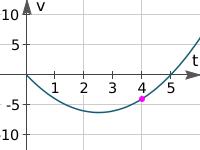
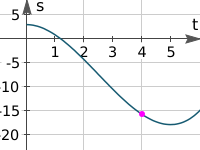
The graphs of the acceleration, velocity and displacement at time t, indicating the velocity and displacement at `t=4`.
Example 2
A proton moves in an electric field such that its acceleration (in cms-2) is
`a = -20(1+2t)^-2`, where `t` is in seconds.
Find the velocity as a function of time if v = 30 cms-1 when t = 0.
Answer
`v=int a\ dt`
So
`v=int(-20\ dt)/((1+2t)^2)`
Put `u = 1 + 2t` then `du = 2\ dt`, so `dt=(du)/2`
`v=int (-10\ du)/(u^2)`
`=int -10u^(-2)du`
`=10/u+K`
`=(10)/(1+2t)+K`
When `t = 0`, `v = 30`, so `K = 20`.
So the expression for velocity as a function of time is:
`v=((10)/(1+2t)+20)\ text[cm s]^-1`
Here are the graphs of the acceleration of the proton, and the velocity we found in Example 2.

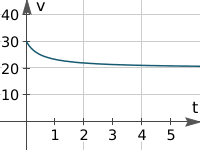
The graphs of the acceleration and velocity at time t. Note `v(0)=30`.
Example 3
A flare is ejected vertically upwards from the ground at 15 m/s. Find the height of the flare after 2.5 s.
Answer
The object has acting on it the force due to gravity, so its acceleration is -9.8 ms-2.
`v=int a dt`
`=int-9.8\ dt`
`=-9.8t+C`
Now at `t = 0`, the velocity = `15\ "ms"^-1`. So `C = 15`.
So the expression for velocity becomes:
`v=-9.8t+15`
Now, we need to find the displacement, so we integrate our expression for velocity:
`s=int v\ dt`
`=int(-9.8t + 15) dt`
`=-4.9t^2+15t+K`
Now, we know from the question that when `t = 0`, `s = 0`.
This gives `K = 0`.
So `s=-4.9t^2+15t`
At time `t = 2.5`, `s = 6.875\ "m"`.
Displacement and Velocity Formulas
Using integration, we can obtain the well-known expressions for displacement and velocity, given a constant acceleration a, initial displacement zero, and an initial velocity `v_0`:
`v=int a\ dt`
`v=at+K`
Since the velocity at `t=0` is `v_0`, we have `K=v_0`. So:
`v=v_0 + at`
Similarly, taking it another step gives:
`s=int v\ dt=int (v_0 + at)dt`
`s=v_0 t + (at^2)/2+C`
Since the displacement at `t=0` is `s=0`, we have `C=0`. So:
`s=v_0t+1/2at^2`
Voltage across a Capacitor
Definition: The current, i (amperes), in an electric circuit equals the time rate of change of the charge q, (in coulombs) that passes a given point in the circuit. We can write this (with t in seconds) as:
`i=(dq)/(dt)`
By writing i dt = dq and integrating, we have:
`q=inti\ dt`
The voltage, VC (in volts) across a capacitor with capacitance C (in farads) is given by
`V_C=q/C`
It follows that
`V_C=1/Cinti\ dt`
You can see some more advanced applications of this at Applications of Ordinary Differential Equations.
Example 4
The electric current (in mA) in a computer circuit as a function of time is `i = 0.3 − 0.2t`. What total charge passes a point in the circuit in `0.050` s?
Answer
The charge, q, is given by:
`q=inti\ dt`
`=int (0.3-0.2t) dt`
`=0.3t-0.1t^2+K`
At `t = 0`, `q = 0`, and this gives us `K = 0`.
So `q=0.3t-0.1t^2`
`[q]_[t=0.050]` `=0.3(0.050)-0.1(0.050)^2` `=0.015\ text[mC]`
(units are milli coulombs, as current `i` was in `"mA"`.)
Example 5
The voltage across an `8.50\ "nF"` capacitor in an FM receiver circuit is initially zero. Find the voltage after `2.00\ μ"s"` if a current `i=0.042t` (in `"mA"`) charges the capacitor.
Answer
`V_C=1/C inti\ dt `
Note: `1\ "nF" = 10^-9"F"`; and `1\ μ"s" = 10^-6"s"`;
Also, `0.042t\ "mA" = 0.042 × 10^-3t\ "A"`
`V_C = (0.042 times 10^-3)/(8.5 times 10^-9)int t\ dt`
`=4.94 times 10^3 (t^2)/(2)+K`
`=2.47 times 10^3t^2 + K`
Now, we are told that when `t = 0`, `V_C= 0`.
So `K= 0`.
Thus
`V_C=2.47 times 10^3 t^2`
So when `t = 2.00\ μ"s"`, we have:
`V_C = 2.47 times 10^3(2 times 10^-6)^2`
`=9.882 times 10^-9`
`=9.88\ text[nV]`