12. Arc Length of Curve: Parametric, Polar Coordinates
by M. Bourne
Arc Length of a Curve which is in Parametric Coordinates
We'll first look at an example then develop the formula for the general case.
Example 1 - Race Track
In the Curvilinear Motion section, we had an example where a race car was travelling around a curve described in parametric equations as:
`x(t) = 20 + 0.2t^3`,`y(t) = 20t − 2t^2`
where x and y are in meters and t is time in seconds.
What is the distance travelled by the car in the first 8 seconds?
Solution
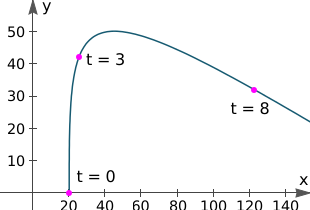
The graph of this case is given below.
It is based on plotting the x- and y-points at times between `t = 0` and `t = 8`.
So for example, at `t = 0`,
`x(0) = 20`, and `y(0) = 0`, so the car starts at `(20, 0)`.
At `t = 3`,
`x(3) = 25.4`, and `y(3) = 42`, so the car is at `(25.4, 42)`.
Finally, at `t = 8`, the car is at
`x(8) = 122.4`, and `y(8) = 32`, that is `(122.4, 32)`.
The parametric curve (x(t), y(t)), showing assorted points.
Estimate: An inspection of the graph shows our final answer should be around 150 m.
We extend the concept from Arc Length of a Curve to the parametric case.
We start with the expression that we met in the earlier section:
`"length"=r=int_a^bsqrt((dx)^2+(dy)^2`
Differentiating with respect to t and squaring gives:
`((dr)/(dt))^2=((dx)/(dt))^2+((dy)/(dt))^2`
Taking the positive square root of each side:
`(dr)/(dt)=sqrt(((dx)/(dt))^2+((dy)/(dt))^2`
Then, integrating with respect to t from t = t1 to t = t2 gives us the formula for the length of a curve in parametric equations form:
`"length"=r` `=int_(t_1)^(t_2)sqrt(((dx)/(dt))^2+((dy)/(dt))^2`
Back to Example 1
Find the required length travelled by the race car using the given formula.
Answer
We now use the formula to find the distance travelled by the car.
In this case, we have:
`x(t) = 20+0.2t^3`, so `(dx)/(dt)=0.6t^2`
`y(t) = 20t − 2t^2` giving `{:(dy)/(dt)=20-4t.:}`
Our lower and upper limits for this example are `t = 0` to `t = 8`.
Substituting these into the distance formula gives:
`text[length]=r` `=int_0^8 sqrt[(0.6t^2)^2+(20-4t)^2]`
Using a computer algebra system (see the answer in Wolfram|Alpha) gives us the length `144.7\ "m"`.
Our answer is reasonable and is consistent with our earlier estimate.
Arc Length of a Curve in Polar Coordinates
Once again we start with an example to get a sense of what we are trying to find.
Example 2 - Golden Spiral
A Golden Spiral has the characteristic such that for every quarter turn (`90^@` or `π/2` in radians), the distance from the center of the spiral increases by the golden ratio `Phi = 1.6180`.
See more on this interesting topic at Golden Spiral, and see background at Polar Coordinates.
The formula for a golden spiral is as follows:
r(θ) = 1.618013 e0.30635θ
Solution
Find the length of the spiral from the center to the point where it has rotated two complete revolutions.
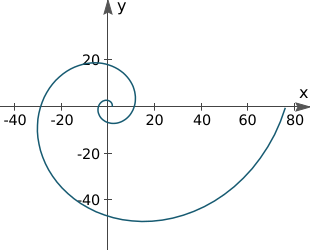
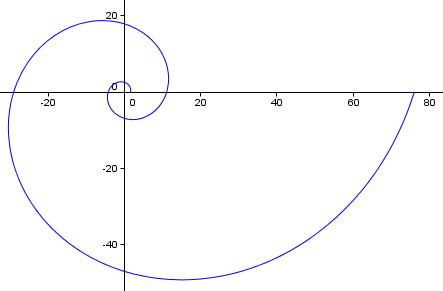
Following is the spiral whose length we need to find. It traces out the angle from `θ = 0` to `θ = 4π` (2 revolutions).
Estimate: It is actually quite difficult to estimate the length of this curve by inspection. But it is reasonable to imagine we can approximate it with a circle, radius 40 and this would give a length (circumference) of
`C = 2πr = 2π(40) = 80π ≈ 251`
Next we'll meet the equation for the length.
General Form of the Length of a Curve in Polar Form
In general, the arc length of a curve r(θ) in polar coordinates is given by:
`L=int_a^bsqrt(r^2+((dr)/(d theta))^2)d theta`
where θ spans from θ = a to θ = b.
Back to Example 2
Use the above formula to find the length of the Golden Spiral, rotated 2 revolutions.
Answer
Applying the formula, we have for our Golden Spiral example:
From the question:
`r = 1.618013\ e^(0.30635\ θ)`
Then
`r^2 = (1.618013\ e^(0.30635\ θ))^2`
`= 2.61797\ e^(0.6127\ θ)`
And
`(dr)/(d theta)=0.49568\ e^[0.30635\ theta]`
We need:
`((dr)/(d theta))^2=0.245697\ e^[0.6127\ theta]`
Putting it together, the required length is:
`L=int_0^[4pi] sqrt[2.61797e^[0.6127theta]+0.2457e^[0.6127 theta]]d theta`
`=int_0^[4pi] sqrt[2.86367e^[0.6127theta]]d theta`
`= 1.69224 int_0^[4pi] [e^[0.30635theta]]d theta`
`= 1.69224 [e^[0.30635theta]]_0^(4pi)/0.30635`
`= 1.69224 [46.979326-1]/0.30635`
`~~254.0`
This is actually quite close to our very rough estimate before.
Notes: We can check our answer using a computer algebra system, like Scientific Notebook or Wolfram|Alpha.
We could have also used a numerical technique, like Simpson's Rule or Riemann Sums.
Archimedean Spiral
We can see Archimedean Spirals in the spring mechanism of clocks.
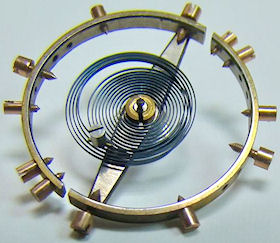
Watch mechanism [Image source]
An Archimedean Spiral has general equation in polar coordinates:
`r = a + bθ`
where
r is the distance from the origin;
a is the start point of the spiral; and
b affects the distance between each arm. (The distance is actually given by `2pib`.)
Example 3
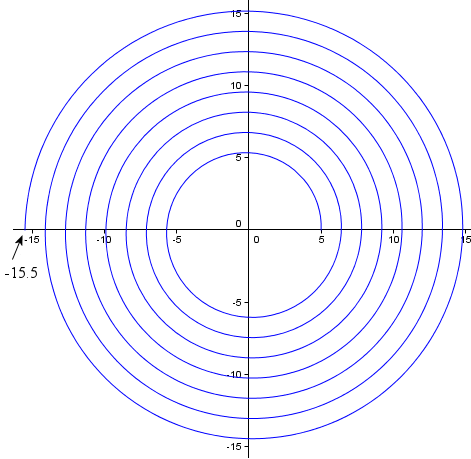
Find the length of a flat clock spring which is in the shape of a spiral having 7.5 turns, where the inner radius is 5 mm and the outer end radius is 15.5 mm.
(You can see more background on this question at Length of Archimedean Spiral.)
Answer
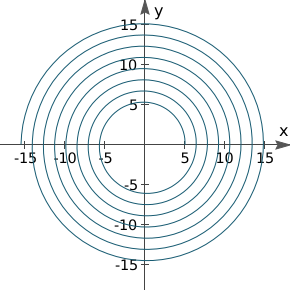
Here is a graph of the situation:
In this case, `a = 5` (since this is where the spiral starts).
The distance between each arm is:
`(15.5 − 5)/7.5 = 10.5/7.5 = 1.4`
and b is found as:
`b = 1.4/(2π) = 0.22282`
So our formula is
`r = 5 + 0.22282\ θ`
The start angle is `θ` is `a = 0` and after `7.5` turns, the end point is `{:b = 7.5 × 2π = 15π = 47.12389.:}`
The derivative is:
`(dr)/(d theta)=0.22282`
Substituting all these in our formula gives:
`L` `=int_0^[15pi] sqrt[(5+0.22282\ theta)^2+(0.22282)^2]\ d theta` ` =483.1`
So the clock spring is `483.1\ "mm"` long.