3. Rectangular Coordinates
A good way of presenting a function is by graphical representation.
Graphs give us a visual picture of the function.
The most common way to graph a function is to use the rectangular co-ordinate system. This consists of:
The x-axis;
The y-axis;
The origin `(0,0)`; and
The four quadrants, normally labelled I, II, III, IV.
The cartesian plane
Where did all this come from?
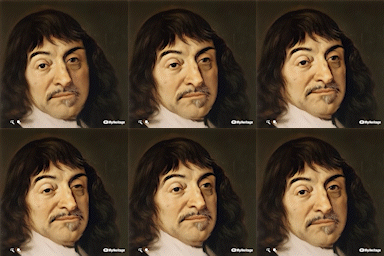
Rene Descartes
The x-y coordinate system is also called the Cartesian Coordinate system, after its developer, Rene Descartes (1596 - 1650). This graphing system was incredibly important for the advancement of science and engineering.
Normally, the values of the independent variable
(generally the x-values) are placed on the horizontal
axis, while the values of the dependent variable
(generally the y-values) are placed on the vertical
axis.
The x-value, called the abscissa, is the perpendicular distance of P from the y-axis.
The y-value, called the ordinate, is the perpendicular distance of P from the x-axis.
The values of x and y together, written as (x, y) are called the co-ordinates of the point P.
It's called the "rectangular" coordinate system because the scale used along the x-axis is evenly spaced, as is the scale along the y-axis. Other systems exist where the scale is not even (see Log-log and semi-log graphs) and some are even circular (see Polar Coordinates)
Polar to Rectangular Calculator
If you're looking to convert complex numbers in polar form to rectangular form, then check out the Polar to Rectangular Online Calculator.
Example 1
Need Graph Paper?


Locate the points `A(2 , 1)` and `B(-4 , -3)` on the rectangular co-ordinate system.
Answer
To answer this properly, we need to do the following:
- Label the axes with x and y.
- Put a scale on the axes (the numbers) such that the points will fit on the graph.
- Then put dots for the required points `A` and `B`.
Here is our result.

Example 2
Three vertices of a rectangle are `A(-3 , -2)`, `B(4 , -2)` and `C(4,1)`.
Where is the fourth vertex `D`?
Answer
Here are the positions of points `A`, `B` and `C`:

Since the opposite sides of a rectangle are equal and parallel, we can see that:
The y co-ordinate of D must be `1`
The x co-ordinate of D must be `-3`
We conclude the co-ordinates of D are `(-3, 1)`.
Here's our completed rectangle:

Example 3
Where are all points `(x , y)` for which `x < 0` and `y < 0`?
Answer
We have:
- `x < 0` means that `x` is negative,
- and `y < 0` also means that `y` is negative,
So the only region where both co-ordinates for all points are negative is the "third quadrant (III)".
The shaded area represents the region in question.
The negative `x`- and negative `y`-axes are dashed to indicate they are not included in the region.
Exercises
Q1 Where are all the points whose abscissas equal their ordinates?
Answer
"Abscissas" means x-values, while "ordinates" means y-values.
So the question means "where on the rectangular system do we have x = y for all points (x, y)?"
In other words, we want a line connecting points like `(-3, -3)` and `(0, 0)` and `(5, 5)` and `(700, 700)`.
The line we want cuts the first and third quadrants in half at `45^@`. We can write this line as y = x.
Q2 Where are all the points `(x, y)` for which `x = 0` and `y < 0`?
Answer
They are on the negative part of the y-axis, indicated by the magenta line.
