Plane Analytical Geometry
By M Bourne
An interesting application from nature:
The Nautilus Shell
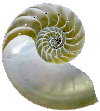
See: Equiangular spiral.
(Image from Tree of Life)
Need Graph Paper?

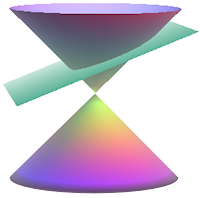
The curves that we learn about in this chapter are called conic sections. They arise naturally in many situations and are the result of slicing a cone at various angles.
Depending on where we slice our cone, and at what angle, we will either have a straight line, a circle, a parabola, an ellipse or a hyperbola. Of course, we could also get a single point, too.
Why study analytic geometry?
Science and engineering involves the study of quantities that change relative to each other (for example, distance-time, velocity-time, population-time, force-distance, etc).
It is much easier to understand what is going on in these problems if we draw graphs showing the relationship between the quantities involved.
The study of calculus depends heavily on a clear understanding of functions, graphs, slopes of curves and shapes of curves. For example, in the Differentiation chapter we use graphs to demonstrate relationships between varying quantities.
In this Chapter
- 1. Distance Formula
- Gradient (Slope) of a Line, and Inclination
- Parallel Lines
- Perpendicular Lines
- 2. The Straight Line
- Perpendicular Distance from a Point to a Line
- 3. The Circle
- 4. The Parabola
- 5. The Ellipse
- 6. The Hyperbola
- 7. Polar Coordinates
- 8. Curves in Polar Coordinates
- Equi-angular Spiral
We begin with the Distance Formula »
