Perpendicular Distance from a Point to a Line
Later, on this page...
(BTW - we don't really need to say 'perpendicular' because the distance from a point to a line always means the shortest distance.)
This is a great problem because it uses all these things that we have learned so far:
- distance formula
- slope of parallel and perpendicular lines
- rectangular coordinates
- different forms of the straight line
- solving simultaneous equations
Need Graph Paper?

The distance from a point (m, n) to the line Ax + By + C = 0 is given by:
`d=(|Am+Bn+C|)/(sqrt(A^2+B^2`
There are some examples using this formula following the proof.
Proof of the Perpendicular Distance Formula
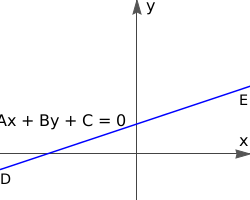
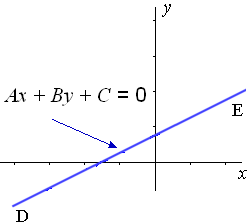
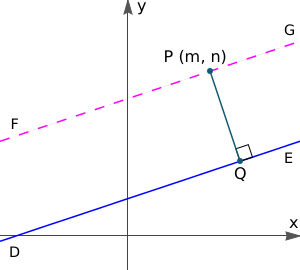
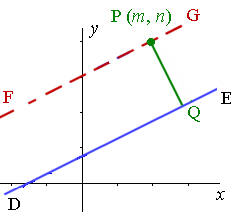
Let's start with the line Ax + By + C = 0 and label it DE. It has slope `-A/B`.
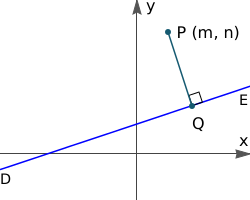
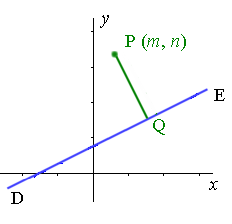
We have a point P with coordinates (m, n). We wish to find the perpendicular distance from the point P to the line DE (that is, distance `PQ`).
We now do a trick to make things easier for ourselves (the algebra is really horrible otherwise). We construct a line parallel to DE through (m, n). This line will also have slope `-A/B`, since it is parallel to DE. We will call this line FG.
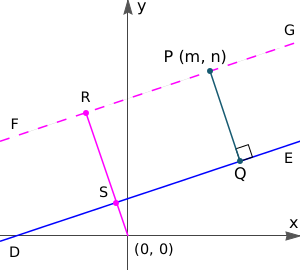
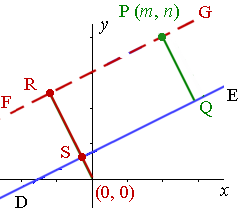
Now we construct another line parallel to PQ passing through the origin.
This line will have slope `B/A`, because it is perpendicular to DE.
Let's call it line RS. We extend it to the origin `(0, 0)`.
We will find the distance RS, which I hope you agree is equal to the distance PQ that we wanted at the start.
Since FG passes through (m, n) and has slope `-A/B`, its equation is `y-n=-A/B(x-m)` or
`y=(-Ax+Am+Bn)/B`.
Line RS has equation `y=B/Ax.`
Line FG intersects with line RS when
`B/Ax=(-Ax+Am+Bn)/B`
Solving this gives us
`x=(A(Am+Bn))/(A^2+B^2`
So after substituting this back into `y=B/Ax,` we find that point R is
`((A(Am+Bn))/(A^2+B^2),(B(Am+Bn))/(A^2+B^2))`
Phone users

NOTE: If you're on a phone, you can scroll any wide equations on this page to the right or left to see the whole expression.
Point S is the intersection of the lines `y=B/Ax` and Ax + By + C = 0, which can be written `y=-(Ax+C)/B`.
This occurs when (that is, we are solving them simultaneously)
`-(Ax+C)/B=B/Ax`
Solving for x gives
`x=(-AC)/(A^2+B^2)`
Finding y by substituting back into
`y=B/Ax`
gives
`y=B/A((-AC)/(A^2+B^2))=(-BC)/(A^2+B^2`
So S is the point
`((-AC)/(A^2+B^2),(-BC)/(A^2+B^2))`
The distance RS, using the distance formula,
`d=sqrt((x_2-x_1)^2+(y_2-y_1)^2`
is
`d=sqrt(((-AC)/(A^2+B^2)-(A(Am+Bn))/(A^2+B^2))^2+((-BC)/(A^2+B^2)-(B(Am+Bn))/(A^2+B^2))^2)`
`=sqrt(({-A(Am+Bn+C)}^2+{-B(Am+Bn+C)}^2)/(A^2+B^2)^2)`
`=sqrt( ((A^2+B^2)(Am+Bn+C)^2)/(A^2+B^2)^2)`
`=sqrt( ((Am+Bn+C)^2)/(A^2+B^2))`
`=(|Am+Bn+C|)/(sqrt(A^2+B^2))`
The absolute value sign is necessary since distance must be a positive value, and certain combinations of A, m , B, n and C can produce a negative number in the numerator.
So the distance from the point (m, n) to the line Ax + By + C = 0 is given by:
`d=(|Am+Bn+C|)/(sqrt(A^2+B^2`
Example 1
Find the perpendicular distance from the point (5, 6) to the line −2x + 3y + 4 = 0, using the formula we just found.
Answer
`d=(|Am+Bn+C|)/(sqrt(A^2+B^2`
`=(|(-2)(5)+(3)(6)+4|)/(sqrt(4+9)`
`=3.328`
Here is the graph of the situation. We can see that our answer of just over 3 units is reasonable.
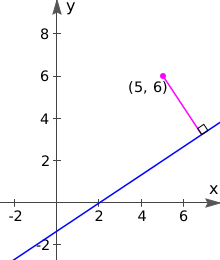
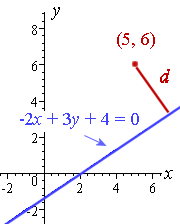
So the required distance is `3.3` units, correct to 1 decimal place.
Example 2
Find the distance from the point `(-3, 7)` to the line
`y=6/5x+2`
Answer
We first need to express the given line in standard form.
`y=6/5x+2`
`5y = 6x + 10`
`6x - 5y + 10 = 0`
Using the formula for the distance from a point to a line, we have:
`d=(|Am+Bn+C|)/(sqrt(A^2+B^2`
`=(|(6)(-3)+(-5)(7)+10|)/sqrt(36+25)`
`=|-5.506|`
`=5.506`
So the required distance is `5.506` units, correct to 3 decimal places.
Problem Solver
Need help solving a different Graphing problem? Try the Problem Solver.
Disclaimer: IntMath.com does not guarantee the accuracy of results. Problem Solver provided by Mathway.