Equiangular Spiral
By M. Bourne
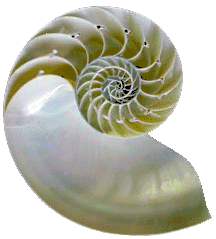
The equation for the equiangular spiral was developed by Rene Descartes (1596-1650) in 1638.
This spiral occurs naturally in many places like sea-shells where the growth of an organism is proportional to the size of the organism.
It's also known as the Logarithmic Spiral due to the way the spiral arms increase in distance from the center at the same ratio.
The general polar equation for the equiangular spiral curve is
r = aeθ cot b
Example 1: Equiangular Spiral
Let a = 0.5 and b = 1.4 (radians).
Then
r = 0.5 eθ cot 1.4
Here's the graph:
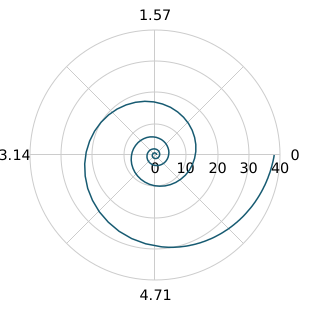
Graph of r = 0.5 eθ cot 1.4, an equiangular spiral.
It is called an "equiangular" spiral because any radius vector makes the same angle with the curve. In this example, b = 1.4 radians, or in degrees, `1.4xx180/pi=80.214^text(o)`.
We can see that any radius vector makes the angle `80^@` with the curve.

Graph of equiangular spiral showing equal angles cut by radius vectors.
[For background, see the vectors chapter.]
Spiral of Archimedes
The equiangular spiral is not the same as the "Spiral of Archimedes" which has the form:
r = aθ
This spiral has arms which are equidistant.
Example 2: Spiral of Archimedes
r = 2θ
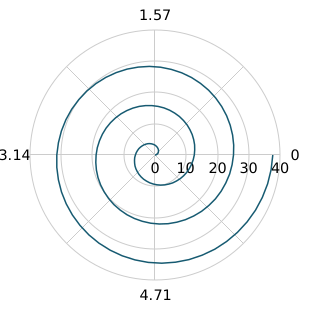
Graph of r = 2θ, an Archimedean Spiral.
See this article on finding the length of an Archimedean Sprial, using calculus.