4. The Definite Integral
by M. Bourne
In the last section, we used the following expression to find the area under a curve.
`int_a^bf(x)dx=[F(x)]_a^b`
`=F(b)-F(a)`
where
`F(x)` is the integral of `f(x)`;`F(b)` is the value of the integral at the upper limit, `x = b`; and
`F(a)` is the value of the integral at the lower limit, `x = a`.
This expression is called a definite integral. Note that it does not involve a constant of integration and it gives us a definite value (a number) at the end of the calculation.
See more about the above expression in Fundamental Theorem of Calculus. It contains an applet where you can explore this concept.
We will use definite integrals to solve many practical problems. First, we see how to calculate definite integrals.
Example 1
Evaluate `int_1^5(3x^2+4x+1)dx`
Answer
This question requires us to:
1) Find the integral and then write the upper and lower limits with square brackets, as follows:
`[x^3+2x^2+x]_1^5`
The upper and lower limits are written like this to mean they will be substituted into the expression in brackets.
2) Next, substitute `5` (the upper limit) into the integral:
`[(5)^3+ 2(5)^2+ 5] = ` `125 + 50 + 5 = 180`
3) Then substitute `1` into the integral:
`[(1)^3+ 2(1)^2+ 1] = ` `1 + 2 + 1 = 4`
4) Subtract the result of (3) from the result of (2) for our final answer:
`180 − 4 = 176`
Normally, we would write our complete solution as follows:
`int_1^5(3x^2+4x+1)dx =[x^3+2x^2+x]_1^5`
`=[(5)^3+ 2(5)^2+ 5]-` `[(1)^3+ 2(1)^2+ 1]`
`=180 − 4 `
`= 176`
Note that our final answer is a number and does not involve "+ K". We are now dealing with definite integrals.
Example 2
Evaluate `int_4^9(2x+3sqrtx)dx`
Answer
This requires:
(1) Find the integral
(2) Substitute 9 into the integral
(3) Substitute 4 into the integral
(4) Subtract the result of Step (3) from the result of Step (2).
`int_4^9(2x+3sqrtx)dx=[x^2+2x^(3//2)]_4^9`
`=[9^2+2(9)^(3//2)]-[4^2+2(4)^(3//2)]`
`=135-32`
`=103`
Explanation: The integral of `sqrt(x)` is as follows (I have not included the constant):
`intsqrtx dx=intx^(1//2)dx`
`=(x^(3//2))/(3//2)`
`=(2x^(3//2))/3`
Example 3
Evaluate `int_1.2^1.6(5+6/x^4)dx`
Answer
This requires:
1) Find the integral
2) Substitute 1.6 into the integral
3) Substitute 1.2 into the integral
4) Subtract.
`int_1.2^1.6(5+6/x^4)dx=int_1.2^1.6(5+6x^-4)dx`
`=[5x-2x^-3]_1.2^1.6`
`=7.5117-4.8426`
`=2.6691`
Definite Integrals and Substitution
Recall the substitution formula for integration:
`int u^n du=(u^(n+1))/(n+1)+K` (if `n ≠ -1`)
When we substitute, we are changing the variable, so we cannot use the same upper and lower limits. We can either:
- Do the problem as an indefinite integral first, then use upper and lower limits later
- Do the problem throughout using the new variable and the new upper and lower limits
- Show the correct variable for the upper and lower limit during the substitution phase.
We will be using the third of these possibilities.
Example 4
Find
`int_-1^0x^3(1-2x^4)^3dx`
using a substitution.
Answer
Put `u = 1 - 2x^4`
Then `du = -8x^3dx`
The question has `x^3dx` so we write
`-(du)/8=x^3dx`
So we have:
`int_-1^0x^3(1-2x^4)^3dx=-1/8int_(x=-1)^(x=0)u^3du`
`=-1/8xx[u^4/4]_(x=-1)^(x=0)`
`=-1/32[u^4]_(x=-1)^(x=0)`
`=-1/32[(1-2x^4)^4]_-1^0`
`=-1/32[(1-0)^4-(1-2)^4]`
`=-1/32[(1)-(1)]`
`=0`
Using the 2nd approach
If we take the second approach, i.e. leaving the variable changed, we have:
`u = 1 - 2x^4`
As `x = -1 → 0` (this means "as `x` takes values from `-1` to `0`"),
then `u = -1 → 1`
So the problem becomes:
`int_-1^0x^3(1-2x^4)^3dx =-1/8int_-1^1u^3du`
`=-1/32[u^4]_-1^1`
`=-1/32[1^4-(-1)^4]`
`=0` as before.
This second approach is quite useful later when the substitutions become more involved (e.g. trigonometric substitution).
Application: Work
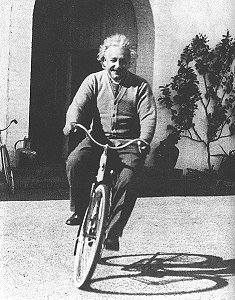
Einstein riding his bicycle.
In physics, work is done when a force acting upon an object causes a displacement. (For example, riding a bicycle.)
If the force is not constant, we must use integration to find the work done.
We use
`W=int_a^bF(x)dx`
where F(x) is the variable force.
Example 5
Find the work done if a force `F(x)=sqrt(2x-1)` is acting on an object and moves it from x = 1 to x = 5.
Answer
To solve this, we need to evaluate
`int_1^5sqrt(2x-1)\ dx`
Put `u = 2x − 1` then `du = 2 dx`
So `(du)/2=dx`
So we have:
`int_1^5sqrt(2x-1) dx=1/2int_(x=1)^(x=5)u^(1//2)du`
`=1/2xx[2/3u^(3//2)]_(x=1)^(x=5)`
`=1/3[(2x-1)^(3//2)]_1^5`
`=1/3[9^(3//2)-1^(3//2)]`
`=1/3[27-1]`
`=26/3`
So the work done is `8.67` units.
For more on work, see: 7. Work by a Variable Force.
Application: Average Value
The average value of a function f(x) in the region x = a to x = b is given by:
`"Average"=(int_a^bf(x)dx)/(b-a)`
Example 6
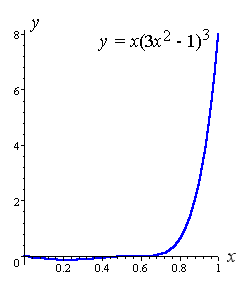
Find the average value of y = x(3x2 − 1)3 from 0 to 1.
Here is the graph of the situation:
The curve y = x(3x2 − 1)3.
Answer
In this case, `b-a=1`, so to find the average value, we simply need to evaluate:
`int_0^1x(3x^2-1)^3dx`
Observing the graph, we notice that it has value near 0 for most values of x between 0 and 1. We estimate the value of the average to be somewhere around y = 0.5.
`int_0^1x(3x^2-1)^3dx`
Put `u=3x^2-1`, then `du = 6x dx`
So `(du)/6=x\ dx`
`int_0^1x(3x^2-1)^3dx=1/6int_(x=0)^(x=1)u^3du`
`=1/6[u^4/4]_(x=0)^(x=1)`
`=1/24[(3x^2-1)^4]_0^1`
`=1/24[(3(1)^2-1)^4-(3(0)^2-1)^4]`
`=1/24[16-1]`
`=15/24`
`=5/8`
So the average value required is `0.625` units. This is consistent with our earlier estimate.
Application: Displacement
If we know the expression, v, for velocity in terms of t, the time, we can find the displacement (written s) of a moving object from time t = a to time t = b by integration, as follows:
`s=int_a^bv\ dt`
Example 7
Find the displacement of an object from t = 2 to t = 3, if the velocity of the object at time t is given by
`v=(t^2+1)/((t^3+3t)^2`
Answer
To find the displacement, we need to evaluate:
`int_2^3(t^2+1)/((t^3+3t)^2)dt`
Put `u=t^3+3t`, then `du=(3t^2+3)dt=3(t^2+1)dt`
So `(du)/3=(t^2+1)dt`
So we have:
`int_2^3(t^2+1)/((t^3+3t)^2)=1/3int_(t=2)^(t=3)1/u^2du`
`=1/3int_(t=2)^(t=3)u^-2du`
`=-1/3[1/u]_(t=2)^(t=3)`
`=-1/3[1/(t^3+3t)]_2^3`
`=-1/3[1/(3^3+3(3))-1/(2^3+3(2))]`
`=-1/3[1/36-1/14]`
`=0.014550`
So the displacement of the object from time `t=2` to `t=3` is `0.015` units.
See more on: displacement, velocity and acceleration as applications of integration.
NOTE 1: As you can see from the above applications of work, average value and displacement, the definite integral can be used to find more than just areas under curves.
NOTE 2: The definite integral only gives us an area when the whole of the curve is above the x-axis in the region from x = a to x = b. If this is not the case, we have to break it up into individual sections. See more at Area Under a Curve.
We now examine a definite integral that we cannot solve using substitution.
Not every integral can be integrated using substitution...
Consider this question.
Find: `int_0^1sqrt(x^2+1)\ dx`
Attempted solution:
We try to put `u = x^2+ 1`.
Then we find the differential:
`du = 2x\ dx`
But the question does not have "`2x\ dx`" (it only has "`dx`") so we cannot replace anything in the question with "`du`" properly. This means we can't solve it using any of the integration methods used above. (Note: This question can be done using Trigonometric Substitution, however, but we don't meet trigonometric substitution until later.)
Explanation: Let's think about if the question said this instead:
`int_0^1sqrt(x^2+1)(2x)dx`
This time, there is a "`2x\ dx`" involved in the question and so we would be able to let:
`u = x^2+ 1`
Then we would find the differential:
`du = 2x\ dx`
Then we could proceed to find the integral like we did in the examples above, by replacing `2x\ dx` with `du` and the square root part with `sqrt u`.
However, the problem `int_0^1sqrt(x^2+1)\ dx` does not have a "`2x`" outside of the square root so I cannot use the "`u`" substitution.
For now, we need to use numerical approaches to evaluate the integral
`int_0^1sqrt(x^2+1)\ dx`
(Note: Historically, all definite integrals were approximated using numerical methods before Newton and Leibniz developed the integration methods we have learned so far in this chapter.)
We can use two different numerical methods for evaluating an integral:
We meet these methods in the next 2 sections.