1. Determinants
by M. Bourne
Before we see how to use a matrix to solve a set of simultaneous equations, we learn about determinants.
A determinant is a square array of numbers (written within a pair of vertical lines) which represents a certain sum of products.
Below is an example of a 3 × 3 determinant (it has 3 rows and 3 columns).
`|(10,0,-3),(-2,-4,1),(3,0,2)|`
The result of multiplying out, then simplifying the elements of a determinant is a single number (a scalar quantity).
Calculating a 2 × 2 Determinant
In general, we find the value of a 2 × 2 determinant with elements a, b, c, d as follows:
`|(a,b),(c,d)|=ad-cb`
We multiply the diagonals (top left × bottom right first), then subtract.
Example 1
`|(4,1),(2,3)|`
`=4xx3-2xx1`
` =12-2`
` = 10`
The final result is a single number.
We will see how to expand a 3 × 3 determinant below.
Using Determinants to Solve Systems of Equations
We can solve a system of equations using determinants, but it becomes very tedious for large systems. We will only do 2 × 2 and 3 × 3 systems using determinants.
Cramer's Rule
The solution (x, y) of the system
`a_1x+b_1y=c_1`
`a_2x+b_2y=c_2`
can be found using determinants:
`x=|(c_1,b_1),(c_2,b_2)|/|(a_1,b_1),(a_2,b_2)|`
`y=|(a_1,c_1),(a_2,c_2)|/|(a_1,b_1),(a_2,b_2)|`
Example 2
Solve the system using Cramer's Rule:
x − 3y = 6
2x + 3y = 3
Answer
First we determine the values we will need for Cramer's Rule:
a1 = 1 b1 = −3 c1 = 6
a2 = 2 b2 = 3 c2 = 3
`x=|(6,-3),(3,3)|/|(1,-3),(2,3)|=(18+9)/(3+6)=3`
`y=|(1,6),(2,3)|/|(1,-3),(2,3)|=(3-12)/(3+6)=(-9)/9` `=-1`
So the solution is `(3, -1)`.
Check:
[1] `3 + 3 = 6` OK
[2] `6 - 3 = 3` OK
3 × 3 Determinants
A 3 × 3 determinant
`|(a_1, b_1,c_1),(a_2,b_2,c_2),(a_3,b_3,c_3)|`
can be evaluated in various ways.
We will use the method called "expansion by minors". But first, we need a definition.
Cofactors
The 2 × 2 determinant
`|(b_2,c_2),(b_3,c_3)|`
is called the cofactor of a1 for the 3 × 3 determinant:
`|(a_1, b_1,c_1),(a_2,b_2,c_2),(a_3,b_3,c_3)|`
The cofactor is formed from the elements that are not in the same row as a1 and not in the same column as a1.
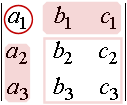
Similarly, the determinant
`|(b_1,c_1),(b_3,c_3)|`
is called the cofactor of a2. It is formed from the elements not in the same row as a2 and not in the same column as a2.
We continue the pattern for the cofactor of a3.
Expansion by Minors
We evaluate our 3 × 3 determinant using expansion by minors. This involves multiplying the elements in the first column of the determinant by the cofactors of those elements. We subtract the middle product and add the final product.
`|(a_1, b_1,c_1),(a_2,b_2,c_2),(a_3,b_3,c_3)|` `=a_1|(b_2,c_2),(b_3,c_3)|` `-a_2|(b_1,c_1),(b_3,c_3)|` `+a_3|(b_1,c_1),(b_2,c_2)|`
Note that we are working down the first column and multiplying by the cofactor of each element.
Example 3
Evaluate
`|(-2,3,-1),(5,-1,4),(4,-8,2)|`
(You can explore what this example is really asking in this 3D interactive systems of equations applet.)
Answer
` |(-2,3,-1),(5,-1,4),(4,-8,2)|` ` =-2|(-1,4),(-8,2)|` ` -5|(3,-1),(-8,2)|` ` +4|(3,-1),(-1,4)|`
`= -2[(-1)(2) − (-8)(4)] − 5[(3)(2) ` `{: − (-8)(-1)] ` `+ 4[(3)(4) ` `{: − (-1)(-1)]`
`= -2(30) − 5(-2) + 4(11)`
`= -60 + 10 + 44`
`= -6`
Here, we are expanding by the first column. We can do the expansion by using the first row and we will get the same result.
Cramer's Rule to Solve 3 × 3 Systems of Linear Equations
We can solve the general system of equations,
a1x + b1y + c1z = d1
a2x + b2y + c2z = d2
a3x + b3y + c3z = d3
by using the determinants:
`x=|(d_1, b_1,c_1),(d_2,b_2,c_2),(d_3,b_3,c_3)|/Delta`
`y=|(a_1, d_1,c_1),(a_2,d_2,c_2),(a_3,d_3,c_3)|/Delta`
`z=|(a_1, b_1,d_1),(a_2,b_2,d_2),(a_3,b_3,d_3)|/Delta`
where
`Delta=|(a_1, b_1,c_1),(a_2,b_2,c_2),(a_3,b_3,c_3)|`
Example 4
Solve, using Cramer's Rule:
2x + 3y + z = 2
−x + 2y + 3z = −1
−3x − 3y + z = 0
Answer
`x=| (2,3,1),(-1,2,3),(0,-3,1) |/Delta`
`y=| (2,2,1),(-1,-1,3),(-3,0,1) |/Delta`
`z=| (2,3,2),(-1,2,-1),(-3,-3,0) |/Delta`
where
`Delta=| (2,3,1),(-1,2,3),(-3,-3,1) |` `=2(11)+1(6)-3(7)` `=7`
So
`x = (2(11)+1(6)+0)/7=28/7=4`
`y = (2(-1)+1(2)-3(7))/7` `=-21/7` `=-3`
`z = (2(-3)+1(6)-3(-7))/7` `=21/7` `=3`
Checking solutions:
[1] 2(4) + 3(-3) + 3 = 2 OK
[2] −(4) + 2(-3) + 3(3) = -1 OK
[3] −3(4) − 3(−3) + 3 = 0 OK
So the solution is `(4, -3, 3)`.
Determinant Exercises
1. Evaluate by expansion of minors:
`|(10,0,-3),(-2,-4,1),(3,0,2)|`
Answer
` |(10,0,-3),(-2,-4,1),(3,0,2)| ` ` =10|(-4,1),(0,2)|` ` -(-2)|(0,-3),(0,2)|` ` +3|(0,-3),(-4,1)|`
`= 10[(−4)(2) − (0)(1)]` ` + 2[(0)(2) − (0)(−3)]` ` + 3[(0)(1) − (-4)(-3)]`
`= 10(-8) + 2(0) + 3(−12)`
`= −80 − 36`
`= −116 `
2. Solve the system by use of determinants:
x + 3y + z = 4
2x − 6y − 3z = 10
4x − 9y + 3z = 4
Answer
`x=| (4,3,1),(10,-6,-3),(4,-9,3) |/Delta`
`y=| (1,4,1),(2,10,-3),(4,4,3) |/Delta`
where
`Delta=| (1,3,1),(2,-6,-3),(4,-9,3) |`
`= 1(−45) − 2(18) + 4(−3)`
`= −93`
Note: Once we have x and y, we can find z without using Cramer's Rule.
So
`x=(4(-45)-10(18)+4(-3))/-93` `=(-372)/-93` `=4`
`y=(1(42)-2(8)+4(-22))/-93` `=(-62)/-93` `=2/3`
Using these two results, we can easily find that z = -2.
Checking the solution:
[1] `(4) + 3(2/3) + -2 = 4`
[2] `2(4) - 6(2/3) - 3(-2) = 10`
[3] `4(4) - 9(2/3) + 3(-2) = 4`
So the solution is `(4, 2/3, -2)`.