8. Using Inverse Laplace Transforms to Solve Differential Equations
Laplace Transform of Derivatives
We use the following notation:
(a) If we have the function `g(t)`, then `G(s) = G = Lap{g(t)}`.
(b) g(0) is the value of the function g(t) at t = 0.
(c) g'(0), g’’(0),... are the values of the derivatives of the function at t = 0.
If `g(t)` is continuous and g'(0), g’’(0),... are finite, then we have the following.
First Derivative
`Lap{g"'"(t)}= Lap{(dg)/(dt)}` `=sG-g(0)`
Second Derivative
`Lap{g"''"(t)}=s^2G-s\ g(0) - g"'"(0)`
We saw many of these expressions in the Table of Laplace Transforms.
NOTATION NOTE: If instead of g(t) we have a function y of x, then Equation (2) would simply become:
`Lap{y’’(x)} = s^2Y − s\ y (0) − y’(0)`
Likewise, if we have an expression for current i and it is a function of t, then the equation would become:
`Lap{i’’(t)} = s^2I − s\ i(0) − i\ ’(0)`
For the n-th derivative
`Lap{(d^ng)/(dt^n)}` `=s^nG-s^(n-1)g(0)-s^(n-2)g ’ (0)-` `...-g^(n-1)(0)`
NOTATION NOTE: If we have y and it is a function of t, then the notation would become:
`Lap{(d^ny)/(dt^n)}` `=s^nY-s^(n-1)y(0)-s^(n-2)y ’ (0)-` `...-y^(n-1)(0)`
Subsidiary Equation
The subsidiary equation is the equation in terms of s, G and the coefficients g'(0), g’’(0),... etc., obtained by taking the transforms of all the terms in a linear differential equation.
The subsidiary equation is expressed in the form G = G(s).
Examples
Write down the subsidiary equations for the following differential equations and hence solve them.
Example 1
`(dy)/(dt)+y=sin\ 3t`, given that y = 0 when t = 0.
Answer
Taking Laplace transform of both sides gives:
`(sY-y(0))+Y=3/(s^2+9)`
`sY+Y=3/(s^2+9)` (since `y(0) = 0`)
`(s+1)Y=3/(s^2+9)`
Solving for Y and finding the partial fraction decomposition gives:
`Y=3/((s+1)(s^2+9))` `=A/(s+1)+(Bs+C)/(s^2+9)`
`3=A(s^2+9)+(s+1)(Bs+C)`
Substituting convenient values of `s` gives us:
`s=-1` gives `3=10A`, which gives `A=3/10`.
`s=0` gives `3=9A+C`, which gives `C=3/10`.
`s=1` gives `3=10A+2B+2C`, which gives us `B=-3/10`.
So
`Y=3/((s+1)(s^2+9))`
`=3/10(1/(s+1)+(-s+1)/(s^2+9))`
`=3/10(1/(s+1)-s/(s^2+9)+1/(s^2+9))`
Finding the inverse Laplace tranform gives us the solution for y as a function of t:
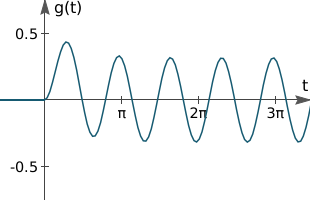
`y=3/10e^(-t)-3/10cos\ 3t+1/10sin\ 3t`
Solution Graph for Example 1
This is the graph of the solution we obtained in the example above.
Example 2
Solve `(d^2y)/(dt^2)+2(dy)/(dt)+5y=0`, given that `y = 1,` and `(dy)/(dt)=0,` when `t = 0.`
Answer
Taking Laplace transform of both sides and appying initial conditions of `y(0) = 1` and `y"'"(0) = 0` gives:
`{s^2Y-sy(0)-y"'"(0)}+` `2{sY-` `y(0)}+5Y=` `0`
`(s^2Y-s)+2(sY-1)+5Y=0`
`(s^2+2s+5)Y=s+2`
Solving for Y and completing the square on the denominator gives:
`Y=(s+2)/(s^2+2s+5)`
`=(s+2)/((s^2+2s+1)+4)`
`=(s+2)/((s+1)^2+4)`
`=(s+1)/((s+1)^2+4)+1/2 2/((s+1)^2+4)`
Now, finding the inverse Laplace Transform gives us the solution for y as a function of t:
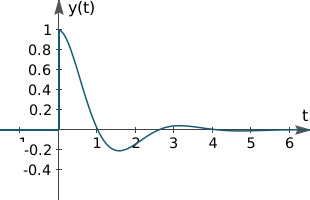
`y=e^(-t)cos\ 2t+1/2e^(-t) sin\ 2t`
Solution Graph for Example 2
Here is the graph of what we just found:
Example 3
`(d^2y)/(dt^2)-2(dy)/(dt)+y=e^t`, given that y = -2, and `(dy)/(dt)=-3` when t = 0.
Answer
Taking Laplace transform of both sides:
`{s^2Y-sy(0)-y"'"(0)}-` `2{sY-y(0)}+Y` `=1/(s-1)`
Applying the initial condition and simplifying gives:
`(s^2Y+2s+3)-2(sY+2)+Y` `=(1)/(s-1) `
`(s^2-2s+1)Y` `=(1)/(s-1)-2s+1 `
`(s-1)^2Y=(1)/(s-1)-2s+1 `
Solving for Y:
`Y=(1)/((s-1)^3)+(-2s+1)/((s-1)^2)` `=1/2(2)/((s-1)^3)+(-2s+1)/((s-1)^2) `
For the first term, we use: `Lap^{:-1:} {(n!)/((s-a)^[n+1])}=e^[at]t^n`, with a = 1 and n = 2.
So
`Lap^{:-1:}{1/2 (2)/((s-1)^3)}` `=1/2 e^t t^2 `
For the second term, we express in partial fractions:
`(-2s+1)/((s-1)^2)` `=(A)/(s-1)+(B)/((s-1)^2) `
`-2s+1=A(s-1)+B `
Comparing coefficients:
`-2s=As ` gives `A = -2`.
`1=-A+B ` gives `B = -1`.
So `(-2s+1)/((s-1)^2)` `=-(2)/(s-1)-(1)/((s-1)^2) `
And
`Lap^{:-1:} { - (2)/(s-1) - (1)/((s-1)^2)}` `=-2e^t - te^t`
Putting our inverse Laplace transform expressions together, the solution for y is:
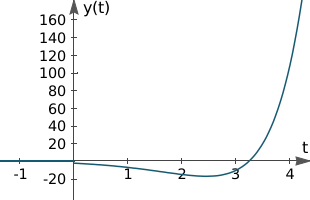
`y(t)=1/2 t^2 e^t - 2e^t - te^t`
Solution Graph for Example 3
Application
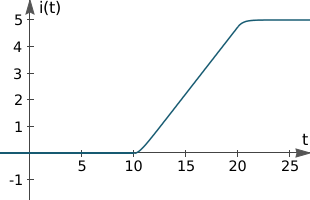
The current i(t) in an electrical circuit is given by the DE
`(d^2i)/(dt^2)+2(di)/(dt)=0,if 0 < t < 10`
`=1,if 10 < t < 20`
`=0,if t > 20`
and i(0) = 0, i’(0) = 0.
Determine the current as a function of t.
Answer
We need to write the RHS of the DE in terms of unit step functions.
`(d^2i)/(dt^2)+2(di)/(dt)` `=u(t-10)-u(t-20)`
Now, taking Laplace transform of both sides gives us:
`(s^2I-s\ i(0)-i"'"(0))+2(sI-i(0))` `=(e^(-10s))/s-(e^(-20s))/s`
`s^2I+2sI` `=1/s(e^(-10s)-e^(-20s))`
`(s^2+2s)I` `=1/s(e^(-10s)-e^(-20s))`
Solving for `I` gives:
`I=1/s((e^(-10s)-e^(-20s))/(s^2+2s))` `=1/(s^2(s+2))(e^(-10s)-e^(-20s))`
We need to find the Inverse Laplace of this expression. First, we concentrate on the `1/(s^2(s+2))` part and ignore the `(e^(-10s)-e^(-20s))` part for now.
Now, we find the partial fractions: `1/(s^2(s+2))` `=A/s+B/s^2+C/(s+2)`
Multiply both sides by `s^2(s+2)`:
`1=As(s+2)+B(s+2)+Cs^2`
`s = 0` gives `1 = 2B` gives `B=1/2`
`s=-2` gives `1 = 4C` gives `C=1/4`
`s=1` gives `1 = 3A + 3B + C` gives `A= -1/4`
So `1/(s^2(s+2))` `=-1/(4s)+1/(2s^2)+1/(4(s+2))`
Now, the inverse Laplace of this expression is:
`Lap^{:-1:}{1/(s^2(s+2))}`
`Lap^{:-1:}{-1/(4s)+1/(2s^2)+1/(4(s+2))}`
`=-1/4+1/2t+1/4e^(-2t)`
So since
`I=1/(s^2(s+2))e^(-10s)-1/(s^2(s+2))e^(-20s)`,
then we have, using the Time-Displacement Theorem (see the Table of Laplace Transforms):
`i(t)=` `[-1/4*u(t-10)+` `1/2(t-10)*u(t-10)+` `{:1/4e^(-2(t-10))*u(t-10)]-` `[-1/4*u(t-20)+` `1/2(t-20)*u(t-20)+` `{:1/4e^(-2(t-20))*u(t-20)]`
`=1/4(2t-21+e^(-2(t-10)))*u(t-10)` `+1/4(41-2t-e^(-2(t-20)))*u(t-20)`