7. The Inverse Laplace Transform
Definition
If `G(s)=Lap{g(t)}`, then the inverse transform of `G(s)` is defined as:
`Lap^{:-1:}G(s) = g(t)`
Some Properties of the Inverse Laplace Transform
We first saw these properties in the Table of Laplace Transforms.
Property 1: Linearity Property
`Lap^{:-1:}{a\ G_1(s) + b\ G_2(s)}` ` = a\ g_1(t) + b\ g_2(t)`
Property 2: Shifting Property
If `Lap^{:-1:}G(s) = g(t)`, then `Lap^{:-1:}G(s - a) = e^(at)g(t)`.
Property 3
If `Lap^{:-1:}G(s) = g(t)`, then `Lap^{:-1:}{(G(s))/s}=int_0^tg(t)dt`.
Property 4
If `Lap^{:-1:}G(s) = g(t),` then
`Lap^{:-1:}{e^(-as)G(s)} = u(t - a) * g(t - a)`.
Examples
Find the inverse of the following transforms and sketch the functions so obtained.
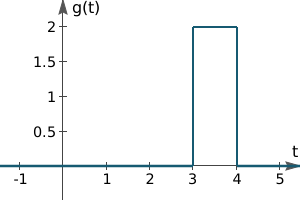
(a) `G(s)=2/s(e^(-3s)-e^(-4s))`
Answer
The Table of Laplace Transforms has:
`Lap^{:-1:}{(e^(-as))/s}=u(t-a)`
(There is no need to use Property (3) above.)
So
`Lap^{:-1:}{2/s(e^(-3s)-e^(-4s))}`
`=2[Lap^{:-1:}{(e^(-3s))/s}-Lap^{:-1:}{(e^(-4s))/s}]`
`=2[u(t-3)-u(t-4)]`
So the inverse Laplace Transform is given by:
`g(t) = 2(u(t − 3) − u(t − 4))`
The graph of `g(t)` is given by:
Graph of `g(t) = 2(u(t − 3) − u(t − 4))`.
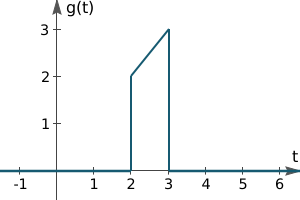
(b) `G(s)=(2s+1)/s^2e^(-2s)-(3s+1)/s^2e^(-3s)`
Answer
Using the Table of Laplace Transforms, we have:
`Lap^{:-1:}{(2s+1)/s^2e^(-2s)-(3s+1)/s^2e^(-3s)}`
`=Lap^{:-1:}{2/se^(-2s)+1/s^2e^(-2s)` `-3/se^(-3s)` `{:-1/s^2e^(-3s)}`
For
`Lap^{:-1:}{1/s^2e^(-2s)}`
we think of it as
`Lap^{:-1:}{e^(-2s)xx1/s^2}`
and use rule (4) from above:
`Lap^{:-1:}{e^(-as)G(s)}` `=u(t-a)*g(t-a)`
Now, `g(t)=Lap^{:-1:}{1/s^2}=t`
so
`Lap^{:-1:}{e^(-2s)xx1/s^2}`
`=u(t-2)xx(t-2)`
`=(t-2)*u(t-2)`
Similarly,
`Lap^{:-1:}{1/s^2e^(-3s)}`
`=Lap^{:-1:}{e^(-3s)xx1/s^2}`
`=(t-3)*u(t-3)`
So
`Lap^{:-1:}{2/se^(-2s)+1/s^2e^(-2s)-` `3/se^(-3s)-` `{:1/s^2e^(-3s)}`
`= 2u(t − 2) + (t − 2) * u(t − 2) ` ` − 3u(t − 3) ` ` − (t − 3) * u(t − 3) `
`= 2u(t − 2) + t * u(t − 2) ` ` −\ 2 * u(t − 2) ` ` −\ 3 * u(t − 3) ` ` −\ t * u(t − 3) ` `+\ 3 * u(t − 3)`
`= t * [u(t − 2) − u(t − 3)] `So
`g(t) = t * (u(t − 2) − u(t − 3))`
Here is the graph of our solution:
Graph of `g(t) = t * (u(t − 2) − u(t − 3))`.
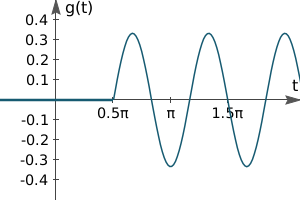
(c) `G(s)=1/(s^2+9)e^(-pis//2)`
Answer
Using the Table of Laplace Transforms, we have:
`Lap^{:-1:}{1/(s^2+9)e^(-pis//2)}`
`=1/3Lap^{:-1:}{3/(s^2+9)e^(-pis//2)}`
`=1/3 sin 3(t-pi/2)*u(t-pi/2)`
`=1/3 cos 3t*u(t-pi/2)`
NOTE:
`sin 3(t-pi/2)`
`=sin(3t-(3pi)/2)`
`=sin 3t\ cos ((3pi)/2)` `-cos 3t\ sin ((3pi)/2)`
`=cos 3t`
So the Inverse Laplace transform is given by:
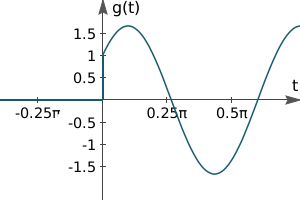
`g(t)=1/3cos 3t*u(t-pi/2)`
The graph of the function (showing that the switch is turned on at `t=pi/2 ~~ 1.5708`) is as follows:
Graph of `g(t)=1/3cos 3t*u(t-pi/2)`.
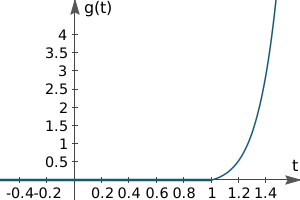
(d) `G(s)=1/((s-5)^2)e^(-s)`
Answer
We use the Table of Laplace Transforms.
Now `Lap^{:-1:}{1/s^2}=t`
and `Lap^{:-1:}{1/((s-5)^2)}=te^(5t)`
Our question involves the product of an exponential expression and a function of s, so we need to use Property (4), which says:
If `Lap^{:-1:}G(s)=g(t)`, then `Lap^{:-1:}{e^(-as)G(s)}` `=u(t-a)*g(t-a)`
In our case,
`G(s)=1/((s-5)^2)`
Our exponential expression in the question is e−s and since e−as = e−s in this case, then a = 1.
Now, since
`g(t)=Lap^{:-1:}[1/(s-5)^2]=te^(5t)`
Then, using function notation,
`g(t − 1) = (t − 1)e^(5(t − 1))`
Putting it all together, we can write the inverse Laplace transform as:
`Lap^{:-1:}{1/((s-5)^2)e^(-s)}` `=(t-1)e^(5(t-1))*u(t-1)`
So the inverse Laplace Transform is given by:
`g(t)=(t-1)e^(5(t-1))*u(t-1)`
The graph of our function (which has value 0 until t = 1) is as follows:
Graph of `g(t)=(t-1)e^(5(t-1))*u(t-1)`.
(e) `G(s)=(s+4)/(s^2+9)`
Answer
`Lap^{:-1:}{(s+4)/(s^2+9)}`
`=Lap^{:-1:}{s/(s^2+9)}` `+Lap^{:-1:}{4/(s^2+9)}`
`=Lap^{:-1:}{s/(s^2+9)}` `+4/3Lap^{:-1:}{3/(s^2+9)}`
`=cos 3t+4/3sin 3t`
For the sketch, recall that we can transform an expression involving 2 trigonometric terms
`a sin theta+b cos theta`
into
`R sin(theta+alpha)`
as follows:
For `g(t)=4/3sin 3t+cos 3t`, we have: `a=4/3,\ \ b=1, \ \ theta=3t`.
`R=sqrt(a^2+b^2)` `=sqrt((4//3)^2+1^2)` `=5/3`
`alpha=arctan{:1/(4//3):}` `=arctan{:3/4:}` `=0.6435`
So
`g(t)=4/3 sin 3t+cos 3t` `=5/3 sin(3t+0.6435)`
Here is the graph:
Graph of `g(t)=5/3 sin(3t+0.6435)`.
(f) `G(s)=3/(s^2+4s+13)`
Answer
We complete the square on the denominator first:
`G(s)=3/((s+2)^2+3^2`
`Lap^{:-1:}{3/((s+2)^2+3^2)}=e^(-2t) sin 3t`
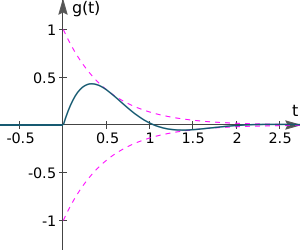
`g(t)=e^(-2t) sin 3t`
(The boundary curves `f(t)=e^(-2t)` and `f(t)=-e^(-2t)` are also shown for reference.)
Graph of `g(t)=e^(-2t) sin 3t`.
For interest: Here's the Scientific Notebook answer:
`Lap^{:-1:}{3/((s+2)^2+3^2)}`
`=-sqrt(-36)/12("exp"((-2+sqrt(-36)/2)t)` `{:-"exp"((-2-sqrt(-36)/2)t))`
`=-j/2(e^((-2+3j)t)-e^((-2-3j)t))`
This answer involves complex numbers and so we need to find the real part of this expression.
`"Re"(-j/2(e^((-2+3j)t)-e^((-2-3j)t)))` `=e^(-2t)sin 3t`
(g) `G(s)=(1-e^((1-s)T))/((s-1)(1-e^(-sT))` (where T is a constant)
Answer
We observe that the Laplace inverse of this function will be periodic, with period T.
This is because of the part:
`1/(1-e^(-sT))`
We find the function for the first period [`f_1(t)`] by ignoring that `(1-e^((1-s)T))` part in the denominator (bottom) of the fraction:
`f_1(t)=Lap^{:-1:}{(1-e^((1-s)T))/(s-1)}`
`=Lap^{:-1:}{(1)/(s-1)}` `-Lap^{:-1:}{(e^((1-s)T))/(s-1)}`
Now, for the first fraction, from the Table of Laplace Transforms we have:
`Lap^{:-1:}{(1)/(s-1)}` `=e^t*u(t)`
(We multiply by `u(t)` as we are considering `f_1(t)`, the first period of our final function only at this point.)
Considering the second fraction, we have:
`e^((1-s)T)=e^(T-sT)`,
which we can think of as:
`e^(T-sT)=e^Te^(-sT)`,
So
`(e^((1-s)T))/(s-1)` `=(e^T)(e^(-sT))(1/(s-1))`
which is in the form:
`e^Txxe^(-as)G(s)`,
where `a = T`.
So we can use Rule (4) again:
`Lap^{:-1:}{(e^((1-s)T))/(s-1)}` `=e^T xx Lap^{:-1:}{e^(-sT) xx1/(s-1)}`
`G(s)=1/(s-1)` and so `g(t)=Lap^{:-1:}{(1)/(s-1)}=e^t`.
This gives `g(t-T)=e^(t-T)`
Using Rule (4):
`Lap^{:-1:}{e^(-sT) xx1/(s-1)}` `=e^(t-T)*u(t-T)`
`e^TxxLap^{:-1:}{e^(-sT) xx1/(s-1)}`
`=e^T xx e^(t-T)*u(t-T)`
`=e^t *u(t-T)`
So the first period, `f_1(t)` of our function is given by:
`f_1(t) =e^t *u(t)-e^t *u(t-T)` `=e^t*[u(t)-u(t-T)]`
So the periodic function with `f(t)=f(t+T)` has the following graph:
Graph of `f(t)=e^t*[u(t)-u(t-T)]`, with `f(t)=f(t+T)`.
Examples Involving Partial Fractions
We first met Partial Fractions in the Methods of Integration section. You may wish to revise partial fractions before attacking this section.
Obtain the inverse Laplace transforms of the following functions:
(h) `G(s)=(2s^2-16)/(s^3-16s)`
Answer
`G(s)=(2s^2-16)/(s^3-16s)`
`=(2s^2-16)/(s(s^2-16))`
`=(2s^2-16)/(s(s+4)(s-4))`
`=A/s+B/(s+4)+C/(s-4)`
Multiplying throughout by `s^3-16s` gives:
`2s^2-16` `=A(s^2-16)+` `Bs(s-4)+` `Cs(s+4)`
Substituting `s=4` gives `16=32C`, which gives us `C=1/2`.
`s=-4` gives `16=32B`, which gives `B=1/2`.
`s=0` gives `-16=-16A`, which gives `A=1`.
So `(2s^2-16)/(s^3-16s)` `=1/s+1/(2(s-4))+1/(2(s+4))`
So the inverse Laplace Transform is given by:
`Lap^{:-1:}{(2s^2-16)/(s^3-16s)} =Lap^{:-1:}{1/s+1/(2(s-4))+1/(2(s+4))}`
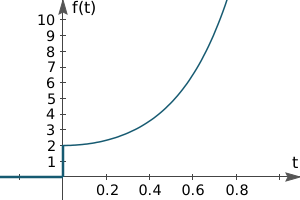
`=1+1/2e^(4t)+1/2e^(-4t)`
Here is the graph of the inverse Laplace Transform function.
Graph of `f(t)=1+1/2e^(4t)+1/2e^(-4t)`.
(i) `G(s)=3/(s^2(s+2))`
Answer
`3/(s^2(s+2))` `=A/s+B/s^2+C/(s+2)`
`3=As(s+2)+B(s+2)+Cs^2`
Substituting convenient values of `s` gives us:
`s=0` gives `3=2B`, which gives `B=3/2`.
`s=-2` gives `3=4C`, which gives `C=3/4`.
`s=1` gives `3=3A+3B+C`, which gives `A=-3/4`.
So `3/(s^2(s+2))` `=-3/(4s)+3/(2s^2)+3/(4(s+2))`
The inverse Laplace Transform is therefore:
`Lap^{:-1:}{3/(s^2(s+2))}`
`=Lap^{:-1:}{-3/(4s)+3/(2s^2)+3/(4(s+2))}`
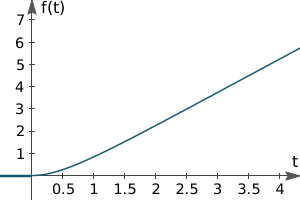
`=-3/4+3/2t+3/4e^(-2t)`
Here is the graph of the inverse Laplace Transform function.
Graph of `f(t)=-3/4+3/2t+3/4e^(-2t)`.
Integral and Periodic Types
(j) `G(s)=omega_0/(s(s^2+(omega_0)^2))`
Answer
We think of this as
`G(s)=1/s((omega_0)/(s^2+(omega_0)^2))`
We use rule (3) from above:
If `Lap^{:-1:}{G(s)}=g(t)`, then `Lap^{:-1:}{(G(s))/s}=int_0^tg(t)dt`
Now, `Lap^{:-1:}{(omega_0)/(s^2+(omega_0)^2)}=sin omega_0t`
So
`Lap^{:-1:}{(omega_0)/(s(s^2+omega_0^2))}`
`=int_0^tsin omega_0t\ dt`
`=[-1/w_0\ cos omega_0t]_0^t`
`=-1/omega_0[cos omega_0t-1]`
`=1/omega_0(1-cos omega_0t)`
(k) `G(s)=(s+b)/(s(s^2+2bs+b^2+a^2))`
Answer
We recognize the question can be written as:
`(s+b)/(s(s^2+2bs+b^2+a^2))` `=(s+b)/(s((s+b)^2+a^2))`
Once again, we will use Property (3). First, we have:
`Lap^{:-1:}{(s+b)/((s+b)^2+a^2)}` `=e^(-bt)cos at`
`Lap^{:-1:}{(s+b)/(s((s+b)^2+a^2))}` `=int_0^te^(-bt)cos at\ dt`
From our table of integrals, we have:
`inte^(au)cos bu\ du` `=(e^(au)(a\ cos bu+b\ sin bu))/(a^2+b^2)`
So our Laplace Inverse is given by:
`g(t) = int_0^te^(-bt)cos at\ dt`
`=[(e^(-bt)(-b\ cos at+a\ sin at))/(a^2+b^2)]_0^t`
`=(e^(-bt)(-b\ cos at+a\ sin at))/(a^2+b^2)-` `(-b/(a^2+b^2))`
`=(e^(-bt)(-b\ cos at+a\ sin at)+b)/(a^2+b^2)`
(l) `G(s)=(1-e^(-sT))/(s(1+e^(-sT)))`
Answer
To get this into a useful form, we need to multiply numerator and denominator by `(1-e^(-sT))`.
(We will use the basic algebraic identity, `(a+b)(a-b)=a^2 - b^2`.)
This gives
`(1-e^(-sT))/(s(1+e^(-sT)))xx(1-e^(-sT))/(1-e^(-sT))`
`=((1-e^(-sT))^2)/(s(1-e^(-2sT)))`
`=(1-2e^(-sT)+e^(-2sT))/(s(1-e^(-2sT))`
The `(1-e^(-2sT))` part indicates that the inverse function will be periodic, with period `2T`.
So
`f_1(t)` `=Lap^{:-1:}{(1-2e^(-sT)+e^(-2sT))/s}`
`=Lap^{:-1:}{1/s-(2e^(-sT))/s+(e^(-2sT))/s}`
`=u(t)-2u(t-T)+u(t-2T)`
`=[u(t)-u(t-T)]+` `(-1)[u(t-T)-u(t-2T)]`
So `f(t)` will repeat this pattern every `t = 2T`.