1b. Products Involving Unit Step Functions
When combined with other functions defined for `t > 0`, the unit step function "turns off" a portion of their graph.
Later, on this page...
The concept is related to having a switch in an electronic circuit open for a period of time (so there is no current flow), then the switch is closed (so the current begins to flow).
Example 1 - Products with Unit Functions
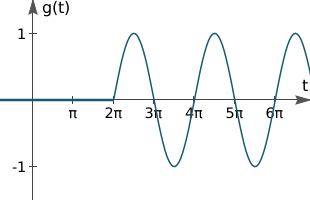
(a) If `f(t) = sin t`, then the graph of `g(t) = sin t · u(t − 2π)` is
Graph of `g(t) = sin t · u(t − 2π)`, the product of a shifted unit function.
The `sin t` portion starts at `t = 2π`, because we have multiplied `sin t` by `u(t − 2π)`.
We use the dot (`·`) for multiplication so that it is easier to read.
(b) If `f(t) = 10e^(-2t)`, then the graph of `g(t) = 10e^(-2t)· u(t − 5)` is
Graph of `g(t) = 10e^(-2t)· u(t − 5)`, the product of a shifted unit function..
The portion `10e^(-2t)` starts at `t = 5`.
Product of u(t) vs. Shifting the Function Along the t-axis
Note the differences between the following:
`f(t) · u(t)`, where the `f(t)` part begins at `t = 0`.
`f(t) · u(t − a)`, where the `f(t)` part begins at `t = a`.
`f(t − a) · u(t)`, where the `f(t)` part has been shifted to the right by `a` units and begins at `t = 0`.
`f(t − a) · u(t − a)`, where the `f(t)` part has been shifted to the right by `a` units and begins at `t = a`.
Let's see some examples.
Example 2
Let `f(t) = 4t + 2` and `a = 1`. We see different combinations of shifting with different starting points.
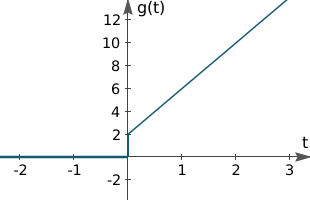
(a) `g_1(t) = f(t) · u(t) = (4t + 2) · u(t)`
Graph of `g_1(t) = (4t + 2) · u(t)`, the product of a unit function..
In this example, the `4t + 2` part starts at `t = 0`.
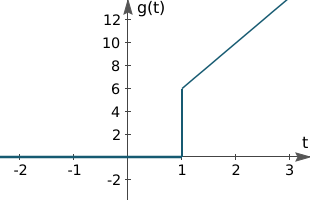
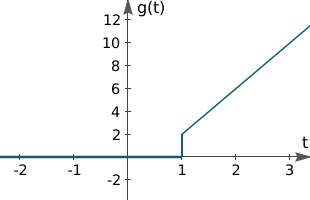
(b) `g_2(t)` ` = f(t) · u(t − a)` ` = (4t + 2) · u(t − 1)`
Graph of `g_2(t) = (4t + 2) · u(t-1)`, the product of a shifted unit function..
In this example, the `4t + 2` part starts at `t = 1`.
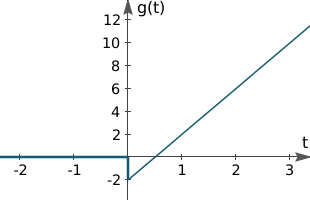
(c) `g_3(t)` ` = f(t − a) · u(t)` ` = (4(t − 1) + 2) · u(t)` ` = (4t − 2) · u(t)`
Graph of `g_3(t) = (4t - 2) · u(t)`, the product of a unit function..
In this example, the `4t + 2` part has been shifted 1 unit to the right and starts at `t = 0`.
(d) `g_4(t)` ` = f(t − a) · u(t − a)` ` = (4(t − 1) + 2) · u(t-1)` ` = (4t − 2) · u(t − 1)`
Graph of `g_4(t) = (4t - 2) · u(t-1)`, the product of a shifted unit function..
In this example, the `4t + 2` part has been shifted 1 unit to the right (like example (c)) and starts at `t = 1`.
Example 3
Let `f(t) = sin t` and `a = 0.7` and we combine them to shift our graph and start at different times, similar to what we did in Example 1.
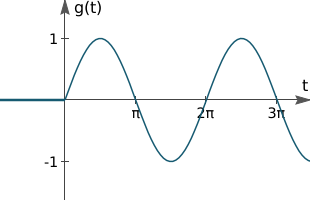
(a) `g_1(t) = sin t · u(t)`
Graph of `g_1(t) = sin t · u(t)`, the product of a unit function..
In this example, the `sin t` part starts at `t= 0`.
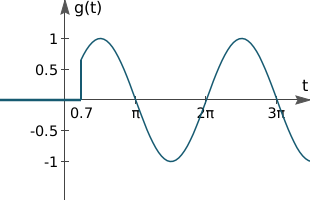
(b) `g_2(t) = sin t · u(t − 0.7)`
Graph of `g_2(t) = sin t · u(t-0.7)`, the product of a shifted unit function..
In this example, the `sin t` part starts at `t = 0.7`.
(c) `g_3(t) = sin (t − 0.7) · u(t)`
Graph of `g_3(t) = sin (t-0.7) · u(t)`, the product of a shifted unit function..
In this example, the `sin t` part has been shifted `0.7` units to the right, and it starts at `t=0`.
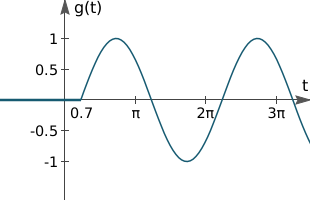
(d) `g_4(t) = sin (t − 0.7) · u(t − 0.7)`
Graph of `g_4(t) = sin (t-0.7) · u(t-0.7)`, the product of a shifted unit function..
In this example, the `sin t` part has been shifted `0.7` units to the right, and it starts at `t = 0.7`.
Exercises
Need Graph Paper?



Rewrite the following functions in a suitable way and then sketch the functions:
1. `f(t) = u(t) + (1 − t) · u(t − 1)` `+ (t − 2) · u(t − 2)`
Answer
`f(t) = u(t) + (1 − t) · u(t − 1) ` `+ (t − 2) · u(t − 2)`
Expanding where possible:
`= u(t) + u(t − 1) − t · u(t − 1)` `+ t · u(t − 2)` ` − 2 · u(t − 2)`
`= [u(t) − u(t − 1)]` ` + 2 · u(t − 1)` ` − t · [u(t − 1) − u(t − 2)] ` ` − 2 · u(t − 2)`
[We wrote `u(t − 1)` as ` − u(t − 1) + 2 · u(t − 1)`, to get the expression in the form we need.]
`= [u(t) − u(t − 1)] ` `+ 2 · [ u(t − 1) − u(t − 2)] ` ` − t · [u(t − 1) − u(t − 2)] `
[We simply moved the last term.]
`= 1 · [u(t) − u(t − 1)]` ` + (2 − t) · [ u(t − 1) − u(t − 2)]`
[Collecting like terms.]
From this expression, we can graph the function. It has value:
`1` between `0 < t < 1`
`2 − t` between `1 < t < 2``0` thereafter
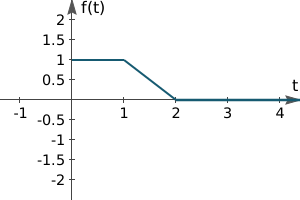
Graph of `f(t)`.
NOTE: We could have obtained the graph of
`f(t) =` ` u(t) + (1 − t) · u(t − 1)` ` + (t − 2) · u(t − 2)`
by adding ordinates (`y`-values) of the 3 parts as follows:
`u(t)` → red
`(1 − t) · u(t − 1)` → blue`(t − 2) · u(t − 2)` → magenta
The green part is the answer.
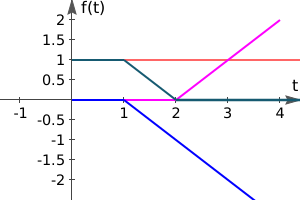
Graph of `f(t)`.
2. `f(t)` ` = t^2 · u(t) − (t^2− 4) · u(t − 2)`
Answer
Expanding:
`f(t)=` `t^2 · u(t)` `-t^2 · u(t-2)` ` + 4 · u(t-2)`
`f(t)=` `t^2 · {u(t)` ` - u(t-2)}` ` + 4 · u(t-2)`
So our graph is as follows. It is a parabola before `t=2`, and then has constant value `4` thereafter.
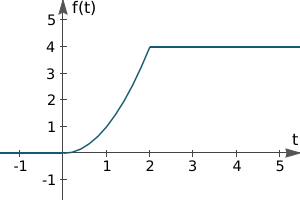
Graph of `f(t)`.
3. `f(t)` ` = u(t) + (sin t − 1) · u(t − π/2)` ` − (sin t + 1) · u(t − (3π)/2)` ` + u(t − 2π)`
Answer
`f(t) = u(t)` `+\ (sin t − 1) · u(t − π/2)` ` −\ (sin t + 1) · u(t − (3π)/2)` `+\ u(t − 2π)`
Expanding:
`f(t) = u(t) + sin t · u(t − π/2)` ` −\ u(t − π/2)` ` − sin t · u(t − (3π)/2)` ` −\ u(t − (3π)/2)` `+\ u(t − 2π)`
`f(t) = [u(t) − u(t − π/2)] ` `+ sin t · [u(t − π/2) − u(t − (3π)/2)] ` ` − [u(t − (3π)/2) - u(t − 2π)]`
From this expression, we can see that the function has value:
`0` for `t < 0``1` between `0 < t < π/2`
`sin t` (it is a curve) between `π/2 < t < (3π)/2``-1` between `(3π)/2 < t < 2π`
`0` for `t > 2π`
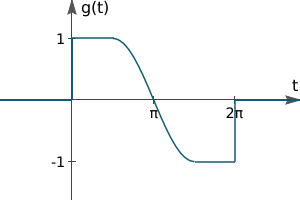
Graph of `f(t)`.
4. `f(t)` ` = 3t^2· u(t)` `+ (12 − 3t^2) · u(t − 2)` ` + (4t − 40) · u(t − 4)` ` − 4(t − 7) · u(t − 7)`
Answer
`f(t) = 3t^2· u(t) ` `+ (12 − 3t^2) · u(t − 2)` `+ (4t − 40) · u(t − 4)` ` − 4(t − 7) · u(t − 7)`
Expanding:
`= 3t^2· u(t)` `+ 12 · u(t − 2)` ` − 3t^2 · u(t − 2) ` `+ 4t · u(t − 4) ` ` − 40 · u(t − 4) ` ` − 4t · u(t − 7) ` `+ 28 · u(t − 7)`
Collecting like terms:
`= 3t^2· [u(t) − u(t − 2)] ` `+ 12 · [u(t − 2) − u(t − 4)]` ` − 28 · u(t − 4)` `+ 28 · u(t − 7)` `+ 4t · u(t − 4) − 4t · u(t − 7)`
Collecting terms and re-expressing into a usable form gives:
`= 3t^2· [u(t) − u(t − 2)] ` `+ 12 · [u(t − 2) − u(t − 4)]` ` − 28 · [u(t − 4) − u(t − 7)]` `+ 4t · [u(t − 4) − u(t − 7)]`
`= 3t^2· [u(t) − u(t − 2)]` `+ 12 · [u(t − 2) − u(t − 4)] ` `+ 4(t − 7)· [u(t − 4) − u(t − 7)]`
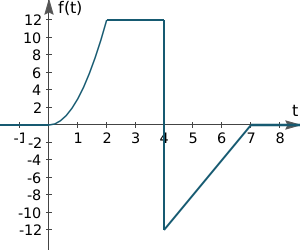
Graph of `f(t)`.