7. Applications: Derivatives of Logarithmic and Exponential Functions
by M. Bourne
We can now use derivatives of logarithmic and exponential functions to solve various types of problems eg. in the fields of earthquake measurement, electronics, air resistance on moving objects etc.
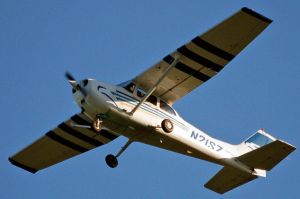
Cessna taking off. [Credit: Photobunny]
Example
A Cessna plane takes off from an airport at sea level and its altitude (in feet) at time t (in minutes) is given by
h = 2000 ln (t + 1).
Find the rate of climb at time t = 3 min.
Answer
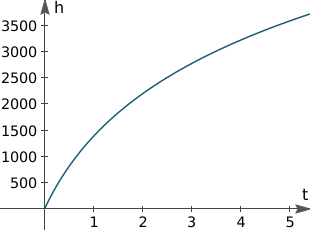
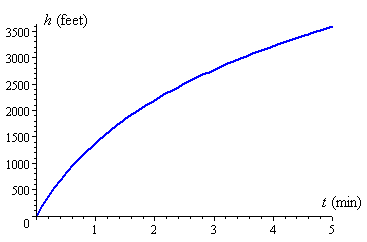
The graph of h = 2000 ln (t + 1) shows that it is a realistic model for the climb performance of a light aircraft. At low altitudes, where the air is more dense, the rate of climb is good, but as you go higher, the rate decreases.
[For some background on graphing logarithm functions, see Graphs of Exponential and Logarithmic Functions.]
To find the rate of climb (vertical velocity), we need to find the first derivative:
`d/(dt)2000 ln(t+1)=2000/(t+1)`
At t = 3, we have v = 2000/4 = 500 feet/min.
So the required rate of climb is 500'/min, which is quite realistic.
Note: In aviation, height above sea level is meaured in feet. It is regarded as a metric unit and is used universally in aviation instrumentation and charts. Problems can occur when civilian charts show heights of mountains in metres.
Sound Pressure and Decibels
The sound pressure P for a given sound is given by:
`P=10 log W/(W_0`
Its units are decibels (dB).
W is the size of a variable energy source (called the sound power), measured in Watts.
Wo is the lowest threshold of sound that humans can typically hear. It is a constant given by:
`W_0=10^(-12) "W/m"^2`.
The sound pressure is related to the sound intensity of a sound wave. Logarithms are used to cope with the large variation in sound pressure that humans can hear (from the whispering wind at around 20 dB up to the roar of a rock concert at 120 dB, depending on the distance from the speakers).
Exercise 1a
Find the rate of change of the sound pressure `P` with repect to time if `W = 7.2` and `(dW)/dt = 0.5` at some given time `t`.
Answer
Since `W_0=10^(-12)\ "W/m"^2`, and using the logarithm law for the log of a fraction, we can write:
`P=10 log (W)/(10^-12)`
`=10(log W-log 10^(-12))`
Now, using the formula for the derivative of a logarithm, and because log 10-12 is a constant, we have:
`(dP)/(dt)=10([1/W log_10e](dW)/(dt)-0)`
`=10[1/W log_10e](dW)/(dt)`
Now we substitute our given values for W and `(dW)/dt` from the question:
`(dP)/(dt)=10([1/7.2 log_10e](0.5))`
`=0.302\ "dB"//"s"`
The units are dB/s since the sound pressure (in dB) is changing over time.
Exercise 1b
If the variable sound power W is given by
W = t2 + t + 1,
find the rate of change of the sound pressure P, at time t = 3 s.
Answer
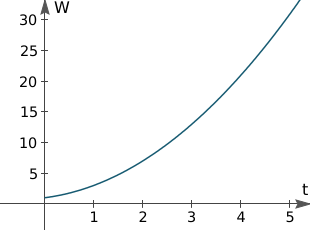
The graph of W = t2 + t + 1 is a simple parabola:
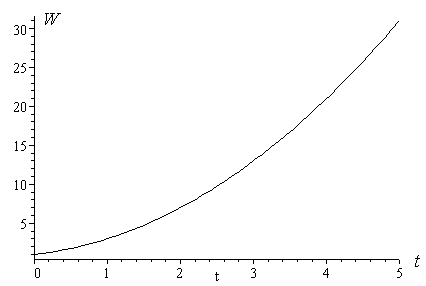
The graph of the sound pressure P,
`P=10 log (t^2+t+1)/(10^(-12)`
is given by:
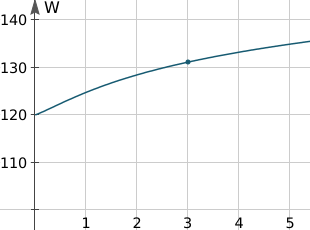
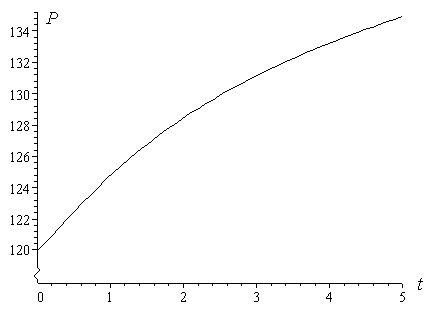
The derivative of P is given by:
`(dP)/(dt)=10[1/W log_10e](dW)/(dt)`
`=10[1/(t^2+t+1) log_10e]xx` `(d(t^2+t+1))/(dt)`
`=4.343(2t+1)/(t^2+t+1)`
At t = 3, the rate of change of P with respect to time is:
`(dP)/(dt)=[4.343(2t+1)/(t^2+t+1)]_(t=3)`
`=2.339\ "dB"//"s"`
The units are dB/s since the sound pressure is changing as time goes on.
Exercise 1c
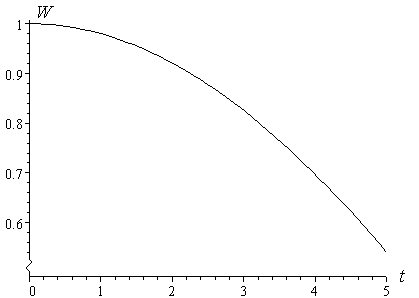
If W = cos 0.2t, find the rate of change of the sound pressure P, at time t = 1 s.
Answer
The graph of `W = cos 0.2t` is as follows:
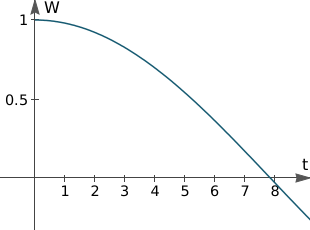
The graph of the sound pressure,
`P=10 log {:(cos 0.2t)/(10^(-12)):}`
is given by:
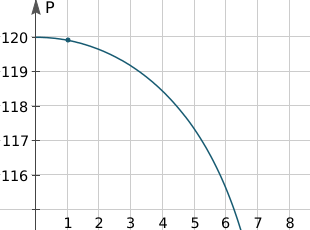
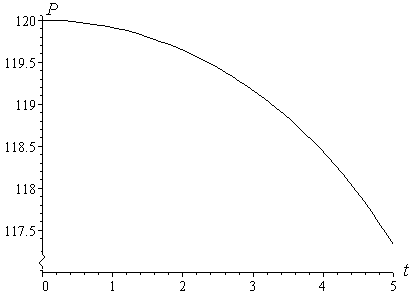
We see that the slope is negative, so we expect a negative answer.
Since
`P=10 log {:(cos 0.2t)/(10^(-12)):}`
we have:
`(dP)/(dt) = d/(dt)10 log_10 (cos 0.2t)/(10^(-12))`
`=10[1/W log_10e](dW)/(dt)`
`=10[1/(cos 0.2t) log_10e]xx` `(-0.2 sin 0.2t)`
`=-0.869 tan 0.2t`
At `t = 1\ "s"`, the value of the derivative is `-0.176\ "dB/s"`. (Of course, t is in radians).
Our answer is negative, as expected.
Exercise 2
The charge of a capacitor in a circuit containing a capacitor of capacitance C, a resistance R, and a source of voltage E is given by
`q=CE(1-e^({:-t:}//{:RC:}))`
Show that this equation satisfies the equation
`R(dq)/(dt)+q/C=E`
Answer
`q=CE(1-e^({:-t:}//{:RC:}))`
so
`(dq)/(dt)=(CE)/(RC)(e^({:-t:}//{:RC:}))`
`=E/Re^({:-t:}//{:RC:}) `
So
`R(dq)/(dt)+q/C =R(E/Re^({:-t:}//{:RC:}))+` `(CE(1-e^({:-t:}//{:RC:})))/c`
`=Ee^({:-t:}//{:RC:})+` `E(1-e^({:-t:}//{:RC:}))`
`=E[e^({:-t:}//{:RC:})+1-e^({:-t:}//{:RC:})]`
`=E`
RC circuits in electronics are an important application of differentiation (and differential equations, which you meet later). In the question we just completed, we showed that the expression for charge satisfies a particular differential equation. If you are brave, you can have a sneak preview of how this all works in Application of Ordinary Differential Equations: RC Circuits.
Exercise 3
We learned in Radius of Curvature section that the radius of curvature at a point on a curve `y=f(x)` is given by
`R=([1+((dy)/(dx))^2]^(3/2))/((d^2y)/(dx^2))`
A roller mechanism moves along a path defined by:
`y = ln(sec x)` for `-1.5\ "dm" < x < 1.5\ "dm"`.
Find the radius of curvature of this path for `x = 0.85\ "dm"`.
[A "dm" is a decimeter, or 1/10 of a meter.]
Answer
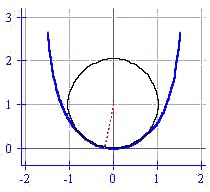
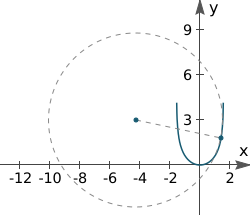
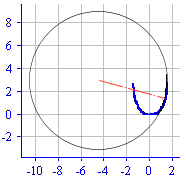
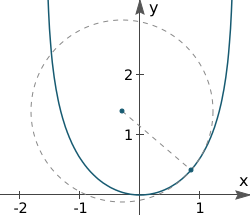
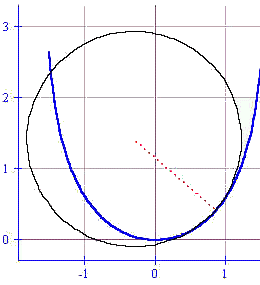
The roller mechanism follows the path indicated by the blue curve. A circle (closely matching the curve) can be drawn through the curve at each point. Let's first have a look at a couple of example points.
When x = −0.2, the radius of curvature is 0.9:
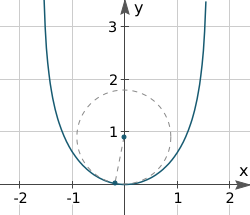
When x = 1.4, the radius of curvature is 5.8:
When x = 0.85 (the value given in the question), this is the situation. What is the radius?
`y=ln(sec x)`
so
`(dy)/(dx)=(sec x tan x)/(sec x)=tan x`
This is 1.138 when x = 0.85.
and
`(d^2y)/(dx^2)=sec^2x`
This is 2.2958 when x = 0.85.
So the radius of curvature is equal to:
`R=([1+((dy)/(dx))^2]^(3/2))/((d^2y)/(dx^2))`
`=([1+(1.138)^2]^(3/2))/2.2958`
`=3.4786/2.2958`
`=1.52\ "dm"`
See other examples of radius of curvature.
Exercise 4
A computer is programmed to inscribe a series of rectangles in the first quadrant under the curve of
`y=e^-x`
What is the area of the largest rectangle that can be inscribed?
[For a reminder on graphing exponential functions, see Graphs of Exponential and Logarithmic Functions.]
Answer
Here is the graph of `y = e^(-x)`:
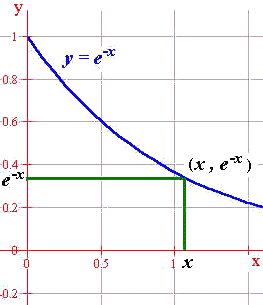
A typical rectangle is shown. It has width `x` and height `e^(-x).`
So the area of a rectangle at any point x is given by:
A = xe−x
The maximum (or minimum) will occur when
`(dA)/(dx)=0`
Now
`(dA)/(dx)=(x)(-e^(-x))+(e^(-x))(1)`
`=e^(-x)(1-x)`
This expression only equals zero when x = 1, and is positive when x < 1 and negative when x > 1, so we have a maximum.
So the maximum area is (1)(e-1) = 0.3679 units2