7. The Inverse Trigonometric Functions
by M. Bourne
In the section Trigonometric Functions of Any Angle, we solved questions like
"Find 2 angles whose cosine is 0.7."
Need Graph Paper?

This question involved the use of the cos-1 button on our calculators. We found cos-10.7 and then considered the quadrants where cosine was positive. Remember that the number we get when finding the inverse cosine function, cos-1, is an angle.
Now we turn our attention to all the inverse trigonometric functions and their graphs. It is good to have a sense of these graphs so that you know why there are restrictions on the values that we find on our calculators.
The Inverse Cosine Function (arccos)
[I have mentioned elsewhere why it is better to use arccos than `cos^-1` when talking about the inverse cosine function.]
Let's first recall the graph of `y = cos\ x` (which we met in Graph of y = a cos x) so we can see where the graph of `y = arccos\ x` comes from.
Graph of y = cos x.
We now choose the portion of this graph from x = 0 to x = π, shown here by the shaded portion:
Graph of y = cos x with shaded portion `0 <= x <= pi`.
The graph of the inverse of cosine x is found by reflecting the chosen portion of the graph of `cos x` through the line `y = x`.
Graph of y = cos x and the line `y=x`.
We now reflect every point on this portion of the `cos x` curve through the line y = x (I've shown just a few typical points being reflected.)
Reflecting points on the curve through the line `y=x`.
The result is the graph `y = arccos x`:
The curve `y=arccos x`.
See an animation of this process here: Inverse Trigonometric Function Graph Animations.
That's it for the graph - it does not extend beyond what you see here. (If it did, there would be multiple values of y for each value of x and then we would no longer have a function.) I've indicated the "start" and "end" points, `(-1, pi)` and `(1,0)` with dots.
NOTE 1: The axes labels have also been reflected. That is, now there are ordinary numbers along the x-axis, and multiples of `0.5pi` on the y-axis.
NOTE 2: You will also see "`arccos`" written as "`"acos"`", especially in computer programming.
The domain (the possible x-values) of arccos x is
-1 ≤ x ≤ 1
The range (of y-values for the graph) for arccos x is
0 ≤ arccos x ≤ π
The Inverse Sine Function (arcsin)
We define the inverse sine function as
`y=arcsin\ x` for `-pi/2<=y<=pi/2`
where y is the angle whose sine is x. This means that
`x = sin y`
The graph of y = arcsin x
Let's see the graph of y = sin x first and then derive the curve of y = arcsin x.
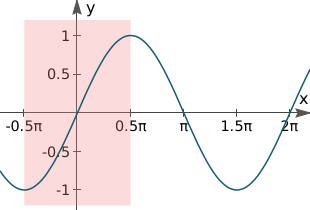
Graph of y = sin x, with the portion from `-pi/2` to `pi/2` highlighted.
As we did previously , if we reflect the indicated portion of y = sin x (the part between `x=-pi/2` and `x=pi/2`) through the line y = x, we obtain the graph of y = arcsin x:
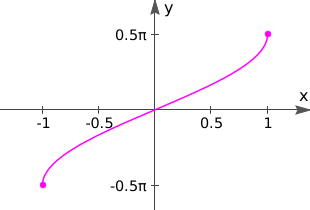
Graph of y = arcsin x.
Once again, what you see is what you get. The graph does not extend beyond the indicated boundaries of x and y. I've indicated the "start" and "end" points with dots.
The domain (the possible x-values) of arcsin x is
-1 ≤ x ≤ 1
The range (of y-values for the graph) for arcsin x is
`-π/2 ≤ arcsin\ x ≤ π/2`
See an animation of this process here:
The Inverse Tangent Function (arctan)
As a reminder, here is the graph of y = tan x, that we met before in Graphs of tan, cot, sec and csc.
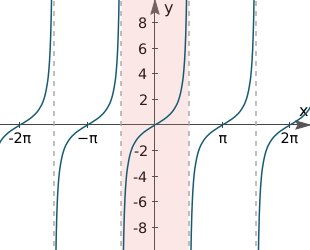
Graph of y = tan x.
Reflecting the shaded portion of the graph (from `x=-pi/2` to `pi/2`) in the line y = x, we obtain the graph of y = arctan x:
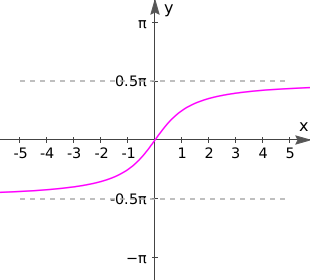
Graph of `y="arctan"\ x`.
This time the graph does extend beyond what you see, in both the negative and positive directions of x, and it doesn't cross the dashed lines (the asymptotes at `y=-pi/2` and `y=pi/2`).
The domain (the possible x-values) of arctan x is
All values of x
The range (of y-values for the graph) for arctan x is
`-π/2 < arctan x < π/2`
Numerical Examples of arcsin, arccos and arctan
Using a calculator in radian mode, we obtain the following:
arcsin 0.6294 = sin-1(0.6294) = 0.6808
arcsin (-0.1568) = sin-1(-0.1568) = -0.1574
arccos (-0.8026) = cos-1(-0.8026) = 2.5024
arctan (-1.9268) = tan-1(-1.9268) = -1.0921
Note that the calculator will give the values that are within the defined range for each function.
The answers in each case are angles (in radians).
The Inverse Secant Function (arcsec)
The graph of y = sec x, that we met before in Graphs of tan, cot, sec and csc:
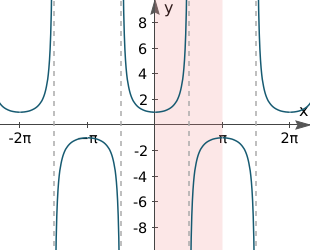
Graph of y = sec x.
The graph of y = arcsec x is obtained by reflecting the shaded portion of the above curve in the line y = x:
: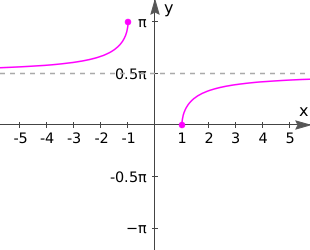
Graph of `y="arcsec"\ x`.
The curve is defined outside of the portion betweem −1 amd 1. I've indicated the "starting" points `(-1,pi)` and `(1,0)` with dots.
The domain of `"arc"sec\ x` is
All values of x, except −1 < x < 1
The range of arcsec x is
0 ≤ arcsec x ≤ π, `"arc"sec\ x ≠ π/2`
The Inverse Cosecant Function (arccsc)
The graph of y = csc x, that we met before in Graphs of tan, cot, sec and csc, looks like this:
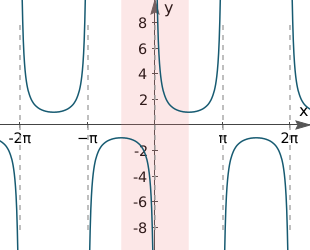
Graph of y = csc x.
Notice there are no values of y between −1 and 1.
Now for the graph of y = arccsc x, which we obtain by reflecting the shaded portion of the above curve in the line y = x:

Graph of `y="arccsc"\ x`.
The graph is not defined between −1 and 1, but extends in the negative and positive x-directions from there.
The domain of arccsc x is
All values of x, except −1 < x < 1
The range of arccsc x is
`-π/2 ≤ "arc"csc\ x ≤ π/2,` arccsc x ≠ 0
The Inverse Cotangent Function (arccot)
The graph of y = cot x, that we met before in Graphs of tan, cot, sec and csc is as follows:

Graph of y = cot x.
Taking the highlighted portion as above, and reflecting it in the line y = x, we have the graph of y = arccot x:
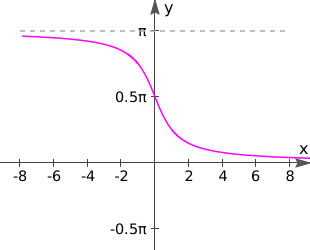
Graph of `y="arccot"\ x`.
The graph extends in the negative and positive x-directions (it doesn't stop at -8 and 8 as shown in the graph).
So the domain of arccot x is:
All values of x
The range of arccot x is
0 < arccot x < π
Alternate View
Some math textbooks (and some respected math software, e.g. Mathematica) regard the following as the region of y = cot x that should be used:

Graph of y = cot x.
This would give the following when reflected in the line y = x:
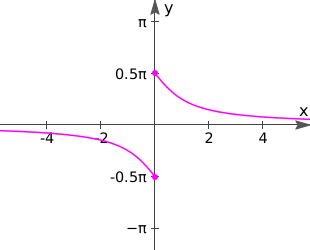
Graph of `y="arccot"\ x`; alternative view.
Once again, the graph extends in the negative and positive x-directions.
The domain of arccot x would also be:
All values of x
Using this version, the range of arccot x would be:
`-π/2 < "arc"cot\ x ≤ π/2` (arccot x ≠ 0)
See the discussion on this at:
Don't miss the animations of all the graphs on this page here:
Numerical Exercises
1. Find `cos (sin^(-1)0.5)`
Answer
The value of the portion in brackets is an angle.
Noting the range for inverse sine function, we get
`sin^(-1)0.5=pi/6`
Hence
`cos(sin^(-1)0.5)=cos(pi/6)=0.8660`
This final answer is a number, not an angle.
2. Write down the meaning (in words) of `y = 2\ sin^-1\ x`
Answer
y is twice the angle whose sine is x.
3. Evaluate `sin^-1 0`
Answer
`sin^-1\ 0 = 0`
4. Evaluate `sec^-1 2`
Answer
`sec^(-1)2 =pi/3`
5. Evaluate `cos [tan^-1(-1)]`
Answer
`tan^(-1)(-1)=-pi/4`
`cos(-pi/4)=1/2sqrt(2)`