3. Graphs of y = a sin(bx + c) and y = a cos(bx + c)
by M. Bourne
Phase shift Interactives...
Later on this page:
In this section, we meet the following 2 graph types:
y = a sin(bx + c)
and
y = a cos(bx + c)
Both b and c in these graphs affect the phase shift (or displacement), given by:
`text(Phase shift)=(-c)/b`
The phase shift is the amount that the curve is moved in a horizontal direction from its normal position. The displacement will be to the left if the phase shift is negative, and to the right if the phase shift is positive.
There is nothing magic about this formula. We are just solving the expression in brackets for zero; `bx + c = 0`.
Example 1
Need Graph Paper?

Sketch the curve
y = sin(2x + 1)
Answer
Let's first graph `y = sin 2x` (without the "+ 1") to get an idea of what phase shift means.
The amplitude is 1 and the period is `(2π)/2 = π.`
I have drawn a little more than 2 cycles, starting from `x = 0`.

The graph of `y=sin(2x)` for `0 ≤ x ≤ 6.5`
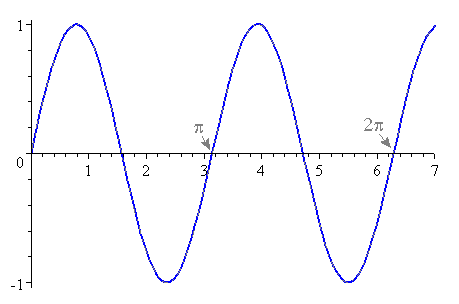
Now let's consider the phase shift. Using the formula above, we will need to shift our curve by:
Phase shift `=-c/b=-1/2=-0.5`
This means we have to shift the curve to the left (because the phase shift is negative) by `0.5`. Here is the answer (in green). I have kept the original y = sin 2x (in dotted gray) so you can see what's happening.

The graph of `y=sin(2x+1)` for `-0.5 ≤ x ≤ 6.7`
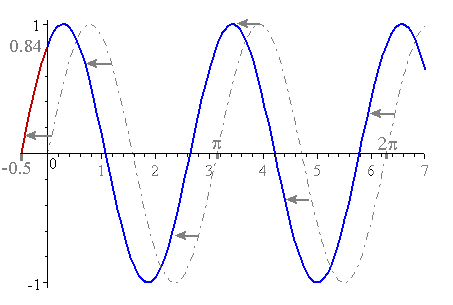
Note that the curve passes through:
- (−0.5, 0) on the x-axis (because we shifted the curve to the left by 0.5) and
- sin 1 = 0.84 on the y-axis. This figure is obtained by substituting x = 0 into y = sin(2x + 1); (in radians, of course).
Example 2
Sketch
`y=12cos(2x-pi/8)`
Answer
In this example, the
amplitude `a = 12`, and
`b = 2`, so the period = `(2π)/b = (2π)/2 = π`, and
`c=-pi/8`
so the phase shift is
`-c/b=-(-pi"/"8)/2=pi/16`
This means we need to move the cosine graph to the right of its normal position (because the displacement is positive in this example) by `pi/16`.
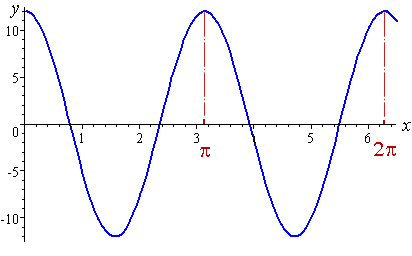
Without phase shift, the cosine curve will be y = 12 cos 2x and its graph is as follows:

The graph of `y=12cos(2x)` for `0 ≤ x ≤ 2pi`
Now, let's shift it to the right by π/16 ≈ 0.1963:
The graph of `y=12cos(2x-pi/8)` for `0 ≤ x ≤ 2pi`
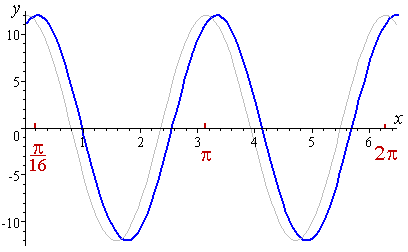
You can see the original cosine curve (in dashed gray) and we have shifted it by `pi/16` to the right to give the required graph of `y = 12 cos (2x − π/8)`, in green.
Phase shift Interactive
In the following interactive, use the slider to change the value of c, which displaces the curve. Observe the "c" and "displacement" values and how they change when you move the curve left and right.
The example you see is `y=sin(pi t)`. This has period given by `(2 pi)/b = (2π)/π = 2`.
You can also see the cosine case by choosing it at the top.
Choose graph type:
Sine Cosine
Guide curve:
On Off
Graph: `y=sin(pi t - 0)`
Displacement = `(-c)/b = 0/pi = 0`
Copyright © www.intmath.com
Phase Angle or Phase Shift?
Phase angle is not always defined the same as phase shift.
The phase angle for the sine curve y = a sin(bx + c) is usually taken to be the value of c and the phase shift is usually given by `-c/b`, as we saw above.
Reminder: In the last section, we saw how to express sine curves in terms of frequency.
Example: Electronics engineers separate the terms "phase angle" and "phase shift", and they use a mix of radians and degrees. We may have a current expressed as follows:
I = 50 sin (2π(100)t + 30°)
This means the amplitude is `50\ "A"`, the frequency is `100\ "Hz"` and the phase angle is`30°`.
See an application of phase angle at An Application to AC Circuits in the complex numbers chapter.
Also, see a discussion on this issue at Phase shift or phase angle? in the math blog.
To keep things simple for now, we will mostly use the term phase shift in this chapter.
Amplitude, period and phase shift graph applet
The following interactive will help you to explore the three key concepts when drawing trigonometric graphs - amplitude, period and phase shift.
Use the sliders under the graph to vary each of the amplitude, period and phase shift of the graph.
The `x`-axis has an integer scale (it's radians, of course), and multiples of `pi` are indicated with a red stroke.
You can also change the function to cosine. Hopefully you can see the concepts work the same for both sine and cosine curves.
Choose graph type:
Sine Cosine
Guide curve:
On Off
Graph: `y=a sin(bx + c)=` `sin(x)`
Period = `(2pi)/b = 6.28/1 = 6.28`
Displacement = `(-c)/b = 0/1 = 0`
Copyright © www.intmath.com
Exercises
Sketch the graph of the following.
1. `y = sin(2x + π/6)`
Answer
`a = 1;`
`"period" = (2π)/2 = π`
`"displacement" = -c/b = -(π/6)/2 = -π/12`
So we need to move the sine graph to the left (because we have a negative number) of its normal position by `pi/12`.
The graph of `y=sin(2x+pi/6)` for `0 ≤ x ≤ pi`
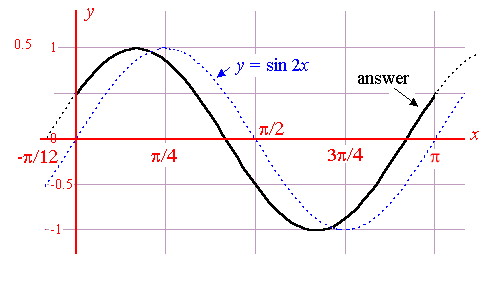
The curve `y=sin(2x)` is shown as grey dashed, and the answer, shifted by `pi/12` to the left, is in dark green.
2. `y = 3 sin(x + π/4)`
Answer
`a = 3`;
`"period" = 2π`;
`"displacement" = -c/b = -(π/4)/1 = -π/4`
The graph of `y=3sin(x+pi/4)` for `0 ≤ x ≤ 2pi`
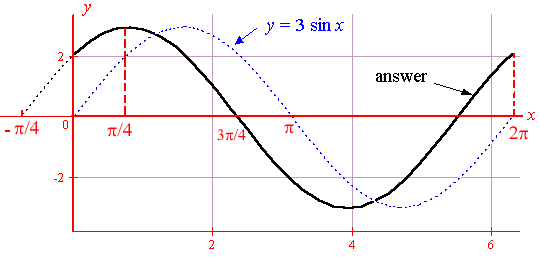
The curve `y=3sin(x)` is shown as grey dashed, and the answer, shifted by `pi/4` to the left, is in dark green.
3. `y = 2 cos(x - π/8)`
Answer
`a = 2`;
`"period" = 2π`;
`"displacement" = -c/b = -(-π/8)/1 = π/8`
This means we need to move y = 2 cos x to the right by ` π/8.`
The graph of `y=2 cos(x-pi/8)` for `0 ≤ x ≤ 2pi`
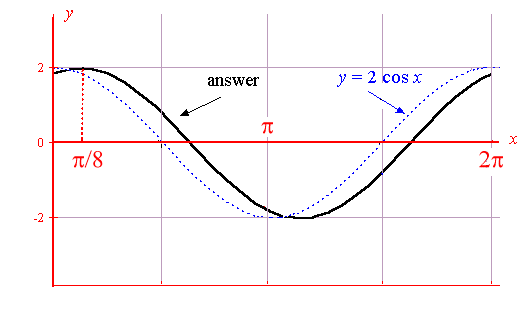
The curve `y=2cos(x)` is shown as grey dashed, and the answer after shifting by `pi/8` to the right, is in dark green.
4. `y = -cos(2x - π)`
Answer
Let's take this one a step at a time.
We'll start by simply drawing the graph of `y = cos\ 2x`.
`a = 1`; `"period" = (2π)/2 = π.`

The graph of `y= cos(2x)` for `0 ≤ x ≤ 2pi`
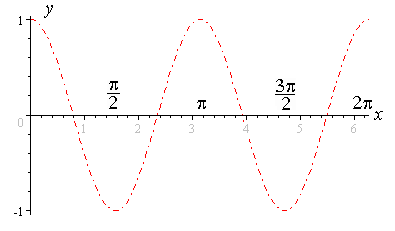
Now, let's shift the curve (we are now considering the "minus π" part of the question.
`"displacement" = -c/b = -(-π)/2 = π/2`
So we have to shift every point on the curve to the right (because phase shift is a positive number) by `pi/2`. This give us y = cos(2x - π), the blue dotted curve.

The graph of `y= cos(2x-pi)` for `0 ≤ x ≤ 2pi`
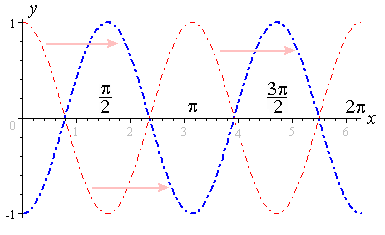
Now we need to consider the minus out the front of the expression y = −cos(2x - π). The minus will just give us a mirror image in the x-axis, since every positive value becomes negative and every negative value becomes positive. In other words, the minus turns it upside down.
The answer for the graph of y = −cos(2x - π) is the green curve:

The graph of `y= -cos(2x-pi)` for `0 ≤ x ≤ 2pi`
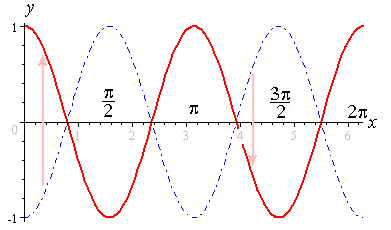
But wait, this is what we started with! It looks the same as `y = cos\ 2x`.
This example shows an interesting thing about phase shift and periodic functions. If you shift far enough, you can easily obtain equivalent sine or cosine expressions.
You will get a better understanding of why this works in Sums and Differences of Angles, which we meet later.