7. Radians
Radians - an Alternative Measure for Angle

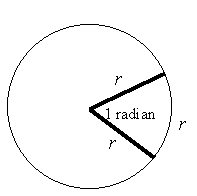
In science and engineering, radians are much more convenient (and common) than degrees. A radian is defined as the angle between 2 radii (radiuses) of a circle where the arc between them has length of one radius.
Another way of putting it is: "a radian is the angle subtended by an arc of length r (the radius)".
In the diagram, we can see the 2 radii of the circle and the subtended arc length of r.
One radian is about `57.3^@`.
Radians are especially useful in calculus where we want to interchange angles and other quantities (e.g. length). For example, see how radians are required in Fourier Series. That stuff won't work if we try to use degrees.
Most computer programs use radians as the default.
Care with your calculator! Make sure your calculator is set to radians when you are making radian calculations.
Also, see this simple introduction to radians with an interactive graph.
Converting Degrees to Radians
Because the circumference of a circle is given by C = 2πr and one revolution of a circle is `360^@`, it follows that:
2π radians `= 360^@`.
This gives us the important result:
π radians = 180o
From this we can convert:
radians → degrees and
degrees → radians.
Example 1
Convert the following to degrees:
a. `1` radian
b. `2` radians
Answer
a. `1\ "radian"=(180^"o")/pi=57.29578^"o"`
b. `2\ "radians"=(2xx180^"o")/pi=114.59156^"o"`
Gradians
Apart from degrees and radians, there is another unit for measuring angles, called gradians. In this system, the right angle is divided into 100 gradians. Gradians are used by surveyors, but not commonly used in mathematics. However, you will see a "grad" mode on most calculators.
Example 2
Convert the following to radians:
a. `50^@`
b. `357^@`
Answer
a. `50^"o"=50xxpi/180=0.8726646`
b. `357^"o"=357xxpi/180=6.2308256`
Example 3
Convert the following:
a. `60^@` to radians
b. `3.1` radians to degrees
c. `π/4` radians to degrees
d. `156.34^@` to radians
Your calculator can do these for you. However, you are encouraged to know what is happening under the hood.
Answer
1) `60^"o"=60xxpi/180=pi/3"rad"`
2) `3.1xx180/pi=177.62^"o"`
3) `pi/4 xx 180/pi = 45^"o"`
4) `156.34xxpi/180=2.7286\ "rad"`
NOTE: We'll see some examples of trigonometric ratios of angles involving radians in the section Radians and the Trigonometric Ratios.
Exercises:
1. Express in radian measure in terms of π:
a) `12^@`
b) `225^@`
Answer
a) `12^"o"=(12pi)/180=pi/15`
b) `225^"o"=(225pi)/180=(5pi)/4`
2. Express the following angles in degrees:
a) `(7pi)/15`
b) `(4pi)/3`
Answer
a) `(7pi)/15=(7xx180^"o")/15=84^"o"`
b) `(4pi)/3=(4xx180^"o")/3=240^"o"`
3. Express in radian measure (use decimals): `168.7^@`
Answer
`168.7^"o"=(168.7xxpi)/180=2.944`
Notice there is no degree sign after the answer. It is an angle in radians.
4. Express in terms of degrees: `1.703` radians.
Answer
`1.703=(1.703xx180)/pi=97.57^"o"`