3. Values of the Trigonometric Functions
by M. Bourne
In the last section, Sine, Cosine, Tangent and the Reciprocal Ratios, we learned how the trigonometric ratios were defined, and how we can use x-, y-, and r-values (r is found using Pythagoras' Theorem) to evaluate the ratios.
Now we'll see some examples of these ratios.
Finding Exact Values of Trigonometric Ratios
Find the exact values indicated. What this means is don't use your calculator to find the value (which will normally be a decimal approximation). Keep everything in terms of surds (square roots). You will need to use Pythagoras' Theorem.
Example 1
Find the exact value of sin θ if the terminal side of θ passes through `(7, 4)`.
Answer
This is what the question means by "the terminal side passes through `(7, 4)`".
We need to know r.
Using Pythagoras, we have
`r=sqrt(7^2+4^2)=sqrt(65)`
So
`sin theta=y/r=4/sqrt(65)`
Example 2
Find the exact values of all 6 trigonometric ratios of θ if the terminal side of θ passes through `(2, 10)`.
Answer
"Find all 6 trigonometric ratios of θ"
means
"find sin θ, cos θ, tan θ, csc θ, sec θ and cot θ".
This is what the question means by "the terminal side passes through `(2, 10)`".
First we need to find r:
`r=sqrt(2^2+10^2)=sqrt104=2sqrt26`
We now use r to find the required trigonometric ratios.
`sin theta=y/r=10/(2sqrt26)=5/sqrt26`
`cos theta=x/r=2/(2sqrt26)=1/sqrt26`
`tan theta=y/x=10/2=5`
`csc theta=r/y=(2sqrt26)/10=sqrt26/5`
`sec theta=r/x=(2sqrt26)/2=sqrt26`
`cot theta=x/y=2/10=1/5`
The following two cases are very common in the study of exact trigonometric ratios.
45o - 45o Triangle
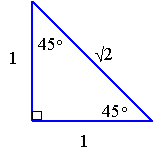
`sin 45^text(o)=text(opp)/text(hyp)=1/sqrt2`
`cos 45^text(o)=text(adj)/text(hyp)=1/sqrt2`
`tan 45^text(o)=text(opp)/text(adj)=1/1=1`
30o - 60o Triangle
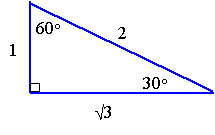
`sin 30^text(o)=text(opp)/text(hyp)=1/2`
`cos 30^text(o)=text(adj)/text(hyp)=sqrt3/2`
`tan 30^text(o)=text(opp)/text(adj)=1/sqrt3`
Memory Aid
In the `30-60` triangle, it is easy to forget where to put the `1, 2, sqrt(3)` sides and the angles. You could remember it like this:
Take an equilateral triangle, sides 2 units:
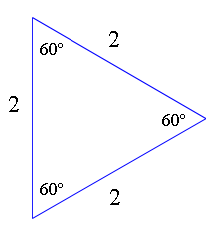
Now, cut it in half horizontally:
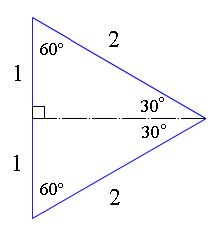
Take the top half only. The unknown side is the `sqrt(3)` and the `30^@` and `60^@` angles are as indicated:
Example 3 - Exact Values
Find exact values of the following:
a. sin 60o
b. cos 60o
c. tan 60o
d. csc 30o
e. cot 45o
f. sec 45o
Answer
Using the 30-60 triangle:
a. `sin 60^"o"=sqrt3/2`
b. `cos 60^"o"=1/2`
c. `tan 60^"o"=sqrt3/1=sqrt3`
d. `csc 30^"o" = 1/(sin 30^"o") = 2`
Questions (e) and (f) need the 45-45 triangle:
e. `cot 45^"o" = 1/ (tan 45^"o") = 1`
f. `sec 45^"o"= = 1/ (cos 45^"o") = sqrt2`
Finding Trigonometric Ratios Using Calculator
Suggestion: Go find the instruction book for your calculator. You are sure to need it in this section. Each calculator brand and model is a bit different - please don't expect your teacher to know how to use every model of every brand of calculator!
Caution: Make sure your calculator is set correctly to degree mode (not radian mode!) for this section. [We learn about radians later. It is very easy to mess up these problems when you are mixing degrees and radians - always check that your answer is reasonable before moving on.]
Example 4
Find using caclulator. Answer correct to 4 decimal places.
a. sin 49o
b. cos 27.53o
c. tan 26o35'57"
d. csc 18.34o
e. sec 5o34'72"
f. cot 73o
Answer
a. This is just one step on the calculator.
sin 49o = 0.7547
b. This question is also just one step on calculator, since it is in decimal degree form.
cos 27.53o = 0.8868
c. For this next one, you need to make sure that you know how to enter an angle in DMS form (degrees - minutes - seconds).
tan 26o35'57" = 0.5007
d. You do not have a "csc" button on your calculator, so you need to do this in 2 steps. Find the sin of 18.34o first, then press the "`1/x`" button (or "x-1" button) to find the reciprocal.
csc 18.34o = 3.1781
e. Likewise with this one, you need to find cos 5o34'72" first, then press the "`1/x`" button.
sec 5o34'72" = 1.0048
f. Similar to numbers 4) and 5), you need to find tan 73o first, then press the "`1/x`" button.
cot 73o = 0.3057
Finding Angles Given The Trig Ratio
We are now going to work the other way around. We may know the final trigonometeric ratio, but we don't know the original angle.
Example 5
Find θ, given that tan θ = 0.3462 and that 0o ≤ θ < 90o.
Solution:
We need to use the inverse tangent function (not the reciprocal function, as we did for cot θ). Our answer will be an angle. So we use the "`tan^-1`" button on our calculator, and we have:
θ = tan-1 0.3462 = 19.096o.
Check: We can use our calculator to check our answer: tan 19.096o = 0.3462. Checks OK.
NOTE 1:
It is very common (and better) to use `"arctan"` instead of "`tan^-1`". You will often see "`arctan`" throughout this site, rather than tan-1. It helps us to remember the difference between the reciprocal ratio (`cot`) and the inverse function (`arctan`).
In the above example, we would write:
θ = arctan 0.3462 = 19.096o.
You'll also see "`arcsin`", "`arccos`", "`"arccsc"`" etc. See more on this in Trigonometry Functions of Any Angle.
NOTE 2:
Be very careful with the difference between (eg) "`sin^-1`" and "`csc`". They are NOT the same!
Example: sin-1 0.935 = 69.23o (this gives us an angle).
But csc 0.935 = 1.2429 (there is no degree sign on `0.935`, so it must be in radians).
This is the `csc` of the angle `0.935` radians. It is a ratio, not an angle, and as you can see, it has a different value. We meet radians later in 7. Radians.
For the record, `csc 0.935` means:
`csc 0.935=1/(sin 0.935)=1.2429` (in radians)
Exercises - Finding Angles
Find θ for 0o ≤ θ < 90o, given that
1. sin θ = 0.6235
2. tan θ = 3.689
3. csc θ = 8.32
4. sec θ = 6.96
(I have restricted the domain for θ from `0^"o"` to `90^"o"` because we haven't seen how to solve it for angles greater than `90^"o"` yet.)
Answer
1. This is straightforward - use the `sin^-1` button on your calculator:
θ = sin-1 0.6235 = 38.572o
This is equivalent to (and better):
θ = arcsin 0.6235 = 38.572o
2. This one uses the `tan^-1` button:
θ = tan-1 3.689 = 74.833o
This is equivalent to:
θ = arctan 3.689 = 74.833o
Can you draw a triangle to illustrate what this means? Go on, try - it really helps to understand it.
3. We have to do some thinking for this one. There is no `csc^-1` button on our calculators, so we need to proceed as follows.
csc θ = 8.32,
so
`sin θ = 1/8.32 = 0.12019`. (since `sin θ` is the reciprocal of `csc θ`).
Now we can use the `sin^-1` button to obtain:
θ = sin-1 0.12019 = arcsin 0.12019 = 6.9032o
4. Similar to Q3, we need to find the reciprocal first.
`sec\ θ = 6.96`, giving us `cos θ = 1/6.96 = 0.143678`.
Therefore
θ = cos-1 0.143678 = arccos 0.143678 = 81.739o