6. Derivative of the Exponential Function
by M. Bourne
The derivative of ex is quite remarkable. The expression for the derivative is the same as the expression that we started with; that is, ex!
`(d(e^x))/(dx)=e^x`
What does this mean? It means the slope is the same as the function value (the y-value) for all points on the graph.
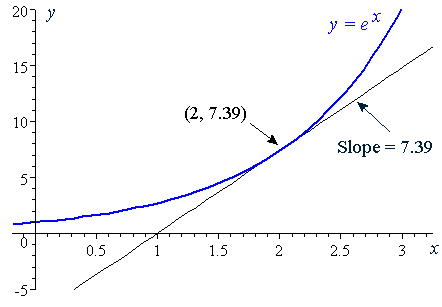
Example: Let's take the example when x = 2. At this point, the y-value is e2 ≈ 7.39.
Since the derivative of ex is ex, then the slope of the tangent line at x = 2 is also e2 ≈ 7.39.
We can see that it is true on the graph:
Let's now see if it is true at some other values of x.

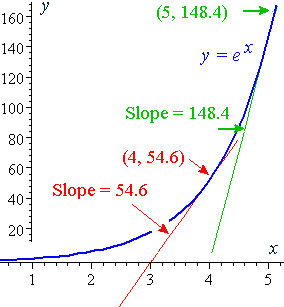

When `x=0,` `y="slope"=1`.

When `x=3,` `y="slope"~~20.1`.
We can see that in each case, the slope of the curve `y=e^x` is the same as the function value at that point.
Other Formulas for Derivatives of Exponential Functions
If u is a function of x, we can obtain the derivative of an expression in the form eu:
`(d(e^u))/(dx)=e^u(du)/(dx)`
If we have an exponential function with some base b, we have the following derivative:
`(d(b^u))/(dx)=b^u ln b(du)/(dx)`
[These formulas are derived using first principles concepts. See the chapter on Exponential and Logarithmic Functions if you need a refresher on exponential functions before starting this section.]
Example 1
Find the derivative of y = 103x.
Answer
`y=10^(3x)`
So:
`(dy)/(dx)=10^(3x)(ln 10)((d(3x))/(dx))`
`=3 ln 10(10^(3x))`
Example 2
Find the derivative of y = ex2.
Answer
`y=e^(x^2)`
So:
`(dy)/(dx)=e^(x^2)((d(x^2))/(dx))`
`=2x(e^(x^2))`
Example 3
Find the derivative of y = sin(e3x).
Answer
`y=sin(e^(3x))`
Let `y=sin u`, where `u=e^(3x)`
`(dy)/(dx)=(dy)/(du)(du)/(dx)`
`=[cos u](d(e^(3x)))/(dx)`
`=[cos e^(3x)](3e^(3x))`
`=3e^(3x) cos e^(3x)`
Example 4
Find the derivative of y = esin x.
Answer
`y=e^(sin x)`
Let `u=sin x`, so `y=e^u`.
So:
`(dy)/(dx)=(dy)/(du)(du)/(dx)`
`=e^u (d(sin x))/(dx)`
`=e^(sin x) (cos x)`
`=cos x(e^(sin x))`
Example 5
Find the derivative of
`y=(ln 2x)/(e^(2x)+2`
Answer
`y=(ln 2x)/(e^(2x)+2`
We let u = ln 2x and v = e2x + 2, and we'll use the derivative of a quotient formula,
`(dy)/(dx)=(v(du)/(dx)-u(dv)/(dx))/(v^2)`
We'll need to find the derivative of both u and v before using the formula.
Now, using the logarithm laws, we have:
u = ln 2x
= ln 2 + ln x.
So simply,
`(du)/(dx)=1/x`
And for v = e2x + 2 we have:
`(dv)/(dx)=2e^(2x)`
So applying the quotient formula, we obtain:
`(dy)/(dx)=((e^(2x)+2)(d(ln 2x))/(dx)-ln 2x(d(e^(2x)+2))/(dx))/((e^(2x)+2)^2`
Using the derivatives we just found for u and v gives:
`(dy)/(dx)=((e^(2x)+2)(1/x)-ln 2x(2e^(2x)))/((e^(2x)+2)^2`
We tidy this up by multiplying top and bottom by x. Also, it's best to write the 2e2x in front of the logarithm expression to reduce confusion. (It's not part of the log expression.)
So our derivative is:
`(dy)/(dx)=((e^(2x)+2)-2e^(2x)(x)(ln 2x))/(x(e^(2x)+2)^2)`
`(dy)/(dx)=((e^(2x)+2)-2x e^(2x)(ln 2x))/(x(e^(2x)+2)^2)`
Exercises
1. Find the derivative of y = 10x2.
Answer
Here, b = 10 and u = x2.
We have:
`(du)/(dx)=2x`
So
`(dy)/(dx)=10^(x^2)(ln 10)(2x)`
2. Find the derivative of
`y=cos 2x(e^(x^2-1))`
Answer
This is a product.
Let u = cos 2x and `v=e^(x^2-1)`
Then `(du)/(dx)=-2 sin 2x`,
and `(dv)/(dx)=e^(x^2-1)(2x)`
So
`(dy)/(dx)=[cos 2x][(e^(x^2-1))(2x)]+` `[(e^(x^2-1))(-2 sin 2x)]`
`=(e^(x^2-1))[cos 2x(2x)-` `{:2 sin 2x]`
`=2e^(x^2-1)[x cos 2x-sin 2x]`
3. Find the derivative of
`y=(2e^(x^2)+x^2)^3`
Answer
`y=(2e^(x^2)+x^2)^3`
Let
`u=2e^(x^2)+x^2`
then y = u3.
So
`(du)/(dx)=2(2x)e^(x^2)+2x`
`=4x e^(x^2)+2x`
and
`(dy)/(du)=3u^2`
`=3(2e^(x^2)+x^2)^2`
So
`(dy)/(dx)=(dy)/(du)(du)/(dx)`
`=3[2e^(x^2)+x^2]^2[4x e^(x^2)+2x]`
`=6x[2e^(x^2)+x^2]^2[2e^(x^2)+1]`
4. Show that
`y=e^(-x)sin x`
satisfies the (second order differential) equation
`(d^2y)/(dx^2)+2(dy)/(dx)+2y=0`
Answer
`y=e^(-x) sin x`
so
`(dy)/(dx)=e^(-x) cos x+sin x(-e^(-x))`
`=e^(-x)[cos x-sin x]`
and
`(d^2y)/(dx^2)=e^(-x)[-sin x-cos x]+` `[cos x-sin x][-e^(-x)]`
`=e^(-x)[-2 cos x]`
So
`"LHS"=(d^2y)/(dx^2)+2(dy)/(dx)+2y`
`=e^(-x)[-2 cos x]+` `2[e^(-x)(cos x-sin x)]+` `2[e^(-x) sin x]`
`=e^(-x)[-2 cos x+2 cos x -` `{:2 sin x+2 sin x]`
`=0`
`="RHS"`
This last exercise is important in electronics, since the funtion `y=e^(-x)sin(x)` represents a decaying signal.
The graph of `y=e^(-x)sinx.`
We'll see more of these curves in Second Order Differential Equations, in the later calculus section.
Problem Solver
Need help solving a different Trigonometry problem? Try the Problem Solver.
Disclaimer: IntMath.com does not guarantee the accuracy of results. Problem Solver provided by Mathway.
Want better grades on your next Trig Exam?
Book one of our Ivy League tutors to help you master math and improve your grades.

.png)
Education: Computer Science & Mathematics, Stanford University
Subjects: Algebra, Geometry, Trig, Calculus, Adv. Calculus, SAT/ACT Prep
Bio: Hi! I am Ligia, I really enjoy mentoring others and have worked as a math tutor at Stanford. I also interested in the physical sciences, and I do research using machine learning in biological problems. I enjoy tennis, Brazilian music, and any type of handcrafting.
Rate:$100/hr