5. Derivative of the Logarithmic Function
by M. Bourne
Later On this Page
Derivative of y = ln x
Derivative of a log of a function
Derivative of logs with base other than e
First, let's look at a graph of the log function with base e, that is:
f(x) = loge(x) (usually written "ln x").
The tangent at x = 2 is included on the graph.

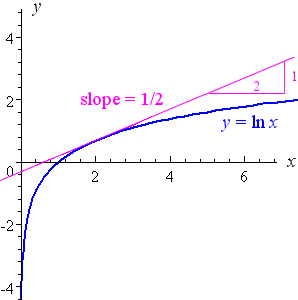
The slope of the tangent of y = ln x at `x = 2` is `1/2`. (We can observe this from the graph, by looking at the ratio rise/run).
If y = ln x,
| `x` | 1 | 2 | 3 | 4 | 5 |
|---|---|---|---|---|---|
| slope of graph | `1` | `1/2` | `1/3` | `1/4` | `1/5` |
| `1/x` | `1` | `1/2` | `1/3` | `1/4` | `1/5` |
We see that the slope of the graph for each value of x is equal to `1/x`. This works for any positive value of x (we cannot have the logarithm of a negative number, of course).
If we did many more examples, we could conclude that the derivative of the logarithm function y = ln x is
`dy/dx = 1/x`
Note 1: Actually, this result comes from first principles.
Note 2: We are using logarithms with base e. If you need a reminder about log functions, check out Log base e from before.
Derivative of the Logarithm Function y = ln x
The derivative of the logarithmic function y = ln x is given by:
`d/(dx)(ln\ x)=1/x`
You will see it written in a few other ways as well. The following are equivalent:
`d/(dx)log_ex=1/x`
If y = ln x, then `(dy)/(dx)=1/x`
We now show where the formula for the derivative of `log_e x` comes from, using first principles.
Proof of formula
For this proof, we'll need the following background mathematics.
First principles formula for the derivative of a function `f(x)`, that is:
`(df)/(dx) = lim_{h->0}(f(x+h)-f(x))/h`
`log a - log b= log (a/b)`
and
`n log a = log a^n`.

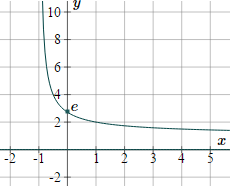
The fact "log" and `e` are inverses, so
`log_e(e) = 1`.
The well-known limit
`lim_{t->0}(1+t)^{1"/"t} = e`
(We will not prove this limit here. The graph on the right demonstrates that as `t->0`, the graph of `y=(1+t)^{1"/"t}` approaches the value `e~~2.71828`.)
I will write `log(x)` to mean `log_e(x) = ln(x)`, to make it easier to read.
We have `f(x) = log(x)` so the derivative will be given by:
`(df)/(dx) = lim_{h->0}(log(x+h)-log(x))/h `
Now the top of our fraction is
`log(x+h)-log(x)` ` = log((x+h)/x)` ` = log(1 + h/x)`.
To simplify the algebra, we now substitute `t=h/x` and this gives us `h = xt`. Of course,
`lim_{h->0}(h) = lim_{t->0}(xt) = 0`.
So we have now:
`(log(x+h)-log(x))/h` ` = 1/(xt)log(1 + t)`.
We write this as:
`1/x[1/tlog(1 + t)]`.
Considering the expression in square brackets, we use the log law
`n log a = log a^n`
and write:
`1/tlog(1 + t) = log(1+t)^(1"/"t}`
Next, the limit of the expression `(1+t)^(1"/"t}` is:
`lim_{t->0}(1 + t)^{1"/"t} = e`.
Because `log(e)=1`, we can conclude:
`(dlog(x))/(dx) = lim_{h->0}(log(x+h)-log(x))/h`
`= 1/x log(lim_{t->0}(1 + t)^{1"/"t})`
` = 1/x log(e)`
` = 1/x`
Tip
For some problems, we can use the logarithm laws to simplify our log expression before differentiating it.
Example 1
Find the derivative of
y = ln 2x
Answer
We use the log law:
log ab = log a + log b
We can write our question as:
y = ln 2x = ln 2 + ln x
Now, the derivative of a constant is 0, so
`d/(dx)ln\ 2=0`
So we are left with (from our formula above)
`d/(dx)(ln\ x)=1/x`
The final answer is:
`(dy)/(dx)=1/x`
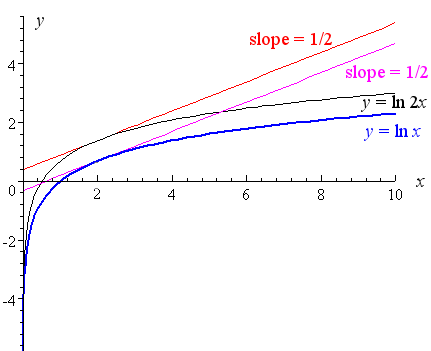
We can see from the following graph that the slope of y = ln 2x (curve in green, tangent in magenta) is the same as the slope of y = ln x (curve in gray, tangent in dashed gray), at the point x = 2.

Example 2
Find the derivative of
y = ln x2
Answer
We use the log law:
log an = n log a
So we can write the question as
y = ln x2 = 2 ln x
The derivative will be simply 2 times the derivative of ln x.
So the answer is:
`d/(dx)ln\ x^2=2 d/(dx)ln\ x=2/x`
We can see from the graph of y = ln x2 (curve in black, tangent in red) that the slope is twice the slope of y = ln x (curve in blue, tangent in pink).

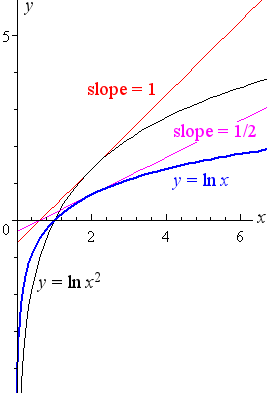
NOTE: The graph of `y=ln(x^2)` actually has 2 "arms", one on the negative side and one on the positive. The above graph only shows the positive arm for simplicity.
Derivative of y = ln u (where u is a function of x)
Unfortunately, we can only use the logarithm laws to help us in a limited number of logarithm differentiation question types.
Most often, we need to find the derivative of a logarithm of some function of x. For example, we may need to find the derivative of y = 2 ln (3x2 − 1).
We need the following formula to solve such problems.
If
y = ln u
and u is some function of x, then:
`(dy)/(dx)=(u')/u`
where u' is the derivative of u
Another way to write this is
`(dy)/(dx)=1/u(du)/(dx)`
You might also see the following form. It means the same thing.
If
y = ln f(x),
then the derivative of y is given by:
`(dy)/(dx)=(f'(x))/(f(x)`
Example 3
Find the derivative of
y = 2 ln (3x2 − 1).
Answer
We put
u = 3x2 − 1
Then the derivative of u is given by:
`u'=(du)/dx=6x`
So the final answer is :
`(dy)/(dx)=2 (u')/u`
`=2xx(6x)/(3x^2-1)`
`=(12x)/(3x^2-1)`
Example 4
Find the derivative of
y = ln(1 − 2x)3.
Answer
First, we simplify our log expression using the log law:
log an = n log a
We can write
y = ln(1 − 2x)3 = 3 ln(1 − 2x)
Then we put
u = 1 − 2x
So
`u' = (du)/dx=-2`
So our answer is:
`(dy)/(dx)=3 (u')/u`
`=3xx(-2)/(1-2x)`
`=(-6)/(1-2x)`
Example 5
Find the derivative of `y=ln[(sin 2x)(sqrt(x^2+1))]`
Answer
First, we use the following log laws to simplify our logarithm expression:
log ab = log a + log b
and
log an = n log a
So we can write our question as:
`y=ln[(sin 2x)(sqrt(x^2+1))]`
`=ln(sin 2x)+ln(sqrt(x^2+1))`
`=ln(sin 2x)+ln(x^2+1)^(1/2)`
`=ln(sin 2x)+1/2ln(x^2+1)`
Next, we use the following rule (twice) to differentiate the two log terms:
`(dy)/(dx)=(u')/u`
For the first term,
u = sin 2x
u' = 2 cos 2x
For the second term, we put
u = x2 + 1,
giving
u' = 2x
So our final answer is:
`(dy)/(dx)=(2\ cos 2x)/(sin 2x)+1/2 (2x)/(x^2+1)`
`=2\ cot\ 2x+x/(x^2+1)`
Differentiating Logarithmic Functions with Bases other than e
If
u = f(x) is a function of x,
and
y = logb u is a logarithm with base b,
then we can obtain the derivative of the logarithm function with base b using:
`(dy)/(dx)=(log_be)(u')/u`
where
`u'` is the derivative of u
logbe is a constant. See change of base rule to see how to work out such constants on your calculator.)
Note 1: This formula is derived from first principles.
Note 2: If we choose e as the base, then the derivative of ln u, where u is a function of x, simply gives us our formula above:
`(dy)/(dx)=(u')/u`
[Recall that logee = 1. ]
[See the chapter on Exponential and Logarithmic Functions base e if you need a refresher on all this.]
Example 6
Find the derivative of y = log26x.
Answer
We begin by using the following log rule to simplify our question:
log ab = log a + log b
We can write our question as:
y = log26x = log26 + log2x
The first term, log26, is a constant, so its derivative is 0.
The derivative of the second term is as follows, using our formula:
`(dy)/(dx)=(log_2e) (1/x)=(log_2e)/x`
The term on the top, log2e, is a constant. If we need a decimal value, we can work it out using change of base as follows:
`log_2e=(log_10e)/(log_10 2)=1.442695041`
Example 7
Find the derivative of y = 3 log7(x2 + 1).
Answer
We put
u = x2 + 1,
giving
u' = 2x
Applying the formula, we have:
`(dy)/(dx)=3\ (log_7e)(2x)/(x^2+1)`
`=6\ (log_7e) x/(x^2+1)`
`=3.083 x/(x^2+1)`
The value 3.083 comes from using the change of base rule.
Note: Where possible, always use the properties of logarithms to simplify the process of obtaining the derivatives.
Exercises
1. Find the derivative of
y = ln(2x3 − x)2.
Answer
Using the Log Law `log a^n = n log a`, we can write:
y = ln(2x3 − x)2 = 2 ln(2x3 − x)
Put
`u = 2x^3 − x`
so
`u' = 6x^2 − 1`
This gives us:
`(dy)/(dx)=` `(dy)/(du)(du)/(dx) ` `=2(6x^2-1)/(2x^3-x`
`x ≠ ±sqrt(0.5)`,
`x ≠ 0`
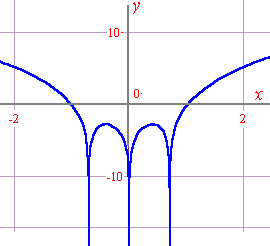
NOTE: We need to be careful with the domain of this solution, as it is only correct for certain values of x.
The graph of y = ln(2x3 − x)2 (which has power 2) is defined for all x except
` ±sqrt(0.5), 0`
Its graph is as follows:

The graph of y = 2 ln(2x3 − x), however, (it has 2 × at the front) is only defined for a more limited domain (since we cannot have the logarithm of a negative number.)
So we can only have x in the range `-sqrt 0.5 < x < 0` and `x > sqrt0.5.`

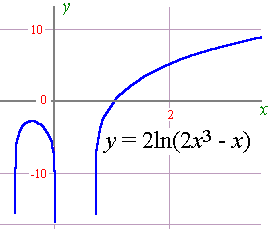
So when we find the differentiation of a logarithm using the shortcut given above, we need to be careful that the domain of the function and the domain of the derivative are stated.
2. Find the derivative of
y = ln(cos x2).
Answer
Firstly,
`d/(dx)cos x^2=-2x\ sin x^2`
So
`(dy)/(dx)=(-2x\ sin x^2)/(cos x^2)=-2x\ tan x^2`
3. Find the derivative of
y = x ln3 x.
Answer
The notation
`y = x(ln^3 x)`
means
`y = x(ln x)^3`
Note that we cannot use the log law
`log a^n= n log a`
Our expression is not
`y = x\ ln x^3`
The brackets make all the difference!
This is a product of x and `(ln x)^3`. So
`(dy)/(dx)=x(3(ln x)^2)/x+(ln x)^3(1)`
`=3(ln x)^2+(ln x)^3`
`=(ln x)^2(3+ln x)`
4. Find the derivative of
3 ln xy + sin y = x2.
Answer
We need to recognise that this is an implicit function. We can simplify it first:
`3(ln\ x+ln\ y)+sin y=x^2`
Taking derivatives:
`3(1/x+1/y(dy)/(dx))+cos y (dy)/(dx)=2x`
Collecting terms gives us:
`3/y(dy)/(dx)+cos y(dy)/(dx)=2x-3/x`
`(dy)/(dx)(3/y+cos y)=2x-3/x`
So
`(dy)/(dx)=(2x-3/x)/(3/y+cos y)`
`=(2x^2y-3y)/(3x+xy\ cos y)`
5. Find the derivative of
y = (sin x)x
by first taking logarithms of each side of the equation.
Answer
NOTE: This has an exponent which is variable. We cannot use our formula
`d/dx x^n=nx^(n-1)`
from before.
Now
`ln\ y=ln[(sin x)^x]=x\ ln(sin x)`
So
`1/y(dy)/(dx)=x(cos x)/(sin x)+ln(sin x)(1)`
Multiplying through by `y` gives:
`(dy)/(dx)=y(x\ cot\ x+ln(sin x))`
`=(sin x)^x(x\ cot\ x+ln(sin x))`
The graph of the function in Exercise 5 is quite interesting:

The graph of y = (sin x)x.