8. An Application of Complex Numbers: AC Circuits
by M. Bourne
Before we see how complex numbers can help us to analyse and design AC circuits, we first need to define some terms.
Resource
You can find more background on this material at Electronics Tutorials
Definitions
Resistance
Symbol: R
Units: Ω (ohms)
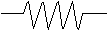
A resistor is any part of a circuit that obstructs the flow of current.
Capacitance
Symbol: C
Units: `"F"` (farads)
A capacitor consists of 2 non-connected plates:

Inductance
Symbol: L
Units: `"H"` (henrys)
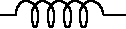
An inductor is coil of wire in which current is induced.
Current: I (in amperes)
Voltage: V (in volts).
Ohm's Law: `V = IR`
Reactance
Reactance is the effective resistance of any part of the circuit. This could be from an inductor or a capacitor. See more in the next section Impedance and Phase Angle.
Symbol: X
Voltage in alternating current circuits
-
The voltage across a resistance is in phase with the current .
-
The voltage across a capacitor lags the current by `90^@`.
-
The voltage across an inductance leads the current by `90^@`
For voltage: V = IX
The voltage across a resistor with resistance R:
VR = IR
The voltage across a capacitor with reactance XC (voltage and current are RMS, or 'root mean square' values):
VC = IXC
The voltage across an inductor with reactance XL (once again, voltage and current are RMS values):
VL = IXL
Representing voltages using the complex plane
Using the complex plane, we can represent voltages across resistors, capacitors and inductors.
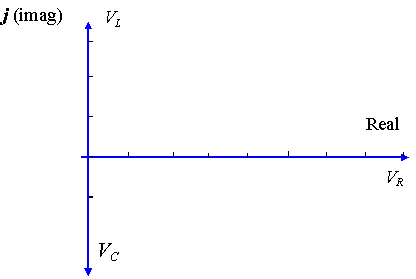
The voltage across the resistor is regarded as a real quantity, while the voltage across an inductor is regarded as a positive imaginary quantity, and across a capacitor we have a negative imaginary quantity. Our axes are as follows: