2. Integration: The Basic Logarithmic Form
by M. Bourne
The general power formula that we saw in Section 1 is valid for all values of n except n = −1.
If n = −1, we need to take the opposite of the derivative of the logarithmic function to solve such cases:
`int(du)/u=ln\ |u|+K`
The `|\ |` (absolute value) signs around the u are necessary since the log of a negative number is not defined. If you need a reminder, see absolute value.
We can also write the formula as:
`int(f^'(x))/(f(x))dx=ln\ |f(x)|+K`
In words, this means that if we have the derivative of a function in the numerator (top) of a fraction, and the function in the denominator (bottom) of the fraction, then the integral of the fraction will be the natural logarithm of the function.
Example 1
`int(2x^3)/(x^4+1)dx`
Answer
`int(2x^3)/(x^4+1)dx`
Let `u=x^4+1`, then `du=4x^3dx`.
`int(2x^3)/(x^4+1)dx=1/2int(du)/u`
`=1/2ln|u|+K`
`=1/2ln|x^4+1|+K`
In this example, we don't actually need the absolute value signs because `x^4+1>0` for all real values of `x`.
Example 2
`int_0^(pi//4)(sec^2x)/(4+tan x)dx`
Answer
`int_0^(pi//4)(sec^2x)/(4+tan x)dx`
Let `u=4+tan x`, then `du=sec^2x\ dx`
`int_0^(pi//4)(sec^2x)/(4+tan x)dx =[ln\ |4+tan x|]_0^(pi//4)`
`=[ln\ |4+tan (pi/4)|]-` `[ln\ |4+tan 0|]`
`=ln\ 5-ln\ 4`
`=0.223`
Here is the curve `y=(sec^2x)/(4+tan x)`:
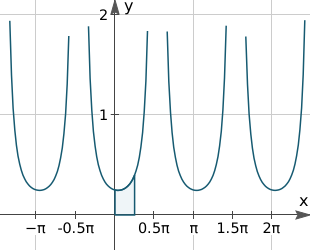
The shaded region represents the integral we just found.
Example 3
`int(dx)/(x\ ln\ x`
Answer
`int(dx)/(x\ ln\ x)`
Let `u=ln\ x`, then `du=1/xdx`
`int(dx)/(x\ ln\ x)=int(du)/u`
`=ln\ |u|+K`
`=ln\ |ln\ x|+K`
Example 4
The equation
`t=int(dv)/(20-v)`
comes from considering a force proportional to the velocity of an object moving down an inclined plane. Find the velocity, v, as a function of time, t, if the object starts from rest.
Answer
`t=int(dv)/(20-v)`
Let `u=20-v`, then `du=-dv`
So `t=int(dv)/(20-v)`
`=-int(du)/u`
`=-ln|u|+K`
`=-ln|20-v|+K`
When `t=0`, `v=0`
So `0=-ln\ 20+K`
Therefore `K=ln\ 20`
So `t=ln\ 20-ln(20-v)`
Applying the log laws, we get:
`t=ln(20/(20-v))`
Taking "`e` to both sides":
`e^t=20/(20-v)`
Inverting the fraction gives:
`e^-t=(20-v)/20`
`20e^-t=20-v`
` v=20-20e^-t`
`v=20(1-e^-t)`
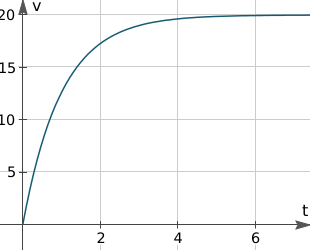
This is the graph of the velocity of the sliding object at time t.
Exercises
Integrate each of the given functions:
Exercise 1
`int(dx)/(x(1+2\ ln\ x)`
Answer
`int(dx)/(x(1+2\ ln\ x)`
Put `u = 1 + 2\ ln\ x`, then `du=2/xdx`.
`int(dx)/(x(1+2\ ln\ x)) =1/2int(du)/u`
`=1/2ln\ |1+2\ ln\ x|+K`
Exercise 2
`int_1^2(x^2+1)/(x^3+3x)dx`
Answer
`int_1^2(x^2+1)/(x^3+3x)dx`
Put `u = x^3+ 3x`, then `du = (3x^2+ 3) = 3(x^2+ 1)\ dx`.
`int_1^2(x^2+1)/(x^3+3x)dx=1/3int_(x=1)^(x=2)(du)/u`
`=1/3[ln|u|]_(x=1)^(x=2)`
`=1/3[ln|x^3+3x|]_1^2`
`=1/3[ln(14)-ln(4)]`
`=0.418`
Here's the graph of `y=(x^2+1)/(x^3+3x)`:
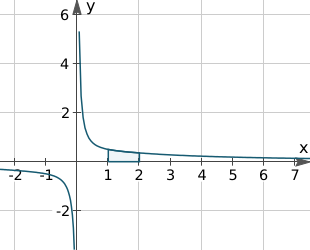
The shaded region is the integral we just found.
Exercise 3
The electric power p developed in a certain resistor is given by
`p=3int(sin pi t)/(2+cos pi t)dt`
where t is the time. Express p as a function of t.
Answer
`p=3int(sin pi t)/(2+cos pi t)dt`
Put `u = 2 + cos π t`, then
`du = −π\ sin π t\ dt`
So
`p=3int(sin pi t)/(2+cos pi t)dt`
`=-3/piint(-pi\ sin pi t)/(2+cos pi t)dt`
`=-3/pi[ln|2+cos pi t|]+K`
Here's the graph of our solution:
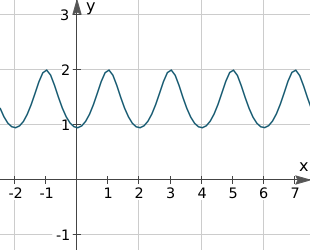
The graph of the power p at time t (using K = 2).