Helpful Revision for Fourier Series
On this page
- Properties of Sine and Cosine Graphs
- Periodic Functions
- Continuity
- Split Functions
- Summation Notation
- Useful Integrals
Background
From previous chapters:
Sine and cosine curves
Even and odd functions
Integral of Sine and Cosine
This page contains some background information that will help you to better understand this chapter on Fourier Series.
You have seen most of this before, but I have included it here to give you some help before getting into the heavy stuff.
Properties of Sine and Cosine Functions
These properties can simplify the integrations that we will perform later in this chapter.
The Cosine Function
The function `f(x) = cos x` is an even function. That is, it is symmetrical about the vertical axis.
We have: `cos(-x) = cos(x)`, and it follows that
`int_(-pi)^picos theta\ d theta=0`
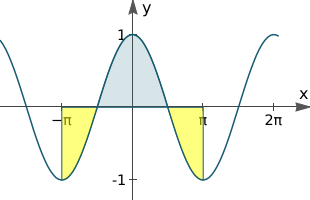
We can see the integral must be `0` if we consider the curve of `y = cos(x)` for `x=-pi` to `x=pi`.
The integral of `y=cos(x)` for `-pi <= x <= pi`
The yellow "negative" portions of the graph when added to the green "positive" portion cancel each other out. They add to zero.
The Sine Function
The function `f(x) = sin x` is an odd function. That is, it is symmetrical about the origin.
We have: `sin(-x) = -sin(x)`, and
`int_(-pi)^pi sin theta\ d theta=0`
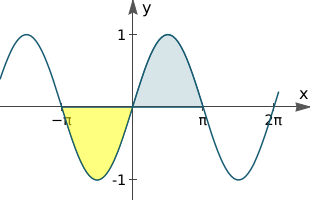
Once again, a consideration of the areas under the graph illustrates why it is so.
The integral of `y=sin(x)` for `-pi <= x <= pi`
Once again, the yellow negative portion is the same size as the green positive portion, so the sum is 0.
Multiples of π for Sine and Cosine Curves
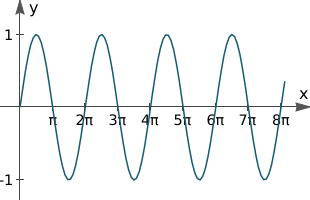
Consider the function `y = sin x`.
The curve `y=sin(x)` for `0 <= x <= 8pi`
From the graph (or using our calculator), we can observe that:
`sin(nπ) = 0,\ ` for n = 0, 1, 2, 3, ... (in fact, all integers)
`sin{:((2n-1)pi)/2:}=(-1)^(n+1),\ ` for n = 0, 1, 2, 3, ... (in fact, all integers)
Cosine case
Next, we consider the curve y = cos x
The curve `y=cos(x)` for `0 <= x <= 8pi`
`cos(2nπ) = 1,\ ` for n = 0, 1, 2, 3, ... (in fact, all integers)
`cos[(2n − 1)π] = −1,\ ` for n = 0, 1, 2, 3, ... (in fact, all integers)
`cos(nπ) = (−1)^n,\ ` for n = 0, 1, 2, 3, ... (in fact, all integers)
Periodic Functions
A function `f(t)` is said to be periodic with period p if
`f(t + p) = f(t)`
for all values of t and if `p > 0`.
The period of the function `f(t)` is the interval between two successive repetitions.
Examples of Periodic Functions
1a. `f(t) = sin t`
The curve `y=sin(x)`, which has period `= 2pi`
Useful Background
For `f(t) = sin t`, we have: `f(t) = f(t + 2π)`. The period is 2π.
1b. Saw tooth waveform, period `= 2`
Graph of saw-tooth waveform with period `2`
Useful background
For this function, we have:
`f(t) = 3t` (for −1 ≤ t < 1)
`f(t) = f(t + 2)` [This expression indicates it is periodic with period `2`.]
1c. Parabolic, period `= 2`
Periodic graph based on parabola, with period `2`.
Useful background
For this function, we have:
`f(t) = t^2` (for `0 ≤ t < 2`)
`f(t) = f(t + 2)` [Indicating it is periodic with period 2.]
1d. Square wave, period = 4
Graph of periodic square wave function.
For this function, we have:
`f(t) = -3` for `-1 ≤ t < 1` and `3` for `1 ≤ t < 3`
`f(t) = f(t + 4)` [The period is 4.]
NOTE: In this example, the period `p = 4`. We can write this as `2L = 4`.
In the diagram we are thinking of one cycle starting at ` −2` and finishing at `2`. For convenience when integrating later, we let `L = 2` and the cycle goes from `-L` to `L`.
Continuity
If a graph of a function has no sudden jumps or breaks, it is called a continuous function.
Examples:
Useful Background
- sine functions
- cosine functions
- exponential functions
- parabolic functions
Finite discontinuity - a function makes a finite jump at some point or points in the interval.
Examples:
- Square wave function
- Saw tooth functions
Split Functions
Much of the behaviour of current, charge and voltage in an AC circuit can be described using split functions.
Examples of Split Functions
Sketch the following functions:
Useful Background
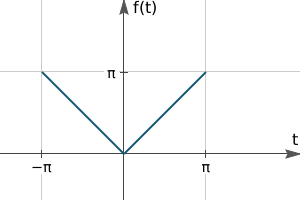
2a. `f(t)=\begin{cases} -t & \text{if} & -\pi \le t < 0 \\ t & \text{if} & 0 \le t < \pi\end{cases}`
Answer
Graph of `f(t)`.
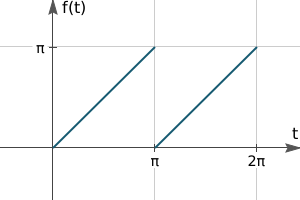
2b. `f(t)=\begin{cases} t & \text{if} & 0 \le t < \pi \\ t-\pi & \text{if} & \pi \le t < 2\pi\end{cases}`
Answer
Graph of `f(t)`, a sawtooth wave.
Useful Background
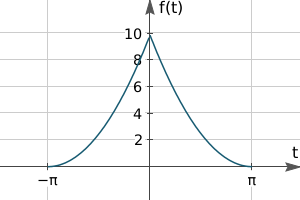
2c. `f(t)=\begin{cases} (t+\pi)^2 & \text{if} & -\pi \le t < 0 \\ (t-\pi)^2 & \text{if} & 0 \le t < \pi\end{cases}`
Answer
We note that `f(0) = pi^2 = 9.8696...`.
Graph of `f(t)`, an even function.
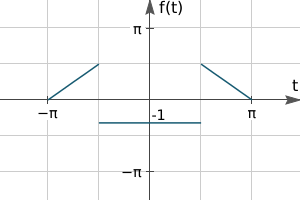
2d. `f(t)=\begin{cases} t+\pi & \text{if} & -\pi \le t < -\frac{\pi}{2} \\ -1 & \text{if} & -\frac{\pi}{2} \le t < \frac{\pi}{2} \\ -t+\pi & \text{if} & \frac{\pi}{2} \le t < \pi\end{cases}`
Answer
Graph of `f(t)`.
Summation Notation
It is important to understand summation notation when dealing with Fourier series.
Examples
Expand the following and simplify where possible:
3a. `sum_(n=1)^3n/(n+1)`
Answer
`sum_(n=1)^3n/(n+1)=` `1/2+2/3+3/4` `=23/12`
3b. `sum_(n=1)^5(2n-1)`
Answer
`sum_{n=1}^5(2n-1)` `=1+3+5+7+9` `=25`
Notice that the expression (2n − 1) generates odd numbers. as n takes values 1, 2, 3, 4, 5.
If we want to generate even numbers, we would use `2n`, as follows:
`sum_{n=1}^5{2n}` `=2+4+6+8+10` `=30`
To generate alternate positive and negative numbers, we multiply the expression in the summation by (−1)n+1. For example:
`sum_{n=1}^5(-1)^{n+1}(n)` `=1-2+3-4+5` `=3`
And here's a final example, giving us alternate positive and negative fractional terms with even denominators:
`sum_{n=1}^5\frac{(-1)^{n+1}}{2n}` `=\frac{1}{2}-\frac{1}{4}+\frac{1}{6}-\frac{1}{8}+\frac{1}{10}` `=\frac{47}{120}`
3c. `sum_(n=1)^5n^2a_n`
Answer
`sum_{n=1}^5 n^2 a_n` `=a_1+4a_2+9a_3+16a_4+25a_5`
3d. `sum_(n=1)^4(npit)/L`
Answer
`sum_(n=1)^4(npit)/L=(pit)/L+(2pit)/L+(3pit)/L+(4pit)/L`
`=(pit)/L(1+2+3+4)`
`=10(pit)/L`
Some Useful Integrals
The next 2 integrals are obtained from integration by parts and can be found in the Table of Common Integrals. We use them quite a bit in this Fourier Series chapter.
`int t sin nt dt` `=1/n^2(sin nt-nt cos nt)+K`
`int t cos nt dt` `=1/n^2(cos nt+nt sin nt)+K`