5. Applications of Trigonometric Graphs
by M. Bourne
Simple Harmonic Motion
Any object moving with constant angular velocity or moving up and down with a regular motion can be described in terms of SIMPLE HARMONIC MOTION.
The displacement, d, of an object moving with SHM, is given by:
d = R sin ωt
where R is the radius of the rotating object and `ω` is the angular velocity of the object.
For an animation of this concept, go back to: sin animation.
NOTE: We may need to use one the following, depending on the situation:
Need Graph Paper?

d = R cos ωt
d = R sin (ωt + α)
d = R cos (ωt + α)
Example 1
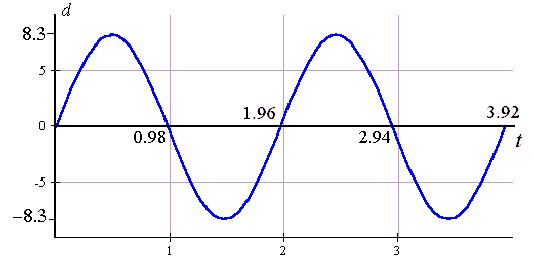
A point on a cam is `8.30\ "cm"` from the centre of rotation. Sketch 2 cycles of d as a function of t, given that d = 0 cm when t = 0 s and ω = 3.20 rad/s.
Answer
Since d = R sin ωt, we have
d = 8.30 sin 3.20t.
This sine curve will have amplitude `8.30` and period given by
`"Period"=(2pi)/b=(2pi)/3.20=1.96`
So the sketch will be:

Example 2
The voltage of an alternating current circuit is given by
e = E cos(ωt + α).
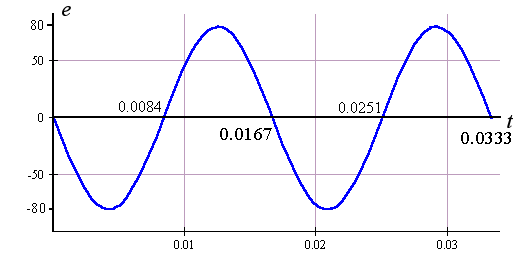
Sketch 2 cycles of the voltage as a function of time if
`E = 80\ "V"`, ` ω = 377\ "rad/s"` and `α = π/2`.
Answer
We need to sketch:
e = E cos(ωt + α)
e = 80 cos(377t + π/2)
This will have amplitude = `80`,
period `=(2pi)/377=0.0167` and
phase shift `= -c/b = -(π/2)/377 = -0.00417`
So our sketch is:

Example 3
The signal received by a radio is given by
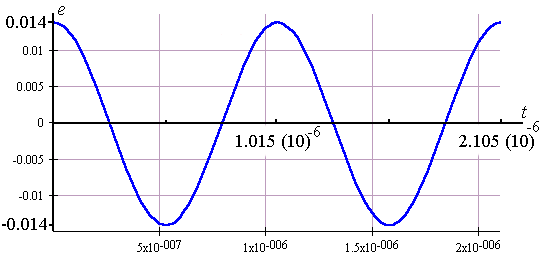
e = 0.014 cos(2πft),
where e is in volts and f is in Hz.
Draw 2 cycles of e for `f = 950\ "kHz"`.
Answer
Now, `f = 950 000`.
We need to find the wavelength to be able to draw 2 cycles.
We have: b = 2πf and we know that
`"Period" ` `=(2pi)/b=(2pi)/(2pixx950000) ` `=1.053xx10^(-6)`
So 2 wavelengths will be: `2xx1.053xx10^-6=2.105xx10^-6`
So, graphing for `0 < t < 2.105 xx 10^-6`, we have:

Graph of e = 0.014 cos(2π ×950000t). Units for t are 10-6 s
Angular Velocity
Another important result in this section is:
The angular velocity ω (in radians per second) of a rotating object, is given by:
ω = 2πf
where f is the frequency of the motion, in cycles per second.
Exercises
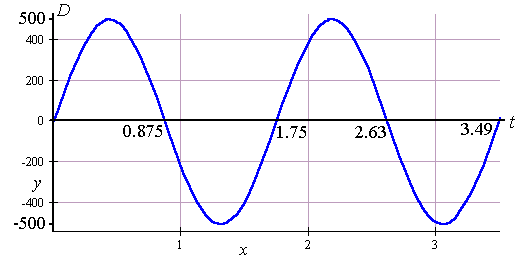
1. A satellite is orbiting the earth so that its displacement D north of the equator is given by
D = A sin(ωt + α).
Sketch 2 cycles of D as a function of t if
`A = 500\ "km"`, `ω = 3.60\ "rad/hr"` and ` α = 0`.
Answer
So we need to sketch: D = 500 sin(3.6t)

Note: Be careful with units! If frequency is in cycles per minute, then the angular velocity will be in radians per minute. Also, be careful with "kilo".
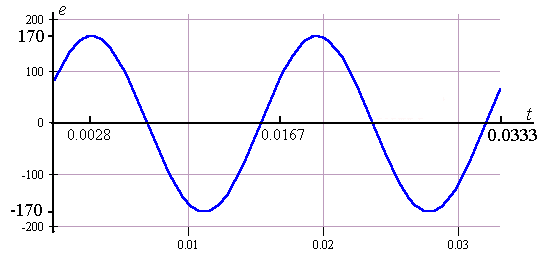
2. Using e = E cos(ωt + α), sketch 2 cycles of the voltage as a function of time if
E = 170 V, ω = 120π rad/s and `α = -π/3`.
Answer
So `e = 170 cos (120πt - π/3)`
Amplitude is `170\ "V"`.
`"Period"` ` = (2π)/b = (2π)/(120π)` ` =1/60` ` = 0.016667 ``"Phase shift"` ` = -c/b = - (-π/3)/(120π)` ` = 1/360` ` = 0.0027778`
So our cosine curve will be shifted to the right by approximately `0.0028` seconds.