3. The Area under a Curve
by M. Bourne
A building has parabolic archways and we need to supply glass to close in the archways. How much glass is needed?

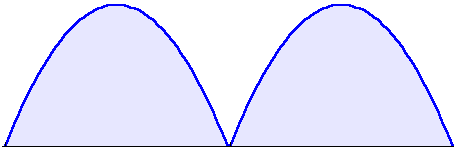
To answer this, we need to know the area under the curve.
We'll see howto do this in 2 ways on this page:
- Using an approximation (finding areas of rectangles)
- Using integration
Before integration was developed, mathematicians could only approximate the answer by dividing the space into rectangles and adding the areas of those rectangles, something like this:

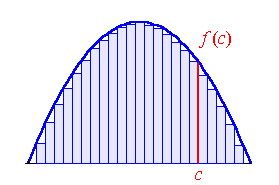
The height of each rectangle is found by calculating the function values, as shown for the typical case x = c, where the rectangle height is f(c). We get a better result if we take more and more rectangles.
In the above diagram, we are approxcimating the area using inner rectangles (each rectangle is inside the curve). We could also find the area using the outer rectangles.
[This method was known to the Ancient Greeks. See Archimedes and the area of a parabolic segment.]
See the Riemann Sums applet where you can interactively explore this concept.
Example 1: Approximation using rectangles
(a) Find the area under the curve y = 1 − x2 between x = 0.5 and x = 1, for n = 5, using the sum of areas of rectangles method.
Answer
The area we are trying to find is shaded in this graph:

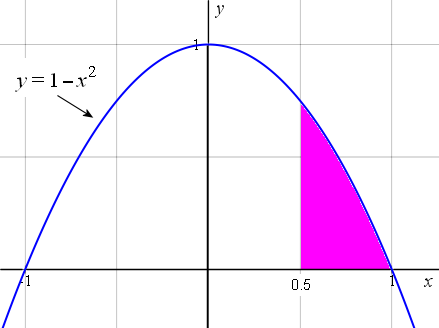
Since `n= 5`, the width of each rectangle will be:
`h=Deltax=(b-a)/n=(1-0.5)/5=0.1`
We aim to find the sum of the areas of the following 5 rectangles:

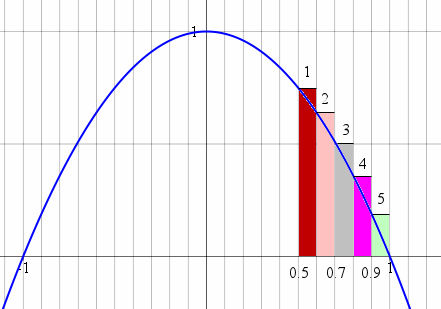
Now the height of each rectangle is given by the function value for that particular x-value.
For example, since `y = f(x) = 1 − x^2`, the first rectangle has height given by:
f(0.5) = 1 − (0.5)2 = 0.75
It has area given by:
`"Area"_1= 0.75 × 0.1 = 0.075`
The second rectangle has height:
f(0.6) = 1 − (0.6)2 = 0.64
The 5th rectangle has height
f(0.9) = 1 − (0.9)2 = 0.19
Adding the areas together gives us the following. (We are writing it using summation notation, which just means the sum of the 5 rectangles. Also, we are adding the heights first then multiplying by the width, which is the same for each rectangle.)
`A=sum_(i=1)^5A_i`
`=(0.75+0.64+0.51+` `0.36+` `{:0.19)(0.1)`
`=2.45(0.1)`
`=0.245`
In the above answer, we are finding the area of the "outer" rectangles. To find a better approximation, we could also find the area of the inner rectangles, and then average the 2 results. The graph for the inner rectangles is as follows:

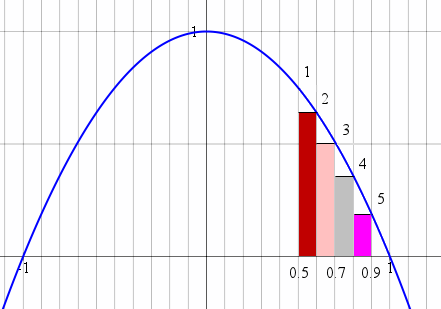
And this is the sum of the areas for the inner rectangles (the 5th one has height 0, so area 0):
`A=sum_(i=1)^5A_i`
` = (0.64+0.51+0.36+` `0.19+` `{:0)(0.1)`
`=1.7(0.1)`
`=0.17`
The average of the 2 areas is given by: `(0.245 + 0.17)/2 = 0.2075`.
A third way of doing this problem would be to find the mid-point rectangles. The diagram for this would be:

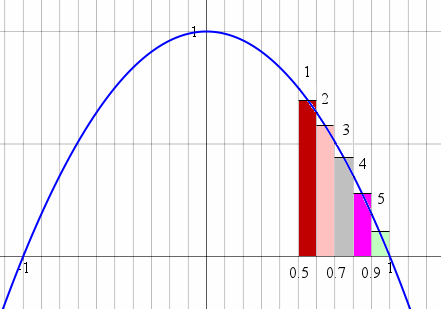
This time our area is
`(0.6975 + 0.5775 +` ` 0.4375 +` ` 0.2775 +` ` {:0.0975) × 0.1` `= 0.20875`
(The first one comes from f(0.55) = 1 − (0.55)2 = 0.6975).
This answer is slightly above the average of the outer and inner rectangles, and less work!
(b) Find the area under the curve given in part (a), but this time use n = 10, using the sum of areas of (upper) rectangles method.
Answer
Since n = 10,
`h=Deltax=(1-0.5)/10=0.05`
Here are the 10 rectangles we are using this time:

We take the outer rectangles and find the areas (10 of them) as follows:
`A=sum_(i=1)^10A_i`
`=(0.6975+0.64+0.19+` `...+0.9755+` `{:0)(0.05)`
`=3.7875(0.05)`
`=0.189375`
You can play with this concept further 0n the Reimann Sums page.
Finding Areas using Definite Integration
There must be a better way than finding areas of rectangles! Integration was developed by Newton and Leibniz to save all this "adding areas of rectangles" work.
General Case

The curve y = f(x), completely above x-axis. Shows a "typical" rectangle, Δx wide and y high.
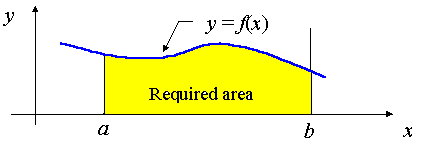
[NOTE: The curve is completely ABOVE the x-axis].
When Δx becomes extremely small, the sum of the areas of the rectangles gets closer and closer to the area under the curve. If it actually goes to 0, we get the exact area.
We use integration to evaluate the area we are looking for. We can show in general, the exact area under a curve y = f(x) from `x = a` to `x = b` is given by the definite integral:
`"Area"=int_a^bf(x)dx`
How do we evaluate this expression?
If F(x) is the integral of f(x), then
`int_a^bf(x)dx=[F(x)]_a^b` `=F(b)-F(a)`
Mini-Lecture
See the mini-lecture on the difference between definite and indefinite integrals.
This means:
To evaluate a definite integral, follow these steps:
- integrate the given function (do not include the K)
- substitute the upper limit (b) into the integral
- substitute the lower limit (a) into the integral
- subtract the second value from the first value
- the answer will be a number
This forms part of The Fundamental Theorem of Calculus.
Mini-Lecture
Example 2: Evaluation of Definite Integral
Evaluate: `int_1^(10)3x^2dx`
Answer
`int_1^(10)3x^2dx=[3xx(x^3)/3]_1^10` (We integrate)
`=[x^3]_1^10`
`=10^3-1^3` (Substitute upper and lower values and substract)
`=1000-1`
`=999`
Example 3: Arches problem
Returning to our arches problem above...

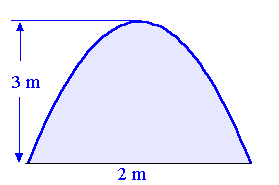
If the arch is 2 m wide at the bottom and
is 3 m high,
(i) find the equation of the parabola
(ii) find the area under each arch using integration.
Answer
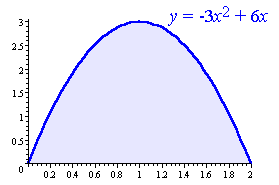
(i) We place the parabola so that the left side of the arch passes through `(0, 0)` and the right side will pass through `(2, 0)`, since the arch is 2 m wide at the bottom. The vertex of the arch is at `(1, 3)`.
General form of a parabola: `y = ax^2+ bx + c`
At `x = 0`, `y = 0` and on substituting, we get `0 = 0 + 0 + c`. So `c = 0`.
At `x = 1`, `y = 3` and on substituting, we get `3 = a + b`.
At `x = 2`, `y = 0` and on substituting, we get `0 = 4a + 2b`.
This gives the simultaneous equations
`a + b = 3`
`2a + b = 0`
Subtracting the 1st line from the 2nd gives `a = -3`.
And so `b = 6`.
So the required parabola is `y = -3x^2+ 6x`, with `x` in metres.

The process of finding the equation is called modeling. It is a very important skill in science and engineering.
(ii) Now for the area:
`int_0^2(-3x^2+6x)dx =[-x^3+3x^2]_0^2`
`=[-(2^3)+3(2)^2]-[0+0]`
`=[-8+12]`
`=4\ "m"^2`
Example 4
Find the (exact) area under the curve y = x2 + 1 between x = 0 and x = 4 and the x-axis.
Answer
This is the area we need to find:
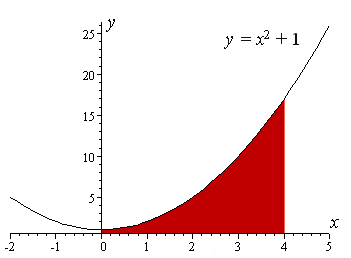
The area is given by:
`int_0^4(x^2+1)dx =[x^3/3+x]_0^4`
`=(4^3/3+4)-(0^3/3+0)`
`=76/3\ "units"^2`
`~~25.3\ "units"^2`