1. The Differential
Earlier in the differentiation chapter, we wrote `dy/dx` and `f'(x)` to mean the same thing. We used `d/dx` as an operator.
We now see a different way to write, and to think about, the derivative.
We will use this new form of the derivative throughout this chapter on Integration.
Mini-Lecture
See the
mini-lecture on differentials.
Definitions
Differentials are infinitely small quantities. We usually write differentials as `dx,` `dy,` `dt` (and so on), where:
`dx` is an infinitely small change in `x`;
`dy` is an infinitely small change in `y`; and
`dt` is an infinitely small change in `t`.
When comparing small changes in quantities that are related to each other (like in the case where `y` is some function f `x`, we say the differential `dy`, of `y = f(x)` is written:
`dy = f'(x)dx`
Note: We are now treating `dy/dx` more like a fraction (where we can manipulate the parts separately), rather than as an operator.
Example 1
Find the differential `dy` of the function `y = 3x^5- x`.
Answer
Here `y=3x^5-x`, so `f'(x)=15x^4-1`.
So the differential is given by:
`dy = f'(x)dx`
` = (15x^4-1)dx`
To find the differential `dy`, we just need to find the derivative and write it with `dx` on the right.
Example 2
Find the differential `dy` of the function `y = 5x^2-4x+2`.
Answer
Since `y=5x^2−4x+2`, then `f'(x)=10x-4`.
So the differential is given by:
`dy = (10x-4)dx`
Note
We could use the differential to estimate the real change in value of a function (`Δy`) caused by a small change in `x` (written as `Δx`). Many text books do this, but it is pretty silly, since we can easily find the exact change - why approximate it?
We are introducing differentials here as an introduction to the notation used in integration.
How are dy, dx and Δy and Δx related?
`Delta y` means "change in `y`, and `Delta x` means "change in `x`".
We learned before in the Differentiation chapter that the slope of a curve at point P is given by `dy/dx.`

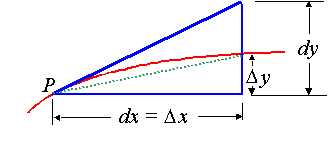
The slope of the dashed line is given by the ratio `(Delta y)/(Delta x).` As `Delta x` gets smaller, that slope becomes closer to the actual slope at P, which is the "instantaneous" ratio `dy/dx`.
That is,
`lim_(Delta x->0) (Delta y)/(Delta x)=dy/dx`
See Slope of a tangent for some background on this.
We now go on to see how the differential is used to perform the opposite process of differentiation, which first we'll call antidifferentiation, and later integration.