2. The Slope of a Tangent to a Curve (Numerical Approach)
by M. Bourne
Since we can model many physical problems using curves, it is important to obtain an understanding of the slopes of curves at various points and what a slope means in real applications.
NOTE
In this section, we show you one of the historical approaches for finding slopes of tangents, before differentiation was developed. This is to give you an idea of how it works.
If you want to see how to find slopes (gradients) of tangents directly using derivatives, go to Tangents and Normals in the Applications of Differentiation chapter.
Remember: We are trying to find the rate of change of one variable compared to another.
Applications include:
- Temperature change at a particular time
- Velocity of a falling object at a particular time
- Current through a circuit at a particular time
- Variation in stockmarket prices at a particular time
- Population growth at a particular time
- Temperature increase as density increases in a gas
Later, we will see how to find these rates of change by differentiating a function and substituting a value. For now, we are going to find rates of change numerically (that is, by substituting numbers in until we find an acceptable approximation.)
We look at the general case and write our functions involving the familiar x (independent) and y (dependent) variables.

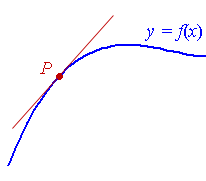
The slope of a curve y = f(x) at the point P means the slope of the tangent at the point P. We need to find this slope to solve many applications since it tells us the rate of change at a particular instant.
[We write y = f(x) on the curve since y is a function of x. That is, as x varies, y varies also.]
Delta Notation
In this work, we write
- change in y as Δy
- change in x as Δx
By definition, the slope is given by:
`m=(text(change in)\ y)/(text(change in)\ x)=(Deltay)/(Deltax)=(y_2-y_1)/(x_2-x_1)`
We use this to find a numerical solution to the slope of a curve.
Example
Find the slope of the curve y = x2 at the point `(2,4)`, using a numerical method.
Solution
We start with a point `Q(1, 1)` which is somewhere near `P(2,4)`:

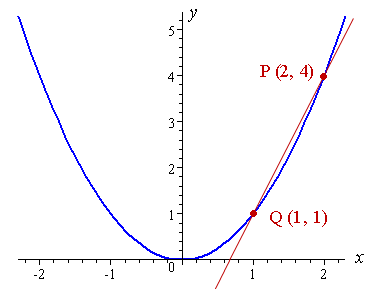
The slope of PQ is given by:
`m=(y_2-y_1)/(x_2-x_1)`
`=(4-1)/(2-1)`
`=3`
Now we move Q further around the curve so it is closer to P. Let's use `Q(1.5,2.25)` which is closer to `P(2,4)`:
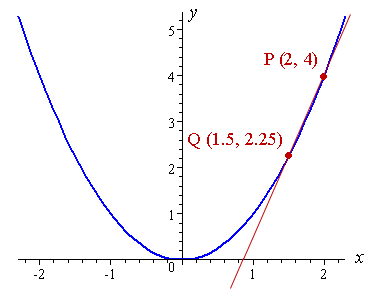
The slope of PQ is now given by:
`m=(y_2-y_1)/(x_2-x_1)`
`=(4-2.25)/(2-1.5)`
`=3.5`
We see that this is already a pretty good approximation to the tangent at P, but not good enough.
Now we move Q even closer to P, say `Q(1.9,3.61)`.
Now we have:

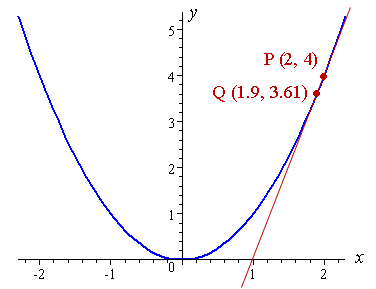
So
`m=(y_2-y_1)/(x_2-x_1)`
`=(4-3.61)/(2-1.9)`
`=3.9`
We can see that we are very close to the required slope.
Now if Q is moved to `(1.99,3.9601)`, then slope PQ is `3.99`.
If Q is `(1.999,3.996001)`, then the slope is `3.999`.
Clearly, as `x → 2`, the slope of `PQ → 4`. But notice that we cannot actually let `x = 2`, since the fraction for m would have `0` on the bottom, and so it would be undefined.
We have found that the rate of change of y with respect to x is `4` units at the point `x = 2` .
Explore
Explore this example using an interactive applet on the following page:
3. The Derivative from First Principles.
We will now extend this numerical approach so that we can find the slope of any continuous curve if we know the function. We will learn about an algebraic approach that can be used for most functions.