10. Partial Derivatives
by M. Bourne
So far in this chapter we have dealt with functions of single variables only. However, many functions in mathematics involve 2 or more variables. In this section we see how to find derivatives of functions of more than 1 variable.
This section is related to, but is not the same as Implicit Differentiation that we met earlier.
Example 1 - Function of 2 variables
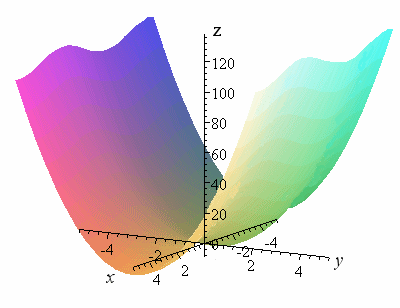
Here is a function of 2 variables, x and y:
F(x,y) = y + 6 sin x + 5y2
To plot such a function we need to use a 3-dimensional co-ordinate system.
Partial Differentiation with respect to x
"Partial derivative with respect to x" means "regard all other letters as constants, and just differentiate the x parts".
In our example (and likewise for every 2-variable function), this means that (in effect) we should turn around our graph and look at it from the far end of the y-axis. We are looking at the x-z plane only.
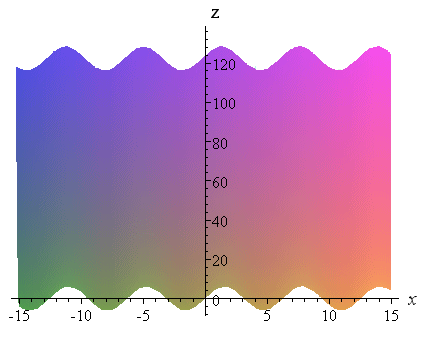
We see a sine curve along the x-axis and this comes from the "6 sin x" part of our function F(x,y) = y + 6 sin x + 5y2. The y parts are regarded as constants (in fact, 0 in this case).
Now for the partial derivative of
F(x,y) = y + 6 sin x + 5y2
with respect to x:
`(del F)/(del x)=6 cos x`
The derivative of the 6 sin x part is 6 cos x. The derivative of the y-parts is zero since they are regarded as constants.
Notice that we use the curly symbol ∂ to denote "partial differentiation", rather than "`d`" which we use for normal differentiation.
NOTE: You can explore this example using this 3D interactive applet in the Vectors chapter. In the drop-down list of examples, this is the last one.
Partial Differentiation with respect to y
The expression
Partial derivative with respect to y
means
"Regard all other letters as constants, just differentiate the y parts".
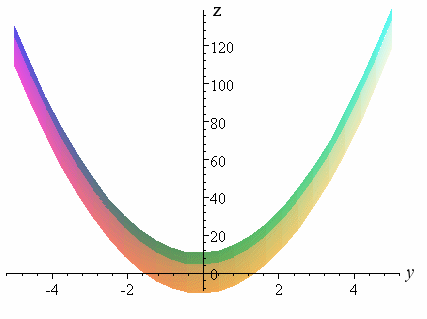
As we did above, we turn around our graph and look at it from the far end of the x-axis. So we see (and consider things from) the y-z plane only. (Notice the horizontal axis on the following graph is labeled y, not x.)
We see a parabola. This comes from the y2 and y terms in F(x,y) = y + 6 sin x + 5y2. The "6 sin x" part is now regarded as a constant. (It actually has the effect of moving the base of the parabola `z=y+5y^2` down by 6 units.)
Now for the partial derivative of
F(x,y) = y + 6 sin x + 5y2
with respect to y.
`(delF)/(dely)=1+10y`
The derivative of the y-parts with respect to y is 1 + 10y. The derivative of the 6 sin x part is zero since it is regarded as a constant when we are differentiating with respect to y.
NOTE: Once again, you can explore this particular example (rotate it, view it from different axes, etc) using the 3D interactive applet in the Vectors chapter. In the drop-down list of examples, select the last one.
Second Order Partial Derivatives
We can find 4 different second-order partial derviatives. Let's see how this works with an example.
Example 2
For the function we used above, F(x,y) = y + 6 sin x + 5y2, find each of the following:
(a) `(del^2F)/(delydelx)`
Answer
This could also be written as
`del/(dely)[(delF)/(delx)]`
This expression means:
"First, find the partial derivative with respect to x of the function F (this is in brackets), then find the partial derivative with respect to y of the result ".
In our example above, we found
`(delF)/(delx)=6 cos x`
To find `(del^2F)/(delydelx)`, we need to find the partial derivative with respect to y of `(delF)/(delx)`.
` (del^2F)/(delydelx)=del/(dely)[(delF)/(delx)] `
`=del/(dely)[6 cos x]`
`=0`
Since cos x is a constant (when we are considering differentiation with respect to y), its derivative is just 0.
(b) `(del^2F)/(delxdely)`
Answer
This could also be written as
`del/(delx)[(delF)/(dely)]`
This expression means
Find the partial derivative with respect to x of the partial derivative with respect to y.
In our example above, F(x,y) = y + 6 sin x + 5y2, we found
`(delF)/(dely)=1+10y`
To find `(del^2F)/(delxdely)`, we need to find the partial derivative with respect to x of `(delF)/(dely)`.
`(del^2F)/(delxdely)=del/(delx)[(delF)/(dely)]`
`=del/(delx)[1+10y]`
`=0`
Since y is a constant (when we are considering differentiation with respect to x), its derivative is just 0.
(c) `(del^2F)/(delx^2)`
Answer
This could also be written as
`del/(delx)[[delF)/(delx)]`
This expression means
Find the partial derivative with respect to x of the partial derivative with respect to x.
In our example above, we found
`(delF)/(delx)=6 cos x`
To find `(del^2F)/(delx^2)`, we need to find the derivative with respect to x of `(delF)/(delx)`.
`(del^2F)/(delx^2)=del/(delx)[[delF)/(delx)]`
`=del/(delx)[6 cos x]`
`=-6 sin x`
(d) `(del^2F)/(dely^2)`
Answer
This could also be written as
`del/(dely)[(delF)/(dely)]`
This expression means:
Find the partial derivative with respect to y of the partial derivative with respect to y.
In our example above, F(x,y) = y + 6 sin x + 5y2, we found
`(delF)/(dely)=1+10y`
To find `(del^2F)/(dely^2)`, we need to find the derivative with respect to y of `(delF)/(dely)`.
` (del^2F)/(dely^2)=del/(dely)[(delF)/(dely)]`
`=del/(dely)[1+10y]`
`=10`