4. Related Rates
by M. Bourne
On this page...
Don't miss the animations of each example, found after the "answer" dropdowns.
If 2 variables both vary with respect to time and have a relation between them, we can express the rate of change of one in terms of the other.
We need to differentiate both sides w.r.t. (with respect to) time.
That is, we'll be finding `(df)/(dt)` for some function `f(t)`.
Suggested procedure
This is the approach we'll take for solving each of the problems on this page.
- Make a sketch of the problem
- Identify constant and variable quantities
- Establish relationship between quantities.
- Differentiate w.r.t time.
- Evaluate at point of interest.
Revision
Recall from implicit differentiation the following for some function `x` of `t`:
`d/(dt)x^2=2x(dx)/(dt)`
`d/(dt)x^3=3x^2(dx)/(dt)`
`d/(dt)x^4=4x^3(dx)/(dt)`
`d/(dt)x^5=5x^4(dx)/(dt)`
We use this concept throughout this section on related rates.
Example 1
A `20\ "m"` ladder leans against a wall. The top slides down at a rate of 4 ms-1. How fast is the bottom of the ladder moving when it is 16 m from the wall?
Answer
Here's the sketch of the situation. The variables `x` and `y` vary as time varies.
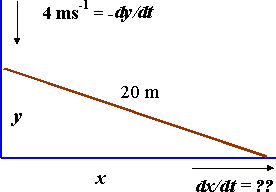
(We regard UP as being the POSITIVE direction.)
Now the relation between x and y is:
x2 + y2 = 202
Differentiating throughout with respect to time (since the value of x and y depends on t):
`d/(dt)x^2+d/(dt)y^2=0`
`2x(dx)/(dt)+2y(dy)/(dt)=0`
Divide throughout by 2:
`x(dx)/(dt)+y(dy)/(dt)=0`
Solving for `dx/dt`:
`(dx)/(dt)=-y/x(dy)/(dt)`
Now, we know
`(dy)/(dt)=-4`
and we need to know the horizontal velocity (`dx/(dt)`) at the point when
`x = 16`.
The only other unknown is y, which we obtain using Pythagoras' Theorem:
`y=sqrt(20^2-16^2)=sqrt(144)=12`
So
`(16)(dx)/(dt)+(12)(-4)=0`
gives
`(dx)/(dt)=3\ "ms"^-1`.
Animation of Example 1
In this animation, you will see:
- The top of the ladder is descending at a constant `v_y = (dy)/dt = -4\ "m/s"`. (This is not very realistic, of course - this would normally accelerate due to gravity.)
- At the point where the bottom of the ladder is `x = 16\ "m"` from the wall (as required in the question), you'll see its position indicated by a grey "static" ladder.
- At that point, observe the horizontal velocity, `v_x = (dx)/dt=3\ "m/s"`, as we found in our solution
Speed:
Copyright © www.intmath.com Frame rate: 0
Example 2
A stone is dropped into a pond, the ripples forming concentric circles which expand. At what rate is the area of one of these circles increasing when the radius is `4\ "m"` and increasing at the rate of 0.5 ms-1?
Answer
The area of a circle with radius `r` is:
`A=pi r^2`
Differentiate w.r.t. time, and then substitute known values:
`(dA)/(dt)=d/(dt)(pir^2)`
`=2pir(dr)/(dt)`
`=2pi(4)(0.5)`
`~~12.56\ "m"^2"s"^-1`
Animation of Example 2
In this animation, you will see:
- The water ripple increasing at a constant `(dr)/dt = 0.5/ "m/s"`.
- At the point where the radius is `r = 4\ "m"` (as required in the question), you'll see it indicated by a grey circle.
- At that point, observe the change in area, `(dA)/dt=12.56\ "m"^2"/s"`, as we found in our solution
Speed:
Copyright © www.intmath.com Frame rate: 0
Example 3
An earth satellite moves in a path that can be described by
`x^2/72.5+y^2/71.5=1`
where x and y are in thousands of kilometres.
If `dx/dt = 12900\ "km/h"` for `x = 3200\ "km"` and `y > 0`, find `dy/dt`.
Answer
Here is the path of the satellite. It is an ellipse, but is very nearly circular.

Elliptical path of the satellite.
We can see from the above that `(dy)/(dt)` should be a negative value (as it is going "down" in this reference frame).
We differentiate the expression with respect to t:
`x^2/72.5+y^2/71.5=1`
`(2x(dx)/(dt))/72.5+(2y(dy)/(dt))/71.5=0`
We need to find y. We do this by substituting `x = 3.2` (because `x` is in 1000s of kilometers) into the original expression:
`3.2^2/72.5+y^2/71.5=1`
Solving this gives:
`(71.5)(3.2)^2+72.5y^2=(71.5)(72.5)`
`732.16+72.5y^2=5183.75`
`y^2=(5183.75-732.16)/(72.5)`
`y^2=61.401`
`y=+-7.836`
The question tells us to take the positive value only. Substituting our known values gives:
`(2(3.2)(12.9))/72.5+(2(7.836)(dy)/dt)/71.5=0`
`(71.5)(2)(3.2)(12.9)+` `(72.5)(2)(7.836)(dy)/(dt)=0`
`(dy)/(dt)=-5.195`
This means the velocity in the y-direction is −5195 km/h (since the units are 1000s of kilometers).Animation of Example 3
In this animation, you will see:
- The satellite orbiting the Earth. The unit "`"Mm"`" (megameter) means `1000\ "km"`.
- Where `x = 3200\ "km"` and `y>0` (as required in the question), you'll see the position of the satellite indicated by a grey dot.
- At that point, observe `dy/dt=-5.2\ "Mm/h"`, as we found in our solution
Speed:
`(dx)/dt = ` `(dy)/dt = `
Copyright © www.intmath.com Frame rate: 0
Example 4
The tuning frequency f of an electronic tuner is inversely proportional to the square root of the capacitance `C` in the circuit.
If f = 920 kHz for C = 3.5 pF, find how fast f is changing at this frequency if `(dC)/(dt) =0.3\ "pF/s"`.
Answer
Now
`f=k/sqrtC`
and substituting our given values, we have that
`920000=k/sqrt(3.5xx10^-12`
and this gives `k = 1.721`.
So
`f=1.721/sqrtC=1.721C^(-1"/"2)`
We need to find `(df)/(dt)`.
`(df)/(dt)=-1.721/2C^(-3"/"2)(dC)/(dt)`
We are told that `C = 3.5\ "pF"` and `(dC)/(dt) =0.3\ "pF/s"`.
So
`(df)/(dt)=-1.721/2(3.5xx10^-12)^(-3"/"2)xx` `(0.3xx10^-12)`
`=-39424.8\ "Hz s"^-1`
So the frequency of the electronic tuner is decreasing at the rate of 39.4 kHz s-1.
Animation of Example 4
In this animation, you will see:
- The value of C (the capacitance) increasing from `1\ "pF"` (picaFarads) to `7\ "pF"` (at a constant rate of `0.3\ "pF/s"`).
- At the point where `C = 3.5\ "pF"` (as required in the question), you'll see the value indicated by a grey dot.
- The changing tuning frequency is represented by the sine curve, whose period increases as the frequency decreases
- The grey sine curve that appears indicates the frequency required in the question: `920\ "kHz"`
- The frequency and change in frequency at time `t`.
- The frequency (when `C = 3.5\ "pF"`) is changing at the rate of `39.4\ "kHz/s"`, as we found in our solution
Speed:
Copyright © www.intmath.com Frame rate: 0