6. More on Curve Sketching Using Differentiation
by M. Bourne
This section deals with curves which are NOT polynomials. They have discontinuities or other unusual behaviour. It is important to understand these types of graphs, since they arise out of real-life situations. Also, we need to be able to interpret error messages or other unexpected behaviour when we are using computers to draw them.
We use all the techniques applied in Section 5 Curve Sketching and also examine the behaviour of the function as
- x → −∞
- x → +∞
- x `→` left side of the discontinuity
- x ` →` right side of the discontinuity
Symmetry
We can use symmetry about the y-axis to help us sketch the curve (it will be a mirror image about the y-axis).
Domain and range
The domain (all possible x-values) and range (all resulting y-values) is important when graphing certain types of questions (e.g. those involving square root).
Our method
Find the following first:
1. x-intercepts
2. y-intercepts
3. Limit as x approaches infinity
4. Domain and Range
5. Maxima and minima
6. Second derivative
7. Behaviour near discontinuity
Example 1
Need Graph Paper?

Sketch `y=x+4/x^2`
Answer
1. x-intercepts
`x+4/x^2=0`
`x^3+4=0`
`x=(-4)^{1//3}~~-1.6`
2. y-intercepts:
We cannot have `x = 0`, so there is NO y-intercept, and there must be an asymptote at `x = 0`.
3. Limits
As x → −∞,
`4/x^2 -> 0` ,
so y → −∞
(In fact, the curve approaches the line y = x on the negative side.)
As x → +∞, y → ∞
(In fact, the curve approaches the line y = x on the positive side.)
4. Domain all real x, except `0`
Range all real y
5. Maxima and minima?
`y=x+4/x^2=x+4x^-2`
`(dy)/(dx)=1-8x^-3`
`=1-8/x^3`
Now
`1-8/x^3=0`
when
` x^3-8=0`
That is, when `x=2`
So we have a max or min at `(2,3)`.
Now, as x → -∞, `dy/dx → 1`,
and as x → ∞, `dy/dx → 1`.
6. Second derivative:
`(d^2y)/(dx^2)=24/x^4>0` for all `x`.
So concave up for all x, except `0`. So `(2,3)` is a MIN.
7. Near discontinuity:
As `x → 0^-`, (which means x approaches `0` from the negative side), y → ∞
[Try `x = -1, -0.5, -0.1, -0.01, -0.001` etc to see this].
As `x → 0^+`, (`0` from the positive side), y → ∞
[Try `x = 1, 0.5, 0.1, 0.01, 0.001` etc to see this].
So we are ready to sketch the curve:
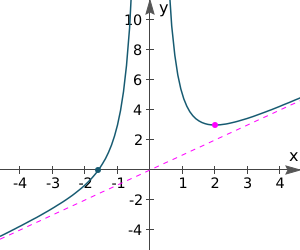
Graph of `y=x+4/x^2`.
The following features are indicated on the graph:
`x`-intercept `(-1.6,0)` (green dot)
Local minimum `(2,3)` (magenta dot)
Asymptote (magenta dashed line)
Example 2
Sketch `y=(9x)/(x^2+9)`
Answer
1. x-intercepts
`(9x)/(x^2+9)=0`
when
`9x=0`
That is, when `x=0`
2. y-intercepts:
When `x = 0`, `y = 0`.
3. Limit as x
approaches infinity:
Dividing top and bottom by `x^2` gives:
`(9x)/(x^2+9) ÷ x^2/x^2 =(9/x)/(1+9/x^2`
As `x → -∞`,
`y=(9x)/(x^2+9)=(9/x)/(1+9/x^2)` `rarr(0)/(1+0) = 0`
Also, as `x → +∞`, `y → 0`
4. Domain: all real x
Range [see later, in the next section].
5. Maxima and minima?
`y=(9x)/(x^2+9)`
`(dy)/(dx)=((x^2+9)(9)-(9x)(2x))/((x^2+9)^2)`
`=(-9x^2+81)/(x^2+9)^2`
`=(-9(x^2-9))/((x^2+9)^2)`
Now,
`(dy)/(dx)=0` when `x=+-3`
So we have a max or min at `(-3, -1.5)` or `(3, 1.5)`.
Some consideration of the expression for `dy/dx` shows that it is
- POSITIVE for `-3 < x < 3` and
- NEGATIVE for `x < -3` and `x > 3`.
We conclude that `(-3, -1.5)` is the MINIMUM and `(3, 1.5)` is the MAXIMUM.
So the Range is `-1.5 ≤ y ≤ 1.5`.
Also, the slope at `x = 0` is
`(dy)/(dx)=[(-9x^2+81)/((x^2+9)^2)]_(x=0)`
`=(0+81)/9^2`
`=1`
6. Second derivative:
In this case, the second derivative may be too cumbersome to calculate quickly, and the benefits are doubtful.
So we are ready to sketch the curve:
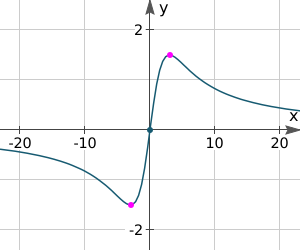
Graph of `y=(9x)/(x^2+9)`.
The following features are indicated on the graph:
`x`-intercept `(0,0)` (green dot)
Local maximum `(3,1.5)` (magenta dot)
Local minimum `(-3,-1.5)` (magenta dot)