3. Curvilinear Motion
by M. Bourne
In the last Chapter (in The Derivative as an Instantaneous Rate of Change), we found out how to find the velocity from the displacement function using:
`v=(ds)/(dt)`
and the acceleration from the velocity function (or displacement function), using:
`a=(dv)/dt=(d^2s)/(dt^2)`
These formulae are only appropriate for rectilinear motion (i.e. velocity and acceleration in a straight line). This is inadequate for most real situations, so we introduce here the concept of curvilinear motion, where an object is moving in a plane along a specified curved path.
We generally express the x and y components of the motion as functions of time. This form is called parametric form. (See another example using parametric form in Lissajous Figures.)
Example 1: Parametric Equations
Need Graph Paper?

Draw the curve
x(t) = sin t,
y(t) = cos t
for t = 0 to 2π in `0.5` intervals.
First, we need to set up a table of values which we obtain by substituting various values of t:
| t | 0 | 0.5 | 1.0 | 1.5 | 2.0 | 2.5 | 3.0 | 3.5 | 4.0 | 4.5 | 5.0 | 5.5 | 6.0 |
| x(t) | 0 | .48 | .84 | 1.0 | .91 | .60 | .14 | −.35 | −.76 | −.98 | −.96 | −.71 | −.28 |
| y(t) | 1 | .88 | .54 | .07 | −.42 | −.80 | −.99 | −.94 | −.65 | −.21 | .28 | .71 | .96 |
Answer
We plot our 13 points, starting at `(0, 1)` as follows (we move clockwise in this example, and I have numbered the points):

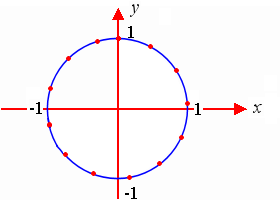
If we were to use a smaller interval for `t,` we would obtain a smooth parametric curve, which in this case is a circle.

We see that we have formed a circle, centre `(0,0)`, radius `1` unit.
Notice that the variable t does not appear in the axes of this graph, just the variables x and y.
of this example, later on this page...
Horizontal and Vertical Components of Velocity
The horizontal component of the velocity is written:
`v_x=(dx)/(dt)`
and the vertical component is written:
`v_y=(dy)/(dt)`
We want to find the magnitude of the resultant velocity v once we know the horizontal and vertical components. We use:
`v=sqrt((v_x)^2+(v_y)^2`
The direction θ that the object is moving in, is found using:
`tan\ theta_v=(v_y)/(v_x`
Example 2
If x = 5t3 and y = 4t2 at time t, find the magnitude and direction of the velocity when t = 10.
Answer
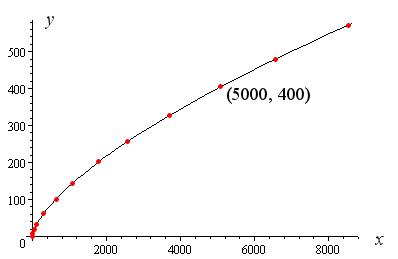
When `t = 10`, the particle is at `(5000, 400)`.
Here is the graph of the motion.
Note:
- The axes are x and y (and do not involve t).
- The particle is accelerating as time goes on (the numbered pink dots are at one second intervals)

We are told that
x = 5t3
So
`dx/dt=15t^2`
At t = 10, the velocity in the x-direction is given by:
`dx/dt = v_x=15(10)^2=1500\ "ms"^-1`
Also, y = 4t2, so the velocity in the y-direction is:
`dy/dt=8t`
When t = 10, the velocity in the y-direction is:
`dy/dt=v_y=8(10)=80\ "ms"^-1`
So the magnitude of the velocity will be:
`v=sqrt((v_x)^2+(v_y)^2)`
`=sqrt(1500^2+80^2)`
`=1502.1\ "ms"^-1`
Now for the direction of the velocity (it is an angle, relative to the positive x-axis):
`tan\ theta_v=v_y/v_x=80/1500`
So `θ_v= 0.053` radians `= 3.05^@`.
of Example 2, later on this page...
Example 3
If
`x=(20t)/(2t+1)`
and
`y=0.1(t^2+t)`
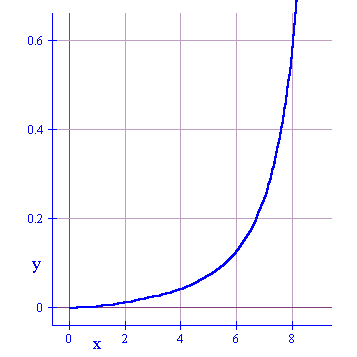
at time t, find the magnitude and direction of the velocity when t = 2. Plot the curve.
Answer
When `t = 2`, the particle is at `(8, 0.6)`.
`x=(20t)/(2t+1)`
so
`(dx)/(dt)=((2t+1)20-20t(2))/(2t+1)^2`
`=20/((2t+1)^2)`
At `t = 2`,
`dx/dt = v_x= 20/25 = 0.8\ "ms"^-1`.
Also, y = 0.1(t2 + t) so
`(dy)/(dt)=0.1(2t+1)`
When `t = 2`,
`dy/dt = v_y= 0.5\ "ms"^-1`.
So
`v=sqrt((v_x)^2+(v_y)^2)`
`=sqrt(0.8^2+0.5^2)`
`=0.943\ text(ms)^-1`

Now for the direction:
`tan\ theta_v=(v_y)/(v_x)=0.5/0.8 = 0.625`
So `θ_v= arctan(0.625) = 0.558` radians
of Example 3, later on this page...
Acceleration of a Body in Curvilinear Motion
The expressions for acceleration are very similar to those for velocity:
Horizontal component of acceleration:
`a_x=(dv_x)/(dt)`
Vertical component of acceleration:
`a_y=(dv_y)/(dt)`
Magnitude of acceleration:
`a=sqrt((a_x)^2+(a_y)^2)`
Direction of acceleration:
`tan\ theta_a=(a_y)/(a_x)`
Example 4
A car on a test track goes into a turn described by x = 20 + 0.2t3, y = 20t − 2t2, where x and y are measured in metres and t in seconds.
(i) Sketch the curve for 0 ≤ t ≤ 8.
(ii) Find the acceleration of the car at `t = 3.0` seconds.
Answer
(i) Sketch: We substitute values of `t` from `0` to `8` into the expressions for `x` and `y` and obtain the following after joining the dots.

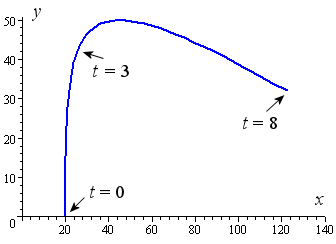
Note the axes are x- and y-based, and do not involve t.
(ii) Acceleration:
Horizontal acceleration:
x = 20 + 0.2t3
`v_x=(dx)/(dt)=0.6t^2`
`a_x=(d^2x)/(dt^2)=1.2t`
At t = 3.0, ax = 3.6
Vertical acceleration:
y = 20t − 2t2
`v_y=(dy)/(dt)=20-4t`
`a_y=(d^2y)/(dt^2)=-4`
At t = 3.0, ay = -4
Now
`a=sqrt((a_x)^2+(a_y)^2)` `=sqrt(3.6^2+(-4)^2)` `=5.38`
and
`theta_a=arctan((a_y)/(a_x))` `=arctan\ ((-4)/3.6)` `=312^"o"` [4th quadrant]
So the car's acceleration has magnitude 5.38 ms-2, and direction `312^@` from the positive x-axis.
of Example 4, later on this page...
What if x and y are NOT given as functions of t?
Example 5
A particle moves along the path y = x2 + 4x + 2 where units are in centimetres. If the horizontal velocity vx is constant at 3 cm s-1, find the magnitude and direction of the velocity of the particle at the point (-1, -1).
Answer
This is a different situation to the other examples. This time we have y in terms of x, and there are no expressions given in terms of "t" at all.
To be able to find magnitude and direction of velocity, we will need to know
`v_x=(dx)/(dt)`
and
`v_y=(dy)/(dt)`
But the question already gives us
`v_x=(dx)/(dt)=3`
so all we need to find is `(dy)/(dt)`.
To find this, we differentiate the given function with respect to t throughout using the techniques we learned back in implicit differentiation:
y = x2 + 4x + 2
`(dy)/(dt)=2x(dx)/(dt)+4(dx)/(dt)+0`
Since
`(dx)/(dt)=3`
and we want to know the velocity at `x = -1`, we substitute these two values and get:
`(dy)/(dt)=2(-1)(3)+4(3)=6`
So now we have vy = 6 cm s-1.
So the magnitude of the velocity is given by:
`v=sqrt((v_x)^2+(v_y)^2)=sqrt(3^2+6^2)` `=6.7082`
The direction of the velocity is given by:
`theta_v=arctan((v_y)/(v_x))=arctan(6/3)` `=63.432^"o"`
So the velocity is 6.7 cm s-1, in the direction `63.4^@`.
of Example 5, later on this page...
Example 6
A rocket follows a path given by (distances in km):
`y=x-x^3/90`
If the horizontal velocity is given by V(x) = x, find the magnitude and direction of the velocity when the rocket hits the ground (assume level terrain) if time is in minutes.
Answer
Let's first see a graph of the motion, to better understand what is going on.

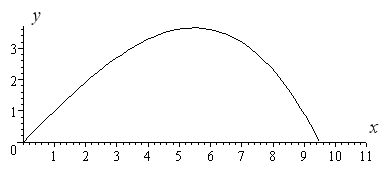
We can see that the rocket hits the ground again somewhere around x = 9.5 km. At this point, the horizontal velocity is positive (the rocket is going left to right) and the vertical velocity is negative (the rocket is going down).
"V(x) = x" means that as x increases, the horizontal velocity also increases with the same number (different units, of course). So for example, at x = 2 km, the horizontal speed is 2 km/min, and at x = 7 km, the horizontal speed is 7 km/min, and so on.
To calculate the magnitude of the velocity when the rocket hits the ground, we need to know the vertical and horizontal components of the velocity at that point.
(1) Horizontal velocity. We just need to solve the following equation to find the exact point the rocket hits the ground:
`x-x^3/90=0`
Factoring gives:
`x-x^3/90=x(1-x^2/90)`
And solving for 0 gives us `x = 0`, `x = -3sqrt(10)`, `x = 3sqrt(10)`
We only need the last value, `x = 3sqrt(10)~~ 9.4868\ "km"` (This value is consistent with the graph above).
So the horizontal speed when the rocket hits the ground is 9.4868 km/min (since V(x) = x).
(2) Vertical velocity. We now need to use implicit differentiation with respect to t (not x!) to find the vertical velocity.
`y=x-x^3/90`
`(dy)/(dt)=(dx)/(dt)-1/30x^2(dx)/(dt)`
But we already know `dx/(dt)` and x at impact, so we simply substitute:
`(dy)/(dt)` `=(9.48683298)-` `1/30(9.48683298)^2(9.48683298)`
This gives us a negative velocity, as we expected before:
`(dy)/(dt)=-18.97366596`
So now we need to find the magnitude of the velocity. This takes into account both the horizontal and vertical components.
`"Magnitude"=sqrt(((dx)/(dt))^2+((dy)/(dt))^2`
Substituting, we have:
`sqrt((9.48683298)^2+(-18.97366596)^2)` `=21.21320344`
Velocity has magnitude and direction. Now for the direction part.
`"angle of motion" = arctan\ (dy"/"dt)/(dx"/"dt)`
Substituting our vertical and horizontal components, we have:
`arctan\ (-18.97366596)/9.48683298` `=-1.107148718`
In degrees, this is equivalent to
`-1.107148718 × 57.25578` ` = -63.3907^@`
We can see that this answer is reasonable by zooming in on the portion of the graph where the rocket hits the ground (with equal-axis scaling):

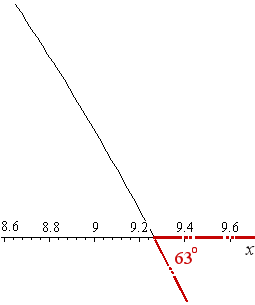
So in summary, the velocity of the rocket when it hits the ground is 21.2 km/min in the direction `63.4^@` from the horizontal.
of Example 6 below.
Curvilinear motion animations
The animations in the applet below allow you to see what that curvilinear motion actually looks like in each of the examples we met above.
3 curves explanation
There are 3 curves shown for each example:
- The t-x graph at the left top shows the x-value at time t. It is rotated 90° so the x-values (originally on the vertical axis) align with the x-y graph below it;
- The t-y graph at the bottom right shows the y-value at time t, and the y-values of this graph align with the y-values of the x-y graph to the left of it;
- The bottom-left x-y graph shows the position of the particle in space at time t.
You will see dots on each of the 3 curves indicating the position of the particle at (approximately) one-second intervals.
There are six curvilinear motion examples to choose from. See below the animations for some explanation of what the graphs involve, and where things came from.
Things to do
- Choose any of the function examples in the pull-down menu, and observe the graphical analysis of the motion in terms of x and y at time t.
- You can also choose to display the velocity vectors for each of the graphs.
- You can slow down or pause the animations to help you see what is going on.
The animations
Choose function: show vectors
Speed:
Copyright © www.intmath.com
Some explanations
The above animations demonstrate what's going on in curvlinear motion.
The examples used in this graph applet were first introduced above. Here we explain some background to the mathematics behind these animations.
In Examples 1 to 4, we are given expressions for x and y in terms of t, and that's what I have graphed.
However, in the last two examples, we are given y in terms of x only, and I needed to calculate the x and y expressions in terms of t in order to draw the graphs and calculate the velocity vectors.
For Example 5, it was a parabola, y = x2+ 4x + 2. We were told `dx/dt=3`, and on integrating this, we have `x=3t+K`. We assume `x=0` at `t=0`, giving us `K=0` and finally,
`x=3t`.
Now for `y` in terms of `t`. We are given y = x2+ 4x + 2, so substituting our expression for `x`, we have:
`y = (3t)^2 +4(3t)+2 = 9t^2+12t+2`.
For Example 6, we are told `dx/dt=x`. Rearranging and integrating this, we have:
`dx/x = dt`
`int dx/x = int dt`
So `ln x = t` plus a constant, which we'll add in the next row.
`x=e^t+K`
We know `x=0` at `t=0`, so `K=-1`. This gives us:
`x(t)=e^t-1`
Now we need the expression for `y` at time `t`. The question says `y=x-x^3/90`, so on substituting, we have:
`y(t) = (e^t-1)-(e^t-1)^3/90`
Let's now move on to 4. Related Rates.