6. Applied Verbal Problems
Mathematics is really about solving problems, not just about moving letters and numbers around.
Most real-world problems are stated using words and we need to translate them into mathematical statements.
You need to:
- Read the problem carefully
- Sketch the situation (a picture is worth a thousand words)
- Estimate the solution where possible
- Assign letters to the unknown quantities
- Form an equation (or equations)
- Solve the equation
- Check your solution against your estimate and against the original statements
- Write a sentence answer (include units)
For this section, you will need to know:
We will see how to solve each problem using two methods:
- one variable
- simultaneous equations
You can decide which method you understand best, but if you can follow the simultaneous equations method, it is probably best for future problems.
Good luck!
Example 1
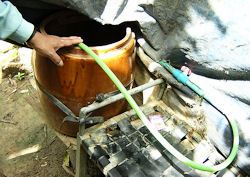
Water is being drained out of a tank through 2 pipes at the rate of 330L/min. We know that one pipe releases 50L/min more than the other. How much do the 2 pipes drain each?
Solution A: Using one variable:
Answer
Rough estimate: The amount coming out of the 2 pipes is about 300 L/min so if each pipe has the same width, then the rate will be about 150 L/min for each pipe. But one pipe's rate is 50 L/min more than the other, so we expect the answers to be around 125 L/min and 175 L/min.
Solution: Let x be the rate of the slower pipe (in L/min).
The rate of the faster pipe will be
`(x + 50)` L/min.
Together they release: x + (x + 50) = 330
So `2x + 50 = 330`
`2x = 280`
`x = 140`
So the drainage rates of the 2 pipes are `140` L/min and `190` L/min.
[This is close to our earlier estimate. Together they give a rate of `330` L/min and they differ by 50 L/min, so we can be confident our answer is correct.]
Solution B: Using 2 variables and simultaneous equations:
Answer
Let A be the rate of the faster pipe and B be the rate of the slower pipe.
We have A − B = 50 and A + B = 330.
Solving these simultaneous equations, we have:
`A - B = 50`
`A + B = 330`
`2A = 380`
So `A = 190`. Since `B` is `50` L/min slower, then `B = 140`.
CHECK:
`190 + 140 = 330`
`190 - 50 = 140.`
So the drainage rate of the faster pipe is `190` L/min and the rate of the slower pipe is `140` L/min.
Example 2
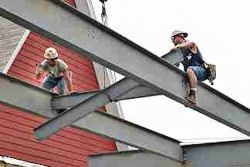
Builders constructing roof beams.
A beam is supported by 2 pillars. The downwards force (due to gravity) is equal to the sum of the 2 upwards forces (due to the 2 pillars). Such a system is said to be in equilibrium.
The downward force is off-center in this example, so it is not acting in the center of the beam.The downwards force is four times the first upward force, and the second of the two upward forces is `6.4\ "N"` more than the first.
What are the 3 forces? (Assume we are taking the positive magnitude of the forces only.)
Vocabulary
Sometimes a question will have some words which you may not know. In this question:
Pillar: A support column.
Equilibrium: Forces are in "equilibrium" if they cancel each other out and there is no movement in the system.
Beam: A beam is normally made of timber, steel or concrete and holds up a roof (or similar).
Solution A: Using one variable:
Answer
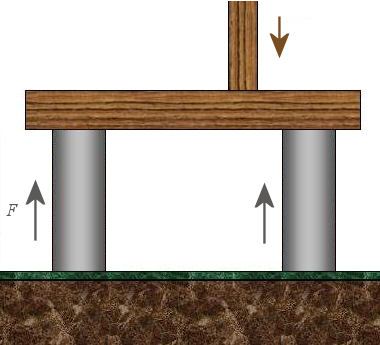
Here is our system. Note the off-center weight acting on the beam.
Rough estimate
We expect the three forces to each be less than 10 N, based on some quick trial and error. If the first upwards force is 2 N, the second will be about 8 N (that's 6 N more) and 2 + 8 = 10. Our downward force is 5 times the first, somewhere near the 4 times that what we need, so it's a pretty good guess.
Solution
Let the first upward force be F, as shown in the diagram.
The statement "the downwards force is four times the first upward force" gives us:
- The downwards force is `4F`, and
The statement "the second of the two upward forces is `6.4\ "N"` more than the first" gives us
- The second upward force is `F+6.4`.
The second sentence in the question tells us that the sum of the 2 upwards forces equals the downwards force. So
`F + (F + 6.4) = 4F`
`2F + 6.4 = 4F`
`6.4 = 2F`
So `F = 3.2`
The second force is `F + 6.4 = 3.2 + 6.4 = 9.6`
The third (downward) force is `4F = 4 xx 3.2 = 12.8`
So the 3 forces are: `3.2` N, `9.6` N and `12.8` N.
This is close to our earlier estimate and all statements in the question are true with these forces.
Solution B: Using 3 variables and simultaneous equations:
Answer
Let the 3 forces be F and G (upwards) and H (downwards).
We are told F + G = H .....(1)
Also, the second force is `6.4` more than the first, `G = F + 6.4` .....(2)
For the third (downwards) force, `H = 4 xx F` .....(3)
If we substitute equations (2) and (3) into (1), we have:
`F + (F + 6.4) = 4F`
`2F + 6.4 = 4F`
`6.4 = 2F`
So `F = 3.2`
This gives `G = 9.6` and `H = 12.8`.
Checking:
(1) `F + G = 3.2 + 9.6 = 12.8 = H` (OK)
(2) `F + 6.4 = 3.2 + 6.4 = 9.6` (OK)
(3) `4F = 4 xx 3.2 = 12.8` (OK)
So the three forces are `3.2` N, `9.6` N and `12.8` N, respectively.
Reader's Question
A bit confused about the above question, Dale wrote:
"How can the the third force and first force be three times the first force? I just don't get it. How can the first force be three times it self when it is equal to its self? It just confused me."
My reply to Dale
Yes, Dale, these problems often seem to have funny English...
Look at the second sentence:
If the second of the two forces is 6.4 N more than the first and the third is four times the first, what are the forces?
To illustrate what this means, let me just take a guess value for the first force.
Force 1: 10 N (this is my guess value)
Force 2: 16.4 N (this is because it says the second force has to be 6.4 N more than the first)
Force 3: 40 N (this is because the third force has to be four times the first).
[Note: My guess of 10 N for the first force is not the right answer, because the first condition fails ("the sum of two forces must equal the third force") since 10 + 16.4 ≠ 40.]
It may have been easier if the question said:
"The second of the two forces is 6.4 N more than the first. The third force is four times the first. What are the forces?"

Vial of liquid.
Source: Helena Liu, Flickr
Example 3
A vial contains 2 g of a drug which is required for two dosages. One of the patients is a small child and the other is a large adult who needs to get 660 mg more of the drug than the child. How much should be administered to each?
(Vocabulary: A vial is a container for storing liquid).
Solution A: Using one variable:
Answer
We need to use consistent units throughout. The 2 g of drug is equivalent ot 2000 mg.
Rough estimate: We expect the dosages to be around 700 mg and 1300 mg, based on similar thinking to Example 1 above.
Let the amount the adult gets be d mg.
The child will get d − 660.
Together, the two dosages must be: d + (d − 660) = 2000
That is 2d − 660 = 2000
2d = 2660
d = 1330
And d − 660 = 1330 − 660 = 670
So the adult gets 1330 mg and the child gets 670 mg.
Solution B: Using 2 variables and simultaneous equations:
Answer
Let the first amount be x and the second y.
We have: `x + y = 2000` and
`x - y = 660`
Adding gives `2x = 2660` so `x = 1330`, then `y = 670`.
Checking: `x + y = 1330 + 670 = 2000` (OK)
`x - y = 1330 - 670 = 660` (OK)
So the amounts of dosage should be `1330` mg for the adult and `670` mg for the child.
Example 4
The manufacturer of a scooter engine recommends a gasoline-oil fuel mixture ratio of 15 to 1. In a particular garage, we can buy pure gasoline and a gasoline-oil mixture, which is 75% gasoline.
How much gasoline and how much of the gasoline-oil mix do we need to make 8.0 L of fuel for the scooter engine?
Solution A: Using one variable:
Answer
In this question, we must consider the percentage of gasoline in each mixture.
Let A be the amount of 100% gasoline required. So the amount of the 75% gasoline-oil mixture will be `8.0 − A`.
The amount of gasoline in the gasoline-oil mixture is
`75% xx (8.0 − A)` ` = 0.75 xx (8.0 − A)` ` = 6.0 − 0.75A`
A ratio of 15:1 means that out of 16 parts, 15 parts must be gasoline. So, the amount of gasoline required in the outboard engine mix is
`(15/16) xx 8 = 7.5`
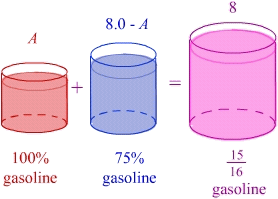
So considering the amount of gasoline in each part, we have
`A + (6.0 − 0.75A) = 7.5`
`0.25A = 1.5`
`A = 6`
Therefore, we need to add `6` L of pure gasoline and `2` L of the 75% gasoline-oil mix to make the correct fuel for the scooter engine.
Solution B: Using 2 variables and simultaneous equations:
Answer
We will let the amount of 100% gasoline be G, the amount of 75% mix be M and the final amount is 8.0 L.
The final mixture is in the ratio 15:1 which means 15/16 is gasoline.
So `G + M = 8` ...(1)
Considering the amount of gasoline in each one,
`100%G + 75%M = 15/16 xx 8`
That is:
`G + 0.75M = 7.5` ...(2)
We subtract equation (2) from equation (1) and get:
`0.25M = 0.5`
and so
`M = 2`.
CHECK: G = 6 (since G + M = 8) and
`6 + 0.75× 2 = 6 + 1.5 = 7.5` OK
So the amount of pure gasoline required is `6` L.
Further examples
Here are some more verbal problems in a later section on fractions (see part b. Word problems):