6. Probability of an Event
Definition of a Probability
On this page...
Suppose an event E can happen in r ways out of a total of n possible equally likely ways.
Then the probability of occurrence of the event (called its success) is denoted by
`P(E)=r/n`
The probability of non-occurrence of the event (called its failure) is denoted by
`P(barE)=(n-r)/n=1-r/n`
Notice the bar above the E, indicating the event does not occur.
Thus,
`P(barE)+P(E)=1`
In words, this means that the sum of the probabilities in any experiment is `1`.
Definition of Probability using Sample Spaces
When an experiment is performed, we set up a sample space of all possible outcomes.
In a sample of N equally likely outcomes we assign a chance (or weight) of `1/N` to each outcome.
We define the probability of an event for such a sample as follows:
The probability of an event E is defined as the number of outcomes favourable to E divided by the total number of equally likely outcomes in the sample space S of the experiment.
That is:
`P(E)=(n(E))/(n(S)`
where
-
`n(E)` is the number of outcomes favourable to E and
-
`n(S)` is the total number of equally likely outcomes in the sample space S of the experiment.
Properties of Probability
(a) 0 ≤ P(event) ≤ 1
In words, this means that the probability of an event must be a number between `0` and `1` (inclusive).
(b) P(impossible event) = 0
In words: The probability of an impossible event is `0`.
(c) P(certain event) = 1
In words: The probability of an absolutely certain event is `1`.
Example 1
What is the probability of...
(a) Getting an ace if I choose a card at random from a standard pack of `52` playing cards.
Answer
In a standard pack of 52 playing cards, we have:
♦ 2 3 4 5 6 7 8 9 10 J Q K A
♣ 2 3 4 5 6 7 8 9 10 J Q K A
♠ 2 3 4 5 6 7 8 9 10 J Q K A
There are 4 aces in a normal pack. So the probability of getting an ace is:
`P("ace")=4/52 = 1/13`
(b) Getting a `5` if I roll a die.
Answer
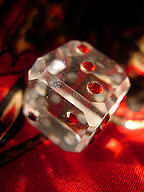
Image source
A die has 6 numbers.
There is only one 5 on a die, so the probability of getting a 5 is given by:
`P(5)=1/6`
(c) Getting an even number if I roll a die.
Answer
Even numbers are `2, 4, 6`. So
`P("even")=3/6=1/2`
(d) Having one Tuesday in this week?
Answer
Each week has a Tuesday, so probability = `1`.
Example 2
There are `15` balls numbered `1` to `15`, in a bag. If a person selects one at random, what is the probability that the number printed on the ball will be a prime number greater than `5`?
Answer
The primes between `5` and `15` are: `7, 11, 13`.
So the probability `=3/15=1/5`
Example 3
The names of four directors of a company will be placed in a hat and a 2-member delegation will be selected at random to represent the company at an international meeting. Let A, B, C and D denote the directors of the company. What is the probability that
(a) A is selected? (b) A or B is selected? (c) A is not selected?
Answer
The possible outcomes are: AB, AC, AD, BC, BD, CD.
[There are a few explanations for each answer - hopefully at least one of them makes sense!]
Part (a)
Explanation 1: The probability is `3/6=1/2` since when we choose A, we must choose one of the remaining 3 directors to go with A. There are `C_2^4=6` possible combinations.
Explanation 2: Probability that A is selected is `{C_1^1 times C_1^3}/{C_2^4} = 3/6 = 1/2`
[Choose A (`C_1^1`), and then choose one from the 3 remaining directors (`C_1^3`), divided by the number of possible outcomes: `C_2^4`.]
Part (b)
Explanation 1: The probability of getting A or B first is `2/4=1/2`.
Now to consider the probability of selecting A or B as the second director. In this case, the first director has to be C or D with probability `2/4` (2 particular directors out of 4 possible).
Then the probability of the second being A or B is `2/3` (2 particular directors out of the remaining 3 directors).
We need to multiply the two probabilities.
So the probability of getting A or B for the second director is `2/4 xx 2/3 = 1/3`
The total is: `1/2 + 1/3 = 5/6`
Explanation 2: Probability that A or B is selected is
`frac{C_1^1 times C_1^3 + C_1^1 times C_1^2}{C_2^4}` `=frac{3+2}{6}` `=5/6`
[Choose A as above, then choose B from the remaining 2 directors in a similar way.]
Explanation 3: If A or B is chosen, then we cannot have the case C and D is chosen. So the probability of A or B is given by:
`P("A or B") = 1-P("C and D")` `=1-1/6` `=5/6`
Part (c)
Probability that A is not selected is `1-1/2=1/2`
Extension
Consider the case if we are choosing 2 directors from 5. The probabilities would now be:
(a) Probability that A is selected is
`frac{C_1^1 times C_1^4}{C_2^5}=4/10=2/5`
[Choose A (`C_1^1`), and then choose one from the 3 remaining directors (`C_1^4`), divided by the number of possible outcomes: `C_2^5`.]
(b) Probability that A or B is selected is
`frac{C_1^1 times C_1^4 + C_1^1 times C_1^3}{C_2^5}` `=frac{4+3}{10}` `=7/10`
[Choose A as above and then choose B from the remaining 3].
(c) Probability that A is not selected is `1-2/5=3/5`.
Coming next...
♦ 2 3 4 5 6 7 8 9 10 J Q K A
♣ 2 3 4 5 6 7 8 9 10 J Q K A
♠ 2 3 4 5 6 7 8 9 10 J Q K A
The next 2 sections give more examples of probability: