5. Curve Sketching using Differentiation
by M. Bourne
NOTES:
- There are now many tools for sketching functions (Mathcad, Scientific Notebook, graphics calculators, etc). It is important in this section to learn the basic shapes of each curve that you meet. An understanding of the nature of each function is important for your future learning. Most mathematical modelling starts with a sketch.
Need Graph Paper?

- You need to be able to sketch the curve, showing important features. Avoid drawing x-y boxes and just joining the dots.
- We will be using calculus to help find important points on the curve.
The kinds of things we will be searching for in this section are:
| x-intercepts | Use y = 0 NOTE: In many cases, finding x-intercepts is not so easy. If so, delete this step. |
| y-intercepts | Use x = 0 |
| local maxima | Use `(dy)/(dx)=0`, sign of first derivative changes `+ → −` |
| local minima | Use `(dy)/(dx)=0`, sign of first derivative changes ` − → +` |
| points of inflection | Use `(d^2 y)/(dx^2)=0`, and sign of `(d^2 y)/(dx^2)` changes |
Finding Maxima and Minima
Local maximum
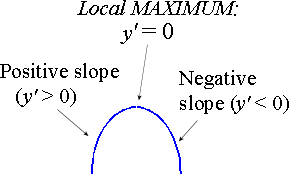
A local maximum occurs when `y' = 0` and `y'` changes sign from positive to negative (as we go left to right).
Local minimum
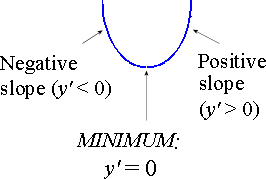
A local minimum occurs when y' = 0 and y' changes sign from negative to positive.
The Second Derivative
The second derivative can tell us the shape of a curve at any point.
Positive Second Derivative: Concave up
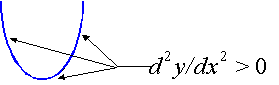
If `(d^2y)/(dx^2) > 0`, the curve will have a minimum-type shape (called concave up)
Example 1
The curve y = x2 + 3x − 2 has `(dy)/(dx)=2x+3`.
Now `(d^2y)/(dx^2)=2` and of course, this is `> 0` for all values of x.
So it has a concave up shape for all x.
Negative Second Derivative: Concave down
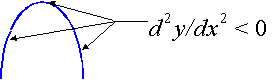
If `(d^2y)/(dx^2) < 0`, the curve will have a maximum-type shape (called concave down)
Example 2
The curve y = x3 − 2x + 5 has `(dy)/(dx)=3x^2-2`. The second derivative is `(d^2y)/(dx^2)=6x` and this is `< 0` for all values of `x < 0`.
So the curve has a concave down shape for all `x < 0` (and it is concave up if `x > 0`).
Finding Points of Inflection
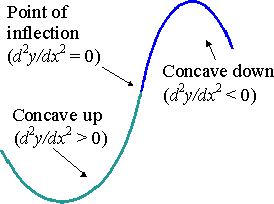
A point of inflection is a point where the shape of the curve changes from a maximum-type shape `(d^2y)/(dx^2) < 0` to a minimum-type shape `(d^2y)/(dx^2) > 0`.
Clearly, the point of inflection will occur when
`(d^2y)/(dx^2) = 0` and when there is a change in sign
(from plus ` →` minus or minus ` →` plus) of `(d^2y)/(dx^2)`.
Example 3
Sketch the following curve by finding intercepts, maxima and minima and points of inflection:
`y=x^3-9x`
Answer
The basic shape of a cubic when the coefficient (number before) `x^3` is:

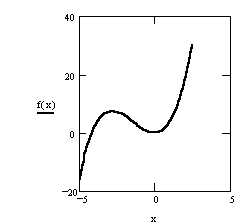
Keeping this in mind helps with the sketching process.
1. x-intercepts:
`y=x^3-9x`
`=x(x^2-9)`
`=x(x+3)(x-3)`
Now `y=0` when
x = 0, `x = -3` and `x = 3`
2. y-intercepts:
When x = 0, y = 0.
3. maxima and minima?
`dy/dx=3x^2-9`
`=3(x^2-3)`
`=3(x+sqrt(3))(x-sqrt(3))`
`=0`
when
`x=-sqrt(3)` or `x=sqrt(3)`
So we have max or min at approximately `(-1.7,10.4)` and `(1.7,-10.4)`.
[We could check which is which by trying some points near `-1.7` and `+1.7` to determine what the sign changes are. But we need to find the second derivative anyway for points of inflection, so we use that to determine max or min.]
4. Second derivative:
`(d^2y)/(dx^2)=6x`
If `x = -1.7`, `y'' < 0`, so MAX at `(-1.7,10.4)`
If `x = +1.7`, `y'' > 0`, so MIN at `(1.7,-10.4)`
5. Point of inflection:
`(d^2y)/(dx^2)=6x`
Now
`(d^2y)/(dx^2)=0` when x = 0
and
`(d^2y)/(dx^2)`
changes sign from negative (concave down) to positive (concave up) as x passes through `0`.
So we are ready to sketch the curve:
Graph of `y=x^3-9x`.
The following points are indicated with dots:
Local maximum (-1.7,10.4)
Point of inflection (0,0)
Local minimum (1.7,-10.4)
General Shapes
If we learn the general shapes of these curves, sketching becomes much easier. Of course, the following are "ideal" shapes, and there are many other possibilities. But at least this helps get us started.
Maximums and minimums are shown with a dot, while points of inflection have a "plus" symbol.
Quadratic
Highest power of x: 2

Typical quadratic shape (parabola). Curve is concave up for all `x`.
1 minimum, no maximum
[if it has a positive x2 term]
No points of inflection
Cubic
Highest power of x: 3

Typical cubic shape showing concave down to concave up.
1 minimum, 1 maximum
1 point of inflection
Quartic
Highest power of x: 4

Typical quartic shape showing local maxima and minima.
2 minimums, 1 maximum
[if it has a positive x4 term]
2 points of inflection
Pentic
Highest power of x: 5

Typical pentic shape showing local maxima and minima.
2 minimums, 2 maximums
3 points of inflection
Example 4
Sketch the curve and show intercepts, maxima and minima and points of inflection:
`y=x^4-6x^2`
Answer
1. x-intercepts
`y=x^4-6x^2 `
`=x^2(x^2-6)`
`=x^2(x+sqrt6)(x-sqrt6)`
`=0`
when
x = 0, `x=-sqrt(6)` and `x=sqrt(6)`
2. y-intercepts:
When x = 0, y = 0.
3. maxima and minima?
`(dy)/(dx)=4x^3-12x `
`=4x(x^2-3) `
`=4x(x+sqrt3)(x-sqrt3)`
`=0`
Now `(dy)/(dx)=0` when x = 0 or `x=-sqrt(3)` and `x=sqrt(3)`
So we have max or min at (0, 0) and `(-sqrt(3),-9)` and `(sqrt(3),-9)`.
4. Second derivative:
`(d^2y)/(dx^2)=12x^2-12`
Now `y'' > 0` for `x = -sqrt3` so `(-sqrt3, -9)` is a local MIN
Now `y'' < 0` for x = 0 so `(0, 0)` is a local MAX
Now `y'' > 0` for `x = sqrt3` so `(sqrt3, -9)` is a local MIN
5. Points of inflection:
We now use the second derivative to find points of inflection:
`(d^2y)/(dx^2)=12x^2-12`
`=12(x+1)(x-1)`
`=0`
when `x = -1` or `x = 1`
If `x < -1`, `y'' > 0`, and for `-1 < x < 1`, we have `y'' < 0`.
The sign of `y''` has changed, so `(-1, -5)` is a point of inflection.
If `x > 1`, `y'' > 0`,
The sign of `y''` has changed, so `(1, -5)` is a point of inflection.
So we are ready to sketch the curve:

Graph of `y=x^4-6x^2`.
The following points are indicated with dots:
`x`-intercepts `(-sqrt(6),0)` and `(sqrt(6),0)` (green dots)
Local maximum, `x`-intercept and `y`-intercept (0, 0) (green dot)
Points of inflection `(-1,-5)` and `(1,-5)` ("plus" signs)
Local minima `(-sqrt(3),-9)` and `(sqrt(3),-9)` (magenta dots)
Example 5
Sketch the curve and show intercepts, maxima and minima and points of inflection:
`y=x^5-5x^4`
Answer
NOTE: This question is fairly sophisticated and is here to show you some of the complications that can occur. If you don't fully understand it now, don't worry!
1. x-intercepts
`y=x^5-5x^4`
`=x^4(x-5)`
`=0`
when x = 0, x = 5
2. y-intercepts:
When x = 0, y = 0.
3. maxima and minima?
`(dy)/(dx)=5x^4-20x^3`
`=5x^3(x-4)`
`=0`
when x = 0 or x = 4
So we have max or min at (0, 0) and `(4,-256)`.
4. Second derivative:
`(d^2y)/(dx^2)=20x^3-60x^2`
Now when x = 0, `y'' = 0`, which is neither positive nor negative, so we can't conclude whether (0, 0) is is a local maximum or a local minimum using the second derivative test. However, since the first derivative changes from negative to positive as we take values on the left of 0 and then on the right of 0, we can conclude (0, 0) is a local MAX.
Now `y'' > 0` for x = 4 so `(4,-256)` is a local MIN
5. Points of inflection
We now use the second derivative to find points of inflection:
`(d^2y)/(dx^2)=20x^3-60x^2`
`=20x^2(x-3)`
`=0`
when x = 0 or `x = 3`
If `x < 0`, `y'' < 0`, so we have a concave down shape:

If `0 < x < 3`, `y'' < 0`, which also gives us a concave down shape:

There is no sign change, so at x = 0, there is NO point of inflection.
If `x > 3`, `y'' > 0`, sp we have a concave up shape:

So the sign of `y''` has changed, so `(3,-162)` is a point of inflection.
Actually, at x = 0, we have an interesting case where the second derivative is momentarily `0`, but is positive either side of `0`. It is a local maximum, even thoough the second derivative is not positive, which is usually the case.
So we are ready to sketch the curve:

Graph of `y=x^5-5x^4`.
The following points are indicated with dots:
`x`-intercepts (0, 0), and `(5,0)` (green dots)
Point of inflection `(3,-162)` ("plus" sign)
Local maximumm (0, 0) (green dot)
Local minimum `(4,-256)` (magenta dot)