4. The Binomial Theorem
by M. Bourne
On this page...
Definition: binomial
A binomial is an algebraic expression containing 2 terms. For example, (x + y) is a binomial.
We sometimes need to expand binomials as follows:
(a + b)0 = 1
(a + b)1 = a + b
(a + b)2 = a2 + 2ab + b2
(a + b)3 = a3 + 3a2b + 3ab2 + b3
(a + b)4 = a4 + 4a3b + 6a2b2 + 4ab3 + b4
(a + b)5 = a5 + 5a4b + 10a3b2 + 10a2b3 + 5ab4 + b5
Clearly, doing this by direct multiplication gets quite tedious and can be rather difficult for larger powers or more complicated expressions.
Pascal's Triangle
We note that the coefficients (the numbers in front of each term) follow a pattern. [This was noticed long before Pascal, by the Chinese.]
1
1 1
1 2 1
1 3 3 1
1 4 6 4 1
1 5 10 10 5 1
1 6 15 20 15 6 1
You can use this pattern to form the coefficients, rather than multiply everything out as we did above.
The Binomial Theorem
We use the binomial theorem to help us expand binomials to any given power without direct multiplication. As we have seen, multiplication can be time-consuming or even not possible in some cases.
Let's consider the properties of a binomial expansion first.
a. Properties of the Binomial Expansion (a + b)n
- There are `n + 1` terms.
- The first term is an and the final term is bn.
- Progressing from the first term to the last, the exponent of a decreases by `1` from term to term while the exponent of b increases by `1`. In addition, the sum of the exponents of a and b in each term is n.
- If the coefficient of each term is multiplied by the exponent of a in that term, and the product is divided by the number of that term, we obtain the coefficient of the next term.
b. General formula for (a + b)n
First, we need the following definition:
Definition: n! represents the product of the first n positive integers i.e.
n! = n(n − 1)(n − 2) ... (3)(2)(1)
We say n! as "n factorial".
Example 1 - factorial values
Here are some factorial values:
(a) `3! = (3)(2)(1) = 6`
(b) `5! = (5)(4)(3)(2)(1) = 120`
(c) `(4!)/(2!)=((4)(3)(2)(1))/((2)(1))=12`
Note: `(4!)/(2!)` cannot be cancelled down to `2!`.
c. Factorial Interactive
Instructions: You can use the following interactive to find the factorial of any positive integer up to 30.
! =
For numbers greater than `22!` (and less than `31!`), you'll see output something like this: `2.652528e+32`. The "`e`" stands for exponential (base `10` in this case), and the number has value `2.652528 xx 10^32`.
d. Binomial Theorem Formula
Based on the binomial properties, the binomial theorem states that the following binomial formula is valid for all positive integer values of n:
`(a+b)^n=` `a^n+na^(n-1)b` `+(n(n-1))/(2!)a^(n-2)b^2` `+(n(n-1)(n-2))/(3!)a^(n-3)b^3` `+...+b^n`
This can be written more simply as:
(a + b)n = nC0an + nC1an−1b + nC2an−2b2 + nC3an−3b3 + ... + nCnbn
We can use the `{::}^nC_r` button on our calculator to find these values.
This can also be written nCr.
e. Binomial Expansion Interactive
The following interactive lets you expand your own binomial expressions. It shows all the expansions from `n=0` up to the power you have chosen.
In the first line of each expansion, you'll see the numbers from Pascal's Triangle written within square brackets, [ ].
The second line of each expansion is the result after tidying up.
Instructions: You can use letters or numbers within the brackets. The maximum power you can use is 6.
Example 2
Using the binomial theorem, expand (x + 2)6.
Answer
In using the binomial formula, we let
`a=x,` `b=2,` and `n=6`.
Substituting in the binomial formula, we get :
`(x+2)^6`
`=(x)^6 +6(x)^5(2)` `+(6(5))/(2!) (x)^4(2)^2` `+(6(5)(4))/(3!)(x)^3(2)^3` `+(6(5)(4)(3))/(4!) (x)^2(2)^4 ` `+(6(5)(4)(3)(2))/(5!) (x)(2)^5+(2)^6`
`=x^6+12x^5` `+60x^4+160x^3+240x^2` `+192x+64`
Example 3
Using the binomial theorem, expand (2x + 3)4
Answer
In using the binomial formula, we let
`a = 2x,` `b = 3` and `n = 4.`
Substituting in the binomial formula, we get:
`(2x+3)^4`
`=(2x)^4+4(2x)^3(3)` `+(4(3))/(2!)(2x)^2(3)^2` `+(4(3)(2))/(3!)(2x)(3)^3+(3)^4`
`=16x^4+96x^3+216x^2+216x+81`
Example 4
Using the binomial theorem, find the first four terms of the expansion `(2a-1/x)^11`
Answer
In using the binomial formula, we let
`text(")atext(")=2a,` `b=-1/x` and `n=11`.
Substituting in the binomial formula, we get:
`(2a-1/x)^11`
`=(2a)^11+11(2a)^10(-1/x)` `+(11(10))/(2!)(2a)^9(-1/x)^2` `+(11(10)(9))/(3!)(2a)^8(-1/x)^3+...`
`=2048a^11-11264(a^10)/x` `+28160(a^9)/(x^2)-42240(a^8)/(x^3)+...`
Binomial Series
From the binomial formula, if we let a = 1 and b = x, we can also obtain the binomial series which is valid for any real number n if |x| < 1.
(1 + x)n = 1 + nx + `(n(n-1))/(2!)x^2` `+(n(n-1)(n-2))/(3!)x^3``+...`
NOTE (1): This is an infinite series, where the binomial theorem deals with a finite expansion.
NOTE (2): We cannot use the `{::}^nC_r` button for the binomial series. The `{::}^nC_r` button can only be used with positive integers.
Don't miss...
The Binomial series graph interactive on the next page illustrates this concept:
Example 5
(a) Using the binomial series, find the first four terms of the expansion `root3(1+x)`.
(b) Use your result from part (a) to approximate the value of `root3(1.2)`.
Answer
(a) We know `root3(1+x) = (1+x)^(1//3)`.
Substituting `n=1/3` into the binomial series, we get:
`(1+x)^(1/3)`
`~~ 1+1/3 x` `+((1/3)(1/3-1))/2 x^2` `+ ((1/3)(1/3-1)(1/3-2))/6 x^3+...`
`= 1+x/3-(x^2)/9+(5x^3)/81-...`
(b) We now use the above expression to approximate `root3(1.2)`.
Substituting `x=0.2` into our expansion for `root3(1+x)`, we have:
`root3(1.2)` `~~ 1+(0.2)/3` `-((0.2)^2)/9` `+(5((0.2)^3))/81-...` `=1.06271604938`
Is it correct?
The calculator value for `root3(1.2)` is `1.06265856918`, so our approximation using binomial series is accurate to the 4th decimal place. Taking more terms of the series would give us a more accurate result.
Here is the graph of what we just did in the answer for Example 5. The darker colored curve is
`y_1=root3(1+x)`
The lighter colored one is the first 4 terms of the series we found, that is:
`y_2=1+x/3-(x^2)/9+(5x^3)/81`.
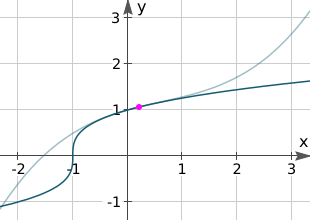
Binomial series approximation for `y=root3(1+x)`
The approximation is quite good between −0.5 < x < 1, but we would need to take many more terms for a good approximation beyond these bounds.
The pink dot on the curve is the point `(0.2, 1.0627)`, representing the value we obtained for `root3(1.2)`.
Explore this example (and Example 6) in Binomial Series Interactive Applet.
Example 6
(a) Using the binomial series, find the first four terms of the expansion `sqrt(4+x^2)`.
(b) Use your result from part (a) to approximate the value of `sqrt(4.25)`.
Answer
(a) To use the binomial series, we need to change the expansion to the form of (1 + u)n.
So we perform the following steps to get it in the required form.
`sqrt(4+x^2)`
`=(4+x^2)^(1/2)`
`=[4(1+x^2/4)]^(1/2)`
`=4^(1/2)(1+x^2/4)^(1/2)`
`=2(1+x^2/4)^(1/2)`
Hence, if we let the "u" term be `x^2/4` and `n=1/2`, and then substituting in the binomial series,
(1 + u)n = 1 + nu + `(n(n-1))/(2!)u^2` `+(n(n-1)(n-2))/(3!)u^3` `+...`
we get:
`2(1+(x^2)/4)^(1/2)`
`~~2[1+(1/2)((x^2)/4)` `+\ ((1/2)(1/2-1))/(2!)((x^2)/4)^2` `+\ ((1/2)(1/2-1)(1/2-2))/(3!)((x^2)/4)^3` `{:+...]`
`=2+x^2/4-x^4/64+x^6/512+...`
(b) We now use the above expression to approximate `sqrt(4.25)`.
If we use `x=0.5`, then `x^2=0.25` and we'll have `4+x^2 = 4.25`.
Substituting `x=0.5` into our expansion for `sqrt(4+x^2)`, we have:
`sqrt(4.25)` `~~2+(0.5)^2/4-(0.5)^4/64+(0.5)^6/512` `~~2.06155395508`
Is it correct?
The calculator value for `sqrt(4.25)` is `2.06155281281`, so we've achieved 5 decimal place accuracy using our binomial series. We'd get a better answer if we were to take more than 4 terms.
Here is the graph of what we just did in the answer for Example 6. The darker colored curve is
`y_1=sqrt(4+x^2)`
The lighter colored curve is the first 4 terms of the series we found, that is:
`y_2=2+x^2/4-x^4/64+x^6/512`.
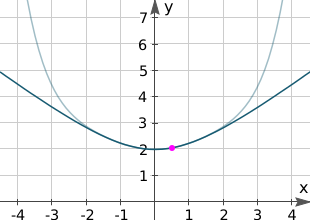
Binomial series approximation for `y=sqrt(4+x^2)`
The approximation is quite good between −2 < x < 2, but we would need to take many more terms for a good approximation beyond these bounds.
The pink dot on the curve is the point `(0.5, 2.06155)`, representing the value we obtained for `sqrt(4.25)`.
Explore this example (and Example 5) on the next page, Binomial Series Interactive Applet.