1. Definitions: Exponential and Logarithmic Functions
by M. Bourne
Exponential Functions
Exponential functions have the form:
`f(x) = b^x`
where b is the base and x is the exponent (or power).
If b is greater than `1`, the function continuously increases in value as x increases. A special property of exponential functions is that the slope of the function also continuously increases as x increases.

It is common to write exponential functions using the carat (^), which means "raised to the power". Computer programing uses the ^ sign, as do some calculators.
Other calculators have a button labeled xy which is equivalent to the ^ symbol.
Example of an Exponential Function
Consider the function `f(x) = 2^x`.
In this case, we have an exponential function with base `2`. Some typical values for this function would be:
| x | `-2` | `-1` | `0` | `1` | `2` | `3` |
|---|---|---|---|---|---|---|
| f(x) | `1/4` | `1/2` | `1` | `2` | `4` | `8` |
Here is the graph of `y = 2^x`.
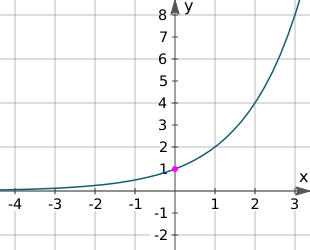
Graph of `y=2^x`.
Notice:
- As x increases, y also increases.
- As x increases, the slope of the graph also increases.
- The curve passes through `(0, 1)`. All exponential curves of the form f(x) = bx pass through `(0, 1)`, if `b > 0`.
- The curve does not pass through the x-axis. It just gets closer and closer to the x-axis as we take smaller and smaller x-values.
Logarithmic Functions
A logarithm is simply an exponent that is written in a special way.
For example, we know that the following exponential equation is true:
`3^2= 9`
In this case, the base is `3` and the exponent is `2`. We can write this equation in logarithm form (with identical meaning) as follows:
`log_3 9 = 2`
We say this as "the logarithm of `9` to the base `3` is `2`". What we have effectively done is to move the exponent down on to the main line. This was done historically to make multiplications and divisions easier, but logarithms are still very handy in mathematics.
The logarithmic function is defined as:
`f(x) =log_b x`
The base of the logarithm is b.
The 2 most common bases that we use are base `10` and base e, which we meet in Logs to base 10 and Natural Logs (base e) in later sections.
The logarithmic function has many real-life applications, in acoustics, electronics, earthquake analysis and population prediction.
Example 1
Write in logarithm form: `8 = 2^3`
Answer
`log_2 8 = 3`
This just follows from the definition of a logarithm.
Example 2
Write in exponential form: `log_10 1000 = 3`
Answer
`1000 = 10^3`
Once again, this just follows from the definition of a logarithm.
Example 3
Find b if
`-4=log_b(1/81)`
Answer
`1/81=b^-4`
`81=b^4`
`b=root(4)81=3`
The first line follows from the logarithm definition. The second line uses negative exponents.
Then we find the 4th root of both sides.
Exercises
1. Evaluate `y = 9^x` if `x = 0.5`
Answer
`y = 9^0.5`
`y = 3`
This is just a fractional index.
2. Express `8^2= 64` in logarithmic form.
Answer
`log_8 64 = 2`
3. Express `log_11 121 = 2` in exponential form.
Answer
`11^2 = 121`
4. Determine the unknown: log10 0.01 = x
Answer
Writing this in exponential form, we have: `10^x = 0.01`. Solving this gives:
`x = -2`
5. Determine the unknown, b:
`log_b(1/4) = -1/2`
Answer
Using the log laws, we can write this as:
`b^(-1/2)=1/4`
And using the rule for negative exponents gives:
`b^(1/2)=4`
Squaring both sides gives: `b = 16`.
Checking our answer, we have:
`16^(-1"/"2)=1/(16^(1"/"2))=1/sqrt16=1/4`And as a logarithm, this can be written as:
`log_16(1/4) = −1/2`