2. The Remainder Theorem and the Factor Theorem
This section discusses the historical method of solving higher degree polynomial equations.
As we discussed in the previous section Polynomial Functions and Equations, a polynomial function is of the form:
f(x) = a0xn + a1xn−1 + a2xn−2 + ... + an
where
a0 ≠ 0 and
n is a positive integer, called the degree of the polynomial.
Example 1
f(x) = 7x5 + 4x3 − 2x2 − 8x + 1 is a polynomial function of degree 5.
Dividing Polynomials
First, let's consider what happens when we divide numbers.
Example (a): Say we try to divide `13` by `5`. We will get the answer `2` and have a remainder of `3`. We could write this as:
`13/5 = 2 + 3/5`
Another way of thinking about this example is:
`13 = 2 × 5 + 3`
Example (b), Long Division: In primary school, you may have learned to divide larger numbers as follows. Let's divide `3,756` by `23`.
| `163` | |||
| `23` | `{:)` | `3756` | |
| `23` | We multiply `23` by `1 = 23`. | ||
| `145` | `37-23 = 14`. Then bring down the `5`. | ||
| `138` | Multiply `23` by `6=138`. | ||
| `76` | `145-138=7`. Bring down the `6`. | ||
| `69` | Multiply `23` by `3=69`. | ||
| `7` | `76-69=7`. This is the remainder. |
So we can conclude `3,756 -: 23 = 163 + 7/23`, or putting it another way, `3,756 = 163xx23 + 7`.
Division of polynomials is an extension of our number examples.
If we divide a polynomial by (x − r), we obtain a result of the form:
f(x) = (x − r) q(x) + R
where q(x) is the quotient and R is the remainder.
Let's now see an example of polynomial division.
Example 2
Divide f(x) = 3x2 + 5x − 8 by (x − 2).
Answer
| `3x+11` | |||
| `x-2` | `{:)` | `3x^2+5x-8` | |
| `3x^2-6x` | We multiply `(x-2)` by `3x =` ` 3x^2-6x`, giving `3x^2` as the first term. | ||
| `11x-8` | `5x-(-6x)` ` = 5x+6x` `=11x`. Then bring down the `-8`. | ||
| `11x-22` | Multiply `(x-2)` by `11=` `11x-22`. | ||
| `14` | `-8-(-22) ` `= 14`. This is the remainder. |
Thus, we can conclude that:
3x2 + 5x − 8 = (x − 2)(3x + 11) + 14
where the quotient `q(x) = 3x + 11` and the remainder `R = 14`.
We can also write our answer as:
`(3x^2+5x-8)-:(x-2)` `=(3x+11)+14/(x-2`
The Remainder Theorem
Consider f(x) = (x − r)q(x) + R
Note that if we let x = r, the expression becomes
f(r) = (r − r) q(r) + R
Simplifying gives:
f(r) = R
This leads us to the Remainder Theorem which states:
If a polynomial f(x) is divided by (x − r) and a remainder R is obtained, then f(r) = R.
Example 3
Use the remainder theorem to find the remainder for Example 1 above, which was divide f(x) = 3x2 + 5x − 8 by (x − 2).
Answer
Since we are dividing f(x) = 3x2 + 5x − 8 by (x − 2), we let
`x = 2`.
Hence, the remainder, R is given by:
`R=f(2)=3(2)^2+5(2)-8=14`
This is the same remainder we achieved before.
Example 4
By using the remainder theorem, determine the remainder when
3x3 − x2 − 20x + 5
is divided by (x + 4).
Answer
If we divide by `(x − r)`, we let `x = r`.
Hence, since we are dividing by `(x + 4)`, we let `x = -4`.
Therefore the remainder
`R=f(-4)`
`=3(-4)^3-(-4)^2` `-20(-4)+5`
`=-192-16+80+5`
`=-123`
The Factor Theorem
The Factor Theorem states:
If the remainder f(r) = R = 0, then (x − r) is a factor of f(x).
The Factor Theorem is powerful because it can be used to find roots of polynomial equations.
Example 5
Is (x + 1) a factor of f(x) = x3 + 2x2 − 5x − 6?
Answer
In this case we need to test the remainder `r = -1`.
`R= f(r)`
`= f(-1) `
`= (-1)^3+ 2(-1)^2- 5(-1) - 6`
`= -1 + 2 + 5 - 6`
`= 0`
Therefore, since `f(-1) = 0`, we conclude that `(x + 1)` is a factor of `f(x)`.
Exercises
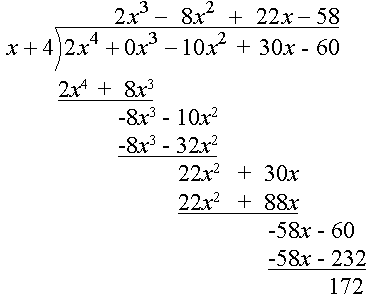
1. Find the remainder R by long division and by the Remainder Theorem.
(2x4 − 10x2 + 30x - 60) ÷ (x + 4)
Answer
| `2x^3-8x^2+22x-58` | ||
| `x+4` | `{:)` | `2x^4+0x^3-10x^2+30x-60` |
| `2x^4+8x^3` | ||
| `-8x^3-10x^2` | ||
| `-8x^3-32x^2` | ||
| `22x^2+30x` | ||
| `22x^2+88x` | ||
| `-58x-60` | ||
| `-58x-232` | ||
| `172` |
From the above working, we conclude the remainder is `172`.
Now, using the Remainder Theorem:
f(x) = 2x4 − 10x2 + 30x − 60
Remainder = f(−4) = 2(-4)4 − 10(−4)2 + 30(−4) − 60 = 172
This is the same answer we achieved by long division.
2. Find the remainder using the Remainder Theorem
(x4 − 5x3 + x2 − 2x + 6) ÷ (x + 4)
Answer
Applying the Remainder Theorem:
f(x) = x4 − 5x3 + x2 − 2x + 6
f(−4) = (−4)4 − 5(−4)3 + (−4)2 − 2(−4) + 6 = 606
So the remainder is `606`.
3. Use the Factor Theorem to decide if (x − 2) is a factor of
f(x) = x5 − 2x4 + 3x3 − 6x2 − 4x + 8.
Answer
f(x) = x5 − 2x4 + 3x3 − 6x2 − 4x + 8
f(2) = (2)5 − 2(2)4 + 3(2)3 − 6(2)2 − 4(2) + 8 = 0
Since `f(2) = 0`, we can conclude that `(x - 2)` is a factor.
4. Determine whether `-3/2` is a zero (root) of the function:
f(x) = 2x3 + 3x2 − 8x − 12.
Answer
`f(-3/2)=2(-3/2)^3+3(-3/2)^2-8(-3/2)` `-12`
`=(-27/4)+(27/4)+12-12`
`= 0`
So yes, `-3/2` is a root of 2x3 + 3x2 − 8x − 12, since the function value is `0`.