1. Integration: The General Power Formula
by M. Bourne
In this section, we apply the following formula to trigonometric, logarithmic and exponential functions:
`intu^ndu=(u^(n+1))/(n+1)+C\ \ \ (n!=-1)`
(We met this substitution formula in an earlier chapter: General Power Formula for Integration.)
Example 1: Integrate: `intsin^(1//3)\ x cos x dx`
Answer
`int sin^[1//3]x\ cos x\ dx`
Our options are to either choose u = sin x, u = sin1/3 x or u = cos x. However, only the first one of these works in this problem.
So we let
u = sin x.
Finding the differential:
du = cos x dx
Substituting these into the integral gives:
`int sin^[1//3]x\ cos x\ dx = int u^[1//3] du`
`= (3u^[4//3])/(4)+K`
`=(3\ sin^[4//3]\ x)/(4)+K`
The last line is obtained by re-expressing our answer in terms of x.
Example 2: Integrate: `int(sin^(-1)4x)/sqrt(1-16x^2)dx`
Answer
`int (sin^-1 4x)/(sqrt[1-16x^2]) dx`
We have some choices for u in this example. Either `sin^-1 4x`, or `1 − 16x^2`, or `sqrt(1 − 16x^2)`. Only one of these gives a result for du that we can use to integrate the given expression, and that's the first one.
So we let `u=sin^-1 4x`
Then, using the derivative of the inverse sine, we have:
`du=(4)/(sqrt[1-16x^2]) dx`
We divide both sides by 4 so we can substitue into our original expression:
`1/4 du=(1)/(sqrt[1-16x^2]) dx`
Now to complete the required subsitution (u = sin-14x and the `(du)/4` expression we just found):
`int(sin^-1 4x)/(sqrt[1-16x^2]) dx=1/4intu\ du`
The expression on the right is a simple integral:
`1/4intu\ du = 1/4((u^2)/(2))+K`
To complete the problem, we substitute sin-14x for u:
`int(sin^-1 4x)/(sqrt[1-16x^2]) dx` ` = ((sin^-1 4x)^2)/(8)+K`
Example 3: Integrate: `int((3+ln\ 2x)^3)/xdx`
Answer
`int ((3+ ln\ 2x)^3)/(x) dx`
Let
u = 3 + ln 2x
We can expand out the log term on the right hand side as follows:
3 + ln 2x = 3 + ln 2 + ln x
Now the first 2 terms on the right are constants (whose derivative equals zero) and the derivative of the natural log of x is `1/x`.
Then `du = 1/x dx`.
`int(3+ln\ 2x)^3/(x)dx =int u^3 du`
`=(u^4)/(4)+K`
`=((3+ln\ 2x)^4)/(4)+K`
Example 4: Integrate: `int2sqrt(1-e^(-x))e^(-x)dx`
Answer
`int2 sqrt[1-e^[-x]]e^[-x] dx`
Let
`u = 1 − e^(-x)`
The derivative of u is
`(du)/dx = 0 − (-e^(-x)) = e^(-x)`
So the differential du is:
`du = e^(-x)dx`
We substitute to give:
`int2 sqrt[1-e^-x] e^-x dx=2 int sqrtu\ du`
`=2int u^[1/2]\ du`
`=2((2)/(3))u^[3/2]+K`
`=4/3(1-e^-x)^[3/2]+K`
Example 5: Find the equation of the curve for which `(dy)/(dx)=((ln\ x)^2)/x` if the curve passes through `(1, 2)`.
Answer
`y=int((ln\ x)^2)/(x)\ dx`
Let `u= ln\ x`.
Then `du = 1/x dx`
`y=int((ln\ x)^2)/(x) dx= int u^2 du`
`=(u^3)/(3)+K`
`= ((ln\ x)^3)/(3)+K`
When `x=1`, `y=2`, so:
`2=((ln\ text[l])^3)/(3)+K`
`K=2`
Therefore the equation is
`y=((ln\ x)^3)/(3)+2`
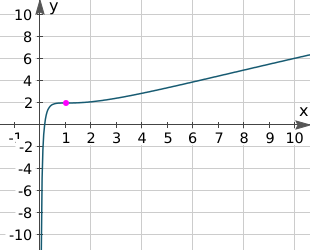
Graph of the solution equation for Example 5, passing through (1, 2).
Exercises
Integrate each of the following functions:
Exercise 1
`int((cos^(-1)2x)^4)/sqrt(1-4x^2)dx`
Answer
`int((cos^-1 2x)^4)/(sqrt[1-4x^2]) dx`
Put `v = cos^-1 2x`
(since this is the only substitution that works. The other "likely" one, `v=1-4x^2`, doesn't give us anything useful when we differentiate while doing the integral. I'm using `v` this time, so as not to confuse things with `u` in the following formula.)
We need to find `(dv)/dx`.
In general, (from 3. Derivatives of the Inverse Trigonometric Functions):
`(d(cos^-1u))/(dx)=(-1)/sqrt(1-u^2)(du)/(dx)`
In this example, `u=2x`, so we have `(du)/dx = 2`.
Thus `(dv)/(dx) = (d(cos^-1 2x))/(dx)= (dv)/(du) (du)/dx ` `= (-1)/sqrt(1-(2x)^2)(2) = (-2)/(sqrt[1-4x^2])`
Now our integral doesn't have `-2` as a constant anywhere, but it does have `1/(sqrt[1-4x^2])dx`, so we'll write our differential expression as follows, by dividing throughout by `-2`:
`-1/2dv=1/(sqrt[1-4x^2]) dx`
So
`int((cos^-1 2x)^4)/(sqrt[1-4x^2]) dx = - 1/2 int v^4 dv`
`=(-1/2) ((v^5)/(5))+K`
`=(-(cos^-1 2x)^5)/(10)+K`
Exercise 2
`int_1^e((1-2 ln x))/xdx`
Answer
`int_1^e ((1-2\ ln\ x))/(x) dx`
Put `u = 1 - 2\ ln\ x`, then `du=(-2)/(x) dx`
`int_1^e ((1-2\ ln\ x))/(x) dx = -1/2 int_[x=1]^[x=e] u\ du`
`=-1/2[(u^2)/(2)]_[x=1]^[x=e]`
`=[(-u^2)/(4)]_[x=1]^[x=e]`
`=[(-(1-2\ ln\ x)^2)/(4)]_1^e`
`=[(-(1-2(1))^2)/(4)]-[(-(1-0)^2)/(4)]`
`=0`
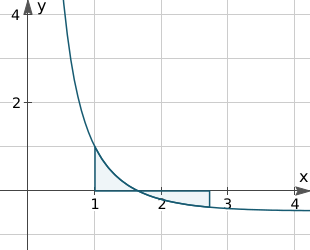
The shaded region represents the integral in Exercise 2.
Exercise 3
`int(e^x+e^(-x))^(1/4)(e^x-e^(-x))dx`
Answer
`int(e^x+e^-x)^(1/4)(e^x-e^-x)dx`
Put `u=e^x+e^-x`, so `du=(e^x-e^-x)dx`
Then
`int(e^x+e^-x)^(1/4)(e^x-e^-x)dx=intu^(1/4)du`
`=(4u^(5//4))/5+K`
`=(4(e^x+e^-x)^(5//4))/5+K`
Exercise 4
`int_(pi//3)^(pi//2)(sin theta\ d theta)/(sqrt(1+cos theta)`
Answer
`int_(pi//3)^(pi//2)(sin theta\ d theta)/(sqrt(1+cos theta`
Put `u=1+cos theta`, then `du=-sin theta\ d theta`
So
`int_(pi//3)^(pi//2)(sin theta\ d theta)/(sqrt(1+cos theta))=-int_(theta=pi//3)^(theta=pi//2)(du)/sqrtu`
`=-int_(theta=pi//3)^(theta=pi//2)u^(-1//2)du`
`=-2[u^(1//2)]_(theta=pi//3)^(theta=pi//2)`
`=-2[sqrt(1+cos theta)]_(pi//3)^(pi//2)`
`=-2[sqrt(1+0)-sqrt(1+0.5)]`
`=0.449489`
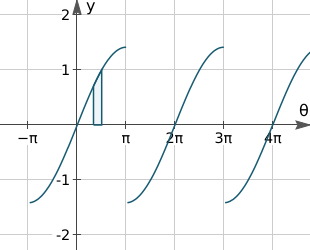
The shaded region represents the integral we needed to find in Exercise 4.
Exercise 5
Find the equation of the curve for which `(dy)/(dx)=(1+tan 2x)^2sec^2 2x` if the curve passes through `(2, 1)`.
Answer
`(dy)/(dx)=(1+tan x)^2sec^2 2x`
We need to find:
`y=int(1+tan 2x)^2sec^2\ 2x\ dx`
Put `u=1+tan 2x`, then `du=2\ sec^2 2x\ dx`
`y = int(1+tan 2x)^2 sec^2 2x\ dx`
`=1/2intu^2du`
`=(u^3)/6+K`
`=((1+tan 2x)^3)/6+K`
The curve passes through `(2, 1)`.
This means when `x = 2`, `y = 1`. Substituting gives:
`1=((1+tan 2(2))^3)/6+K`
`1=((1+tan 4)^3)/6+K`
`1=1.674539+K`
This gives:
`K~~-0.675`
So we finally have the required equation for y:
`y=((1+tan 2x)^3)/6-0.675`
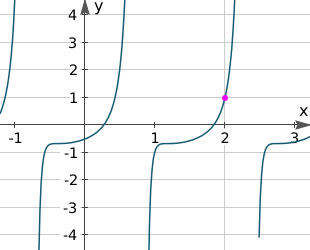
Graph of the solution `y=(1+tan 2x)^3/6-0.675`, passing through (2, 1).
Exercise 6
A space vehicle is launched vertically from the ground such that its velocity v (in km/s) is given by
`v=[ln^2(t^3+1)](t^2)/(t^3+1)`
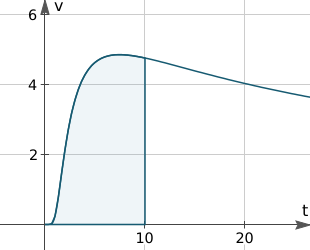
where t is the time in seconds. Find the altitude of the vehicle after 10.0 s.
The graph of `v=[ln^2(t^3+1)](t^2)/(t^3+1)` is as follows:
The shaded region represents the altitude we need to find in Exercise 6.
Answer
Now
`s=int ("velocity") dt`
[We could use s or h for height in this problem.]
We need to find:
`s=int[ln^2(t^3+1)](t^2)/(t^3+1)dt`
We put the following (since any other possible substitution doesn't actually work):
`u = ln(t^3+ 1)`
We need to find `(du)/(dt)`. We have a function of a function, so we'll need to use the Chain Rule to find that derivative. We substitute a new variable, `v`:
`v=t^3+1`, giving `u = ln v`.
Now `(dv)/(dt) = 3t^2` and `(du)/(dv) = 1/v = 1/(t^3+1)`.
Using the Chain Rule, we get:
`(du)/(dt)=(du)/(dv)(dv)/(dt)`
` = 1/(t^3+1) xx (3t^2)`
`=(3t^2)/(t^3+1)`
Writing this as a differential in the form we need for the integral, we have:
`1/3 du=(t^2)/(t^3+1)dt`
Going back to the original integral with the substitution `u = ln(t^3+ 1)`, we get:
`u^2 = ln^2(t^3+ 1)`
So
`s=1/3int[u^2]du`
`=1/3 xx u^3/3+K`
`=u^3/9+K`
`=(ln^3(t^3+1))/9+K`
Now, since the height is `0` when `t = 0`, we substitute and obtain `K = 0`.
`s=(ln^3(t^3+1))/9`
At `t=10`, the height of the space vehicle will be:
`s=(ln^3((10)^3+1))/9=36.6\ "km"`