6. Exponential and Logarithmic Equations
by M. Bourne
Solving Exponential Equations using Logarithms
The logarithm laws that we met earlier are particularly useful for solving equations that involve exponents.
Example 1
Solve the equation 3x = 12.7.
Answer
We can estimate the answer before we start to be somewhere between `2` and `3`, because 32 = 9 and 33 = 27. But how do we find the answer?
First we take the logarithm of both sides of the given equation:
`log\ 3^x= log\ 12.7`
Now, using the 3rd log rule
logb (xn) = n logb x,
we have:
`x\ log\ 3 = log\ 12.7`
Now divide both sides by `log\ 3`:
`x= (log\ 12.7)/(log\ 3)``= 2.3135`
Is it correct? Checking in the original question, we have: `3^2.3135 = 12.7`. Checks okay. Also, our answer is between `2` and `3` as we estimated before.
Example 2
Two populations of bacteria are growing at different rates. Their populations at time t are given by `5^(t+2` and e2t respectively. At what time are the populations the same?
Answer
This problem requires us to solve the equation:
5t+2 = e2t
We need to use loge because of the base e on the right hand side.
ln (5t+2) = ln (e2t)
(t + 2) ln 5 = 2t ln e
Now, ln e = 1, and we need to collect t terms together:
t ln 5 + 2 ln 5 = 2t
t (ln 5 − 2) = −2 ln 5
So
`t=(-2\ ln\ 5)/(ln\ 5-2)=8.241649476`
is the required time.
Graph
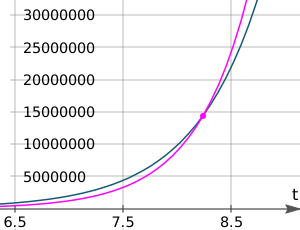
Graphs of `y=e^(2t)` (magenta) and `y=5^(t+2)` (green) showing the intersection point.
We can see on the graph that the 2 curves intersect at `t = 8.2`, as we found above.
Exercises
(1) Solve `5^x= 0.3`
Answer
Taking log of both sides:
log 5x = log 0.3
So
`log\ 5^x=log\ 0.3`
`x\ log\ 5=log\ 0.3`
`x=(log\ 0.3)/(log\ 5)`
`=-0.748070363`
(2) Solve `3\ log(2x − 1) = 1`.
Answer
Divide both sides by 3:
`log(2x - 1) = 1/3`
So
`10^(1"/"3)=2x-1`
`x=1/2(10^(1"/"3)+1)`
`=1.577217345`
Always check your answers with your calculator!
(3) Solve for x:
`log_2 x + log_2 7 = log_2 21`
Answer
We first combine the 2 logs on the left into one logarithm.
`log_2\ 7x=log_2\ 21`
`7x=21`
`x=3`
To get the second line, we actually raise `2` to the power of the left side, and `2` to the power of the right side. We don't really "cancel out" the logs, but that is the effect (only if they have the same base).
(4) Solve for x:
`3\ ln\ 2+ln(x-1)=ln\ 24`
Answer
Recall that `3\ ln\ 2` means `3\ log_e\ 2`.
`3 ln\ 2+ln(x-1)=ln\ 24`
`ln\ 8+ln(x-1)=ln\ 24`
`ln\ 8(x-1)=ln\ 24`
We take "e to both sides":
`8(x-1)=24`
`x-1=3`
`x=4`
(5) [Reader's question.]
I have the following formula:
`S(n) = 5500\ log\ n + 15000` (Using base 10)
If I know S(n) = 40 million, How do I solve it?
Answer
40 000 000 = 5500 log n + 15000
log n = 7270.
This gives us simply n = 107270 (using the log laws) which is pretty big!
(6) In the expression
`ln (x+2)^2 =\ 2,`
why is one of the answers not there when changed to
`2ln (x+2)=2,` thus `ln (x+2)=1,`
giving only one answer?
Solution
One of the best ways to understand this problem is to see what's going on using some graphs.
Recall we can only find the logarithm of positive numbers.
Here's the graph of `y = ln (x+2)^2 - 2`, based on the first expression:
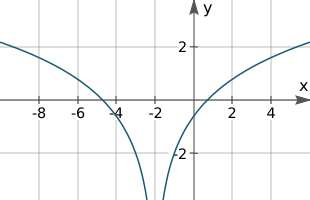
Graph of `y = ln (x+2)^2 - 2`.
We can see there are 2 roots (the 2 places where the graph cuts the `x`-axis.
There are two arms for the graph because we have squared the `(x+2)` term, meaning it will have value `> 0,` so we can take the `ln` of it with no problems (except at `x=-2,` of course, since it is undefined there).
Now let's look at the graph of `y = ln (x+2) - 1`, based on the final expression:
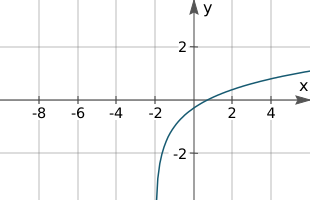
Graph of `y = ln (x+2) - 1`.
Now we only have one arm in the graph, and one place where the graph cuts the `x`-axis, thus giving us one solution for the equation `ln (x+2)=1,` which we find is (after taking `e` to both sides):
`x+2 = e`
`x = e - 2 = 0.718281828...`
So while the Log Law says we can write `ln (x+2)^2` as `2ln (x+2),` they are not really the same function.
Application - World population growth
The population of the earth is growing at approximately `1.3%` per year. The population at the beginning of 2000 was just over `6` billion. After how many more years will the population double to `12` billion?
Answer
We need an expression for the population at time t.
After one year, the population will be `1.3%` higher than in 2000. (1.3% = 0.013)
Population after 1 year: `6\ "billion" × 1.013`.
Population after 2 years: `6\ "billion" × (1.013)^2`.
Population after 3 years: `6\ "billion" × (1.013)^3`.
So our population, P, after t years, is given by:
`P(t) = 6\ "billion" × (1.013)^t`
[In general, for any population growth,
`P(t) = P_0(1 + r)^t`
where P0 is the population at time `t = 0`, r is the rate of growth per time period and t is the time.]
We are asked to find when the population doubles, so we need to solve:
`12\ 000\ 000\ 000 =` ` 6\ 000\ 000\ 000 × (1.013)^t`
This gives `2 = (1.013)^t`
Taking logarithms of both sides, we have:
`log\ 2 = log (1.013)^t`
Using the third log law, we have:
`log\ 2 = t\ log\ 1.013`
So
`t=(log\ 2)/(log\ 1.013)=53.66`
So it will take only about `54` years to double the world's population, if it continues to grow at the current rate.
When the world population is 12 billion, the net number of people in the world will be increasing at the rate of about 5 per second, if the growth rate is still 1.3%. Currently, there are about 2.6 new people per second. However, the rate of growth is expected to drop considerably to about 0.5% within 50 years.
In 2001, the population of India passed one billion, making it the second country after China to reach that scary milestone.
World population
Current world population is approximately:
Loading...
Interactive applet - World Population
Go to the interactive World Population, which has comparisons between present, past and future population growth.
Predicting world population
The following graph shows one of the estimates for world population growth during the 21st century. We see that the population will be 11 billion by about 2100! Think of our water quality, air pollution, global warming, social cohesion and lack of food. Surely this is one of the most important graphs in all of mathematics.
But I digress.
We are, of course, talking American English, here. The British billion has 12 zeroes (Well, even they have recently adopted the 9 zeroes billion...).
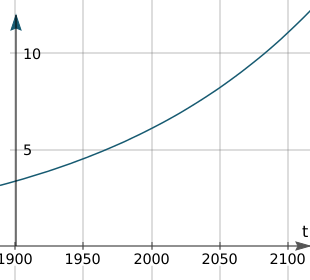
Graph of world population (billions), 1900 to 2100.
The world population is expected to exceed 11 billion by 2100. [Source]
This suggests a growth rate of about 0.6%, much lower than that experienced during the 20th century.
The equation for the above graph is
`P=6.1(1.006)^(t-2000)`, where
6.1 billion was the population in 2000;
the growth rate is represented by `1+6/100 = 1.006`; and
`t` is the time from the year 2000.
See a "live" world population estimation on the next page.