1. Solving Differential Equations (DEs)
A differential equation (or "DE") contains derivatives or differentials.
Our task is to solve the differential equation. This will involve integration at some point, and we'll (mostly) end up with an expression along the lines of "y = ...".
Recall from the Differential section in the Integration chapter, that a differential can be thought of as a derivative where `dy/dx` is actually not written in fraction form.
Differential Math Problem Solver
This tool combines the power of mathematical computation engine that excels at solving mathematical formulas with the power of GPT large language models to parse and generate natural language. This creates math problem solver thats more accurate than ChatGPT, more flexible than a calculator, and faster answers than a human tutor.
Examples of Differentials
dx (this means "an infinitely small change in x")
`d\theta` (this means "an infinitely small change in `\theta`")
`dt` (this means "an infinitely small change in t")
Examples of Differential Equations
Example 1
We saw the following example in the Introduction to this chapter. It involves a derivative, `dy/dx`:
`(dy)/(dx)=x^2-3`
As we did before, we will integrate it. This will be a general solution (involving K, a constant of integration).
So we proceed as follows:
`y=int(x^2-3)dx`
and this gives
`y=x^3/3-3x+K`
But where did that dy go from the `(dy)/(dx)`? Why did it seem to disappear?
In this example, we appear to be integrating the x part only (on the right), but in fact we have integrated with respect to y as well (on the left). DEs are like that - you need to integrate with respect to two (sometimes more) different variables, one at a time.
We could have written our question only using differentials:
dy = (x2 − 3)dx
(All I did was to multiply both sides of the original dy/dx in the question by dx.)
Now we integrate both sides, the left side with respect to y (that's why we use "dy") and the right side with respect to x (that's why we use "dx") :
`int dy = int(x^2 - 3)dx`
Then the answer is the same as before, but this time we have arrived at it considering the dy part more carefully:
`y=x^3/3-3x+K`
On the left hand side, we have integrated `int dy = int 1 dy` to give us y.
Note about the constant: We have integrated both sides, but there's a constant of integration on the right side only. What happened to the one on the left? The answer is quite straightforward. We do actually get a constant on both sides, but we can combine them into one constant (K) which we write on the right hand side.
Example 2
This example also involves differentials:
`\theta^2 d\theta = sin(t + 0.2) dt`
We have:
A function of `theta` with `d theta` on the left side, and
A function of t with dt on the right side.
To solve this, we would integrate both sides, one at a time, as follows:
`int theta^2 d theta = int sin(t+0.2)dt`
`{theta^3}/3 = -cos(t + 0.2) + K`
We have integrated with respect to θ on the left and with respect to t on the right.
Here is the graph of our solution, taking `K=2`:
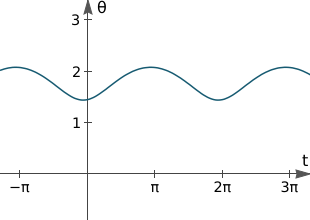
Typical solution graph for the Example 2 DE: `theta(t)=root(3)(-3cos(t+0.2)+6)`.
Solving a differential equation
From the above examples, we can see that solving a DE means finding an equation with no derivatives that satisfies the given DE. Solving a differential equation always involves one or more integration steps.
It is important to be able to identify the type of DE we are dealing with before we attempt to solve it.
Definitions
First order DE: Contains only first derivatives
Second order DE: Contains second derivatives (and possibly first derivatives also)
Degree: The highest power of the highest derivative which occurs in the DE.
Example 3 - Order and Degree
a) `(d^2y)/(dx^2)+((dy)/(dx))^3-3x+2y=8`
This DE has order 2 (the highest derivative appearing is the second derivative) and degree 1 (the power of the highest derivative is 1.)
b) `((dy)/(dx))^5-2x=3 sin(x)-sin(y)`
This DE has order 1 (the highest derivative appearing is the first derivative) and degree 5 (the power of the highest derivative is 5.)
c) `(y'')^4+2(y')^7-5y=3`
This DE has order 2 (the highest derivative appearing is the second derivative) and degree 4 (the power of the highest derivative is 4.)
General and Particular Solutions
When we first performed integrations, we obtained a general solution (involving a constant, K).
We obtained a particular solution by substituting known values for x and y. These known conditions are called boundary conditions (or initial conditions).
It is the same concept when solving differential equations - find general solution first, then substitute given numbers to find particular solutions.
Let's see some examples of first order, first degree DEs.
Example 4
a. Find the general solution for the differential equation
`dy + 7x dx = 0`
b. Find the particular solution given that `y(0)=3`.
Answer
(a) We simply need to subtract 7x dx from both sides, then insert integral signs and integrate:
`dy=-7x dx`
`intdy=-int7x dx`
`y=-7/2x^2+K`
NOTE 1: We are now writing our (simple) example as a differential equation. Earlier, we would have written this example as a basic integral, like this:
`(dy)/(dx)+7x=0`
Then `(dy)/(dx)=-7x` and so `y=-int7x dx=-7/2x^2+K`
The answer is the same - the way of writing it, and thinking about it, is subtly different.
NOTE 2: `int dy` means `int1 dy`, which gives us the answer `y`.
We could also have:
`intdt=t`
`intd theta=theta`
` int da=a`
and so on. We'll come across such integrals a lot in this section.
(b) We now use the information y(0) = 3 to find K.
The information means that at x = 0, y = 3. We substitute these values into the equation that we found in part (a), to find the particular solution.
`3=7/2(0)^2+K` gives K = 3.
So the particular solution is: `y=-7/2x^2+3`, an "n"-shaped parabola.
Here is the graph of the particular solution we just found:
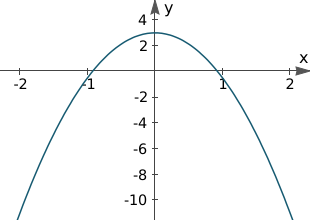
Solution graph: `y=-7/2 x^2 + 3`.
Example 5
Find the particular solution of
`y' = 5`
given that when `x=0, y=2`.
Answer
We can write
y' = 5
as a differential equation:
dy = 5 dx
Integrating both sides gives:
y = 5x + K
Applying the boundary conditions: x = 0, y = 2, we have K = 2 so:
y = 5x + 2
Example 6
Find the particular solution of
`y''' = 0`
given that:
`y(0) = 3,` `y'(1) = 4,` `y''(2) = 6`
Answer
Since y''' = 0, when we integrate once we get:
y'' = A (A is a constant)
Integrating again gives:
y' = Ax + B (A, B are constants)
Once more:
`y = (Ax^2)/2 + Bx + C` (A, B and C are constants)
The boundary conditions are:
y(0) = 3, y'(1) = 4, y''(2) = 6
We need to substitute these values into our expressions for y'' and y' and our general solution, `y = (Ax^2)/2 + Bx + C`.
Now
y(0) = 3 gives C = 3.
and
y'' (2) = 6 gives A = 6
(Actually, y'' = 6 for any value of x in this problem since there is no x term)
Finally,
y' (1) = 4 gives B = -2.
So the particular solution for this question is:
y = 3x2 − 2x + 3
Checking the solution by differentiating and substituting initial conditions:
y' = 6x − 2
y' (1) = 6(1) − 2 = 4
y'' = 6
y''' = 0
Our solution is correct.
Example 7
After solving the differential equation,
`(dy)/(dx)ln x-y/x=0`
(we will see how to solve this DE in the next section Separation of Variables), we obtain the result
`y=c ln x`
Did we get the correct general solution?
Answer
Now, if `y=c ln x`, then `(dy)/(dx)=c/x`
[See Derivative of the Logarithmic Function if you are rusty on this.)
So
`"LHS"=(dy)/(dx)ln x-y/x`
`=(c/x) ln x-((c ln x))/x`
`=0`
`="RHS"`
We conclude that we have the correct solution.
Second Order DEs
We include two more examples here to give you an idea of second order DEs. We will see later in this chapter how to solve such Second Order Linear DEs.
Example 8
The general solution of the second order DE
y'' + a2y = 0
is
`y = A cos ax + B sin ax`
Example 9
The general solution of the second order DE
y'' − 3y' + 2y = 0
is
y = Ae2x + Bex
If we have the following boundary conditions:
y(0) = 4, y'(0) = 5
then the particular solution is given by:
y = e2x + 3ex
Now we do some examples using second order DEs where we are given a final answer and we need to check if it is the correct solution.
Example 10 - Second Order DE
Show that
`y = c_1 sin 2x + 3 cos 2x`
is a general solution for the differential equation
`(d^2y)/(dx^2)+4y=0`
Answer
We have a second order differential equation and we have been given the general solution. Our job is to show that the solution is correct.
We do this by substituting the answer into the original 2nd order differential equation.
We need to find the second derivative of y:
y = c1 sin 2x + 3 cos 2x
First derivative:
`(dy)/(dx)=2c_1 cos 2x-6 sin 2x`
Second derivative:
`(d^2y)/(dx^2)=-4c_1 sin 2x-12 cos 2x`
Now for the check step:
`"LHS"=(d^2y)/(dx^2)+4y`
`=[-4c_1sin 2x-12 cos 2x]+` `4(c_1sin 2x+3 cos 2x)`
`=0`
`="RHS"`
Example 11 - Second Order DE
Show that `(d^2y)/(dx^2)=2(dy)/(dx)` has a solution of y = c1 + c2e2x
Answer
Since
y = c1 + c2e2x, then:
`(dy)/(dx)=2c_2e^(2x)`
and
`(d^2y)/(dx^2)=4c_2e^(2x)`
It is obvious that .`(d^2y)/(dx^2)=2(dy)/(dx)`